
The honor of breaking me into the rewarding (but not high paying) career of assistant instructor
fell to Ed Stetson, a diver and waterman without equal. Ed taught an assistant instructor
certification course to several proto-instructors just a few weeks before. When he put out a call
for volunteers to help assist a class at the University of California, Santa Barbara, I immediately
volunteered.
Dive classes are divided into three parts--classroom instruction, pool skills training, and open
water dives. The class took advantage of all the facilities a university has to offer, a good
classroom, an Olympic-size swimming pool, and in the case of UCSB, the Santa Barbara Channel
for open water dives. Ten students enrolled for the four-week-long class. During the swim test,
we discovered that while ability varied, they were all competent swimmers. Some would swim
like dolphins, the others just kind of paddled along. None swam like an anchor, for which we
silently thanked Poseidon. The group of ten soon coalesced into a class. In class, Ed or I would
occasionally make reference to a hypothetical diver who thought he knew everything as "a real
Mike Nelson." We rotated buddies throughout the pool skills sessions. Confident of their
abilities, we scheduled the open water dives at Anacapa Island for July 26 and the beach dive for
July 27--one year to the day that I was certified as a basic diver.

You may know the typical July Southern California weather pattern--low clouds and fog, with
partial clearing along the coast in mid-afternoon. (In fact, people speculate that one reason our
TV weather personalities are such clowns is that they have to be entertaining since the weather
seldom varies.) We boarded the M/V Captain Midnight owned by Jerry Shapiro,
attorney-turned-dive-boat-owner, and skippered by Capt. Don MacIntyre, from whom I learned a
great deal about reading the moods of the sea. The crossing from Channel Islands Harbor in
Oxnard to Anacapa Island went very smoothly, the seas behaved with little swell.
First Dive--Bat Ray Cove
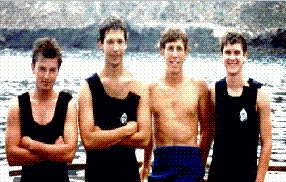
The appropriately named "Bat Ray Cove," scene
of our first dive, did not live up to its billing on
this day, at least for my team. Ed asked me to
take four students on a tour. Jurgen was an
exchange student from Germany. Bruce
graduated a few weeks earlier and spent the
summer tying up some loose ends his academic
record before moving on. Dave, in his third year
of Pre-law wanted to learn to dive so he stayed
around for the summer session. Bill, a temporary refugee from urban Los Angeles, came to
UCSB for summer school to escape USC. (That's University of Southern California, not
University for Spoiled Children.)
After carefully checking each student's gear at the gate, we entered the water one at a time, faced
the divemaster and gave the "OK" sign. We dropped down the anchor line and began our
underwater tour. The marine life cooperated, we examined sea hares, identified scallops and the
plentiful abalone, and tried to play tag with an octopus that really didn't want to be "it." The
twenty-five-foot visibility made the dive seem effortless, the group stayed together. We surfaced
near the stern of the boat, climbed aboard the swim stair, shed our fins, and boarded the boat. I
learned working with later classes things do not always go so well.
Second Dive--Barracuda Rock
After recovering all the divers, and taking roll call to make sure, we moved the boat to Barracuda
Rock. This time the location lived up to its billing. My team consisted of the same four divers
with the addition of Mattius, another German student. I check each diver's repetitive group
computation. We visited a nearby underwater arch, but had to cut the excursion short when the
first diver with 750 psi of pressure signaled "low-on-air." We stay longer, 30 minutes, and go a bit
deeper, 30 feet, on this dive. On the way to the surface, we spotted the silver torpedo-like
silhouette of a barracuda. On the surface, we practiced the kelp crawl--a necessary skill to learn.
Now, if you dive in California, you will eventually find that a rather large kelp bed positioned
itself between you and the boat or the beach during your dive. Also, for some unexplained
reason, you will not have enough air left in the tank to drop down and swim through the kelp. If
you can't go under the canopy, and can't go around it, you have to go through it. The boat will
not come and pick you up. California divers relish telling horror stories about how "man-eating"
kelp drowns unsuspecting divers when they become entangled in the algae, akin to the Sargasso
Sea trapping ships. My own optometrist related how he quit diving after finding the body of a
diver wound into the kelp at Catalina. Don't believe it! To listen to these stories, one would
conclude that the kelp beds are littered with bodies and that more divers are attacked by the kelp
than are certified in any single year! Crawling through kelp can be a pain-in-the-ass, but if done
correctly is a mere nuisance. The secret is not to panic, keep air in the BC, pass over it, and next
time plan your dive a little bit better!
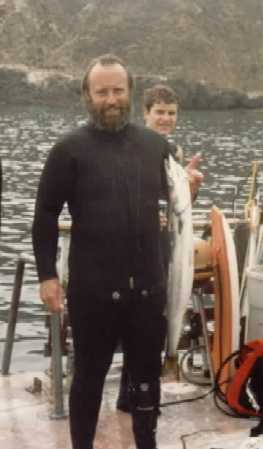 When we got back to the boat, I mentioned to Dennis Divins, the UCSB
Diving Officer, that we saw barracuda. He grabs a spear gun and hops
into the water. Next thing I know, he comes back with a fine specimen
for the evening's dinner.
When we got back to the boat, I mentioned to Dennis Divins, the UCSB
Diving Officer, that we saw barracuda. He grabs a spear gun and hops
into the water. Next thing I know, he comes back with a fine specimen
for the evening's dinner.
Third Dive--Barracuda Rock
We don't move the boat for the third and final dive of the day. On this dive, I show two divers, around the area. Both divers adapt well to the ocean, but the look in the eyes of one of the divers makes me a little more cautious on this dive. Despite the OK sign, I see in one of the divers the onset of wide-eye apprehension. I do what my training tells me to do, I stop the tour, evaluate the situation, and decide on a course of action, which means getting the diver to the surface. The situation did not turn into limb-thrashing panic nor was it likely that it would have. I still have a conservative approach whenever I work with new divers.
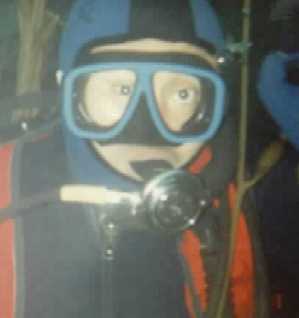
We again took roll-call. In the 10 years that I worked as a divemaster, I
always had an irrational fear of leaving someone behind. Can you imagine
coming to the surface only to see the boat sailing away? Can you imagine
getting a call from the Coast Guard as your boat pulls into the slip
inquiring about the one you left behind? (In court, the attorney for the
estate might be sarcastic and ask if you threw it back because you thought
it was too small.) I always insisted on positive verification that all the
divers were indeed back on board before we pulled the hook and headed for the barn. That habit
started on this trip and has served me (and my divers) well. Not only have my boats always
returned to shore with the same number of divers, they were same ones who got on board the
boat that morning.

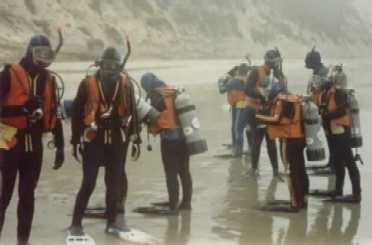
The graduation dive took place at Hendry's Beach near Santa Barbara. The weather reruns from
the previous day as it will tomorrow. The beach offers all the attributes for a great dive, lots of
parking, an area for gearing up, easy access to the water, a decent rock reef with kelp close to
shore, freshwater showers, and a good restaurant for the apres-dive debriefing. It also offers a
beach break large enough to show students how to do surf entries and exits but not so large as to
knock them down in the process.
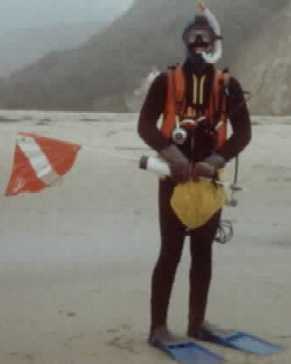 Fins on and shuffling backwards, we enter the water in a line. Ed takes
one end of the line and I take the other. We act as choreographers for
what looks like a line of drunken sea lions doing the cancan. Only Dave,
who carries the dive flag, float, and anchor, is excused from the dance. I
think if I started doing the conga, all would follow my lead. The line
breaks as students stop and brace for the two-foot wave that comes in. At
chest-deep water, we roll over and kick out. At this point, I play border
collie, working to keep buddy pairs together and the pairs together as a
group, reminding divers that the slower swimmer sets the pace for the
team.
Fins on and shuffling backwards, we enter the water in a line. Ed takes
one end of the line and I take the other. We act as choreographers for
what looks like a line of drunken sea lions doing the cancan. Only Dave,
who carries the dive flag, float, and anchor, is excused from the dance. I
think if I started doing the conga, all would follow my lead. The line
breaks as students stop and brace for the two-foot wave that comes in. At
chest-deep water, we roll over and kick out. At this point, I play border
collie, working to keep buddy pairs together and the pairs together as a
group, reminding divers that the slower swimmer sets the pace for the
team.
 We drop down into 25 feet of water on the edge of
the reef. I stay on the bottom while Ed brings the
divers down one-buddy-pair-at a time. Visibility, a
spotty 20 feet, gets driven lower if the students
begin to thrash around. These kids are pretty good.
Ed goes down the line doing final skill checks with
each student--mask removal and replacement,
regulator removal and recovery and so on. I'm an
outrider, swimming back and forth in the event that
anyone needs assistance. After the checks, we
break into two groups. I show the divers how to
use sand ripples for navigation. We see many crabs and kelp bass. We even get checked out by a
bat ray, who undoubtedly came by to apologize for being absent from Bat Ray Cove the day
before.
We drop down into 25 feet of water on the edge of
the reef. I stay on the bottom while Ed brings the
divers down one-buddy-pair-at a time. Visibility, a
spotty 20 feet, gets driven lower if the students
begin to thrash around. These kids are pretty good.
Ed goes down the line doing final skill checks with
each student--mask removal and replacement,
regulator removal and recovery and so on. I'm an
outrider, swimming back and forth in the event that
anyone needs assistance. After the checks, we
break into two groups. I show the divers how to
use sand ripples for navigation. We see many crabs and kelp bass. We even get checked out by a
bat ray, who undoubtedly came by to apologize for being absent from Bat Ray Cove the day
before.
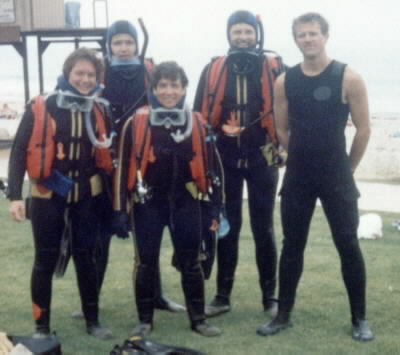
The dive ends uneventfully. We hold our dive
debriefing. We pose for the obligatory after-dive
photos. Today's dive will be number 47 in my log
book. I was certified as a basic diver one year ago to
the day.
Dave hosts a graduation BBQ at his apartment that
night. At the event, he pulls me aside and asks,
"who's this guy Mike Nelson that you guys keep talking about? Was he a student of Ed's who had
really screwed up?" Just then I knew that there was a generation gap, even though I was only
nine years older than the person asking the question.

Teaching scuba is a lot like love affairs. They come and go, they last a short period of time (but
what a wonderful time), and while you may forget faces and names of the participants after a few
dozen, you will always remember most the details about your first, even though it was the most
awkward. So it is with mine. So it is with mine.
The saying, "a journey of a thousand miles begins with a small step," appropriately describes my
life path that began in that instant. Over the last decade-and-a-half, I assisted dozens of scuba
diver certification courses. At times this underwater activity has been a hobby, a vocation, a job,
and an obsession. I have met a lot of interesting people along the way and its been a lot of fun.
I've also met a fair number of people for whom diving may be the quickest path to final
judgement, but that's another story.
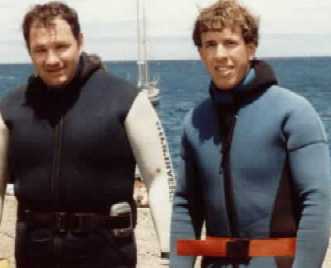 One of the divers in this story, Dave Porter, went on to
become a very good friend and an excellent dive buddy. We
took the UCSB dive club trip over to Catalina for a weekend
that is still talked about. He became an assistant instructor and
went on to teach one season at the Club Med in Playa Blanca,
Mexico. I visited him for a week at the Club. When I walked
in, Dave and the Chief of Scuba asked if I would be interested
in staying for two weeks and teaching scuba, since they were
unexpectedly short-staffed at the end of the season. Despite
the tempting offer, I could not accept since I had an obligation
to get back to in the states. I did work as a dive guide for that
week on the morning dives, which allowed the regular dive staff a little relief time. When I flew
out at the end of the week, Ed flew in to finish out the one week left in the season.
One of the divers in this story, Dave Porter, went on to
become a very good friend and an excellent dive buddy. We
took the UCSB dive club trip over to Catalina for a weekend
that is still talked about. He became an assistant instructor and
went on to teach one season at the Club Med in Playa Blanca,
Mexico. I visited him for a week at the Club. When I walked
in, Dave and the Chief of Scuba asked if I would be interested
in staying for two weeks and teaching scuba, since they were
unexpectedly short-staffed at the end of the season. Despite
the tempting offer, I could not accept since I had an obligation
to get back to in the states. I did work as a dive guide for that
week on the morning dives, which allowed the regular dive staff a little relief time. When I flew
out at the end of the week, Ed flew in to finish out the one week left in the season.