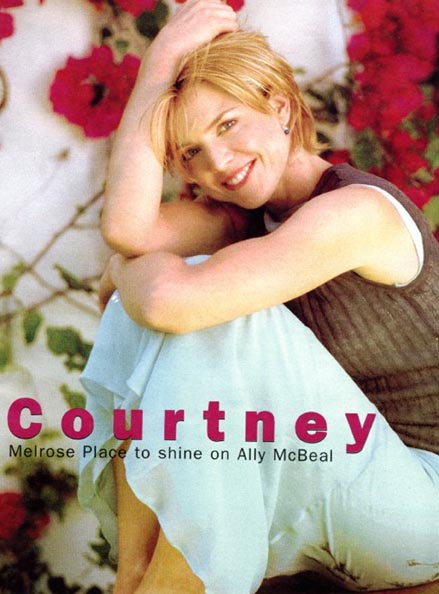
AS FATE WOULD HAVE IT, it's a fairly historic day when we're speaking to Courtney Thorne-
Smith, the fresh-faced blonde who has dazzled on two different series which spoke
immediately and directly to the culture's Zeitgeist first, Melrose Place, and now, Ally
McBeal. It's the day after both Seinfeld's and Frank Sinatra's final bows, not to mention a
day that will live in infamy for many Los Angeles residents all-star catcher and fan
favorite Mike Piazza has been traded from the Dodgers.
Thorne-Smith speaks with ease and authority on the first two topics of our current-events
quiz. "It was hard to live up to the hype," she says diplomatically of the Seinfeld finale.
Of Sinatra, she reports having recently watched his 1956 musical High Society, and observes,
"It was amazing. He was so profoundly cool, and he knew it. It would have been wild to be
in the Rat Pack, to be literally the coolest people in the universe."
On Piazza, however, Thorne-Smith laughs and declares, "On this one, I claim total chickdom
don't care. Call me when he designs a clothing line."
As transitions go, Thorne-Smith's is pretty considerable: from the trashy romp of Melrose
Place to the tonier environs of creator David E. Kelley's Ally McBeal, one of the past
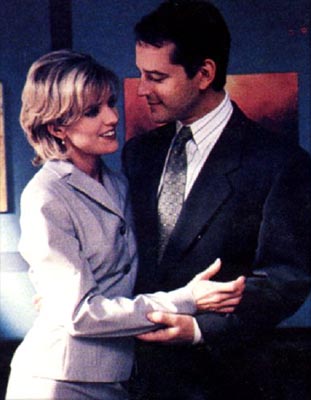
season's few breakout hits. She plays the lovable Georgia, who gets to go home with Gil
Bellows (her husband, Billy) every night while the show's namesake (Calista Flockhart)
seethes and whimpers.
Thorne-Smith took some time during a breather from the production (she's already working
on Ally's sophomore season) to discuss the McBeal phenomenon and Calista Flockhart's legs
some would say they're one and the same not to mention cheer-leading and how a
well-placed explosion is the only way to end a Melrose subplot.
TVGUIDE:
What kind of reaction have you been getting from fans this year have they been
along the lines of "Stand by your man," or more like, "How dare you stand between Ally and
Billy?"
COURTNEY THORNE-SMITH:
People who talk to me probably have a different take from what they
say to Calista "You guys were meant to be together" while to me, they take the party
line "How can you let her do that?"
Now, I think the triangle's done. One of David's strengths as a writer is he gets bored of
a storyline before the audience does. With the triangle fading, they're discovering Billy
and Georgia's relationship, and that is fun. They had thought a lot about why Billy and
Ally couldn't be together, and they thought about why Ally and Georgia should be friends,
but they sort of forgot why Billy and Georgia should be together. Now, we're starting to
do that.
TVG:
You had decided to sit out a year when David Kelley called. Were you looking forward
to a break? If that was your mindset, how difficult was it to hop back into things?
CTS:
It was tough. For one thing, I wanted a year off because I was tired. So tired. And
here I was, coming on a new show, everything was new. As an actor, you either have no hiatus
, or a four-year hiatus you have to be grateful for what you have.
But this first year was an extraordinary experience, in the writing, the energy and the
friendliness of the cast, the unity of the crew. I do not think I would have made it if
it hadn't been for that. That made up for my lack of physical energy it was
intellectually stimulating and emotionally challenging, and that made it easier for me.
TVG:
You've gone from Melrose Place, a show where the writing...
CTS:
Careful... (laughs)
TVG:
(Carefully) ... wasn't considered one of its strong suits, to this highly acclaimed
show. How would you compare the atmosphere on the respective sets?
CTS:
They're extraordinarily different in every way. Melrose does what it does extremely
well. We looked for ways to make it light and fun. We were playing, creating this surreal
world. On Ally, we're doing that as well, while we're searching for the tone. It's
exaggerated in a different way.
Melrose was melodrama, Ally is comedy and straight drama. Melrose had 15 very separate
storylines once you would see one to the end, something would explode and people would
die. (laughs) Here, we work as a group more, which is more fun. I love that. There were
some times on Melrose where you'd have scenes with just one other actor for weeks and
months at a time. In this first year of Ally, we're all playing off each other, getting
the tone of scenes. It's fun, and creates a sense of unity amongst the cast. People would
come on Melrose, like Lisa Rinna I don't think I ever had a scene with her. I can't say
that about anyone on Ally.
TVG:
What was your favorite subplot involving your character on Melrose?
CTS:
I had the most fun. I liked when she was drinking, because I got to go hysterical
she got mad and had some backbone. Otherwise, she just whined a lot. And who wouldn't
look at her life.
TVG:
Georgia is certainly different from your last role in a Kelley production, the Laker
Girl on L.A. Law.
CTS:
I was told she was an aspiring actress. Then, the first day, I walk into wardrobe,
and there's this tiny leotard. 'Oh,' they told me, 'she's a Laker Girl.' I had no idea,
but there I was.
TVG:
And you didn't even make the cheer-leading squad in high school.
CTS:
Yes, thanks for bringing it up. (laughs) At the time, it was a big scandal. I think
I found out they had filled in all the spots by the time I tried out. It was not fair. At
the time, it was dramatic and terribly important everyone else was on the squad, but I
wasn't. But I ended up in the drama department.
TVG:
What has been the reaction of the cast and brain trust to the endless deconstruction
of Ally McBeal in the media? What is it about this show that has touched such a nerve?
CTS:
It's hysterical to us. I think David writes what is interesting and funny to him.
There's no committee, he just puts it out there, and suddenly there are all these people
discussing the show, like why she wears such short skirts. Well, Calista looks great in
short skirts. She has great legs there's no sinister plot.
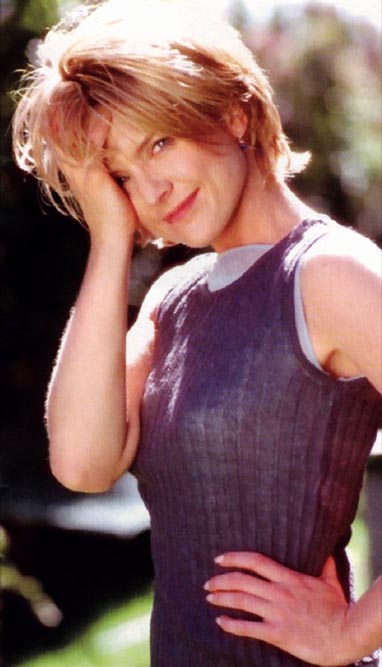
Then I got a haircut because David had a whim, so I got my hair cut. Now, I can't walk
down the street without people demanding to know why I did that. It's odd, when we're just
going to work and doing our job, and all these people are analysing and psychoanalysing. I
wonder if David thinks it's as funny as we do.
By DAVID KRONKE.