|
Information on County Galway
Galway is a large county divided
into two contrasting regions by the expanse of Lough Corrib.
To the west,
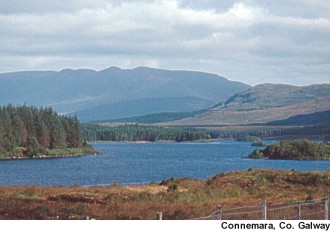
lying between the lake and the Atlantic, is Connemara - a region of superb
scenic grandeur dominated
by the rocky mountain range known as the Twelve
Pins. A great many of the inhabitants are Irish speakers,
and much of the
ancient Gaelic culture is preserved. Galway East,
or East of Lough Corrib, is a fertile limestone plain extends to Roscommon
In the 1400’s, there began in
Galway
the rule of the 'Tribes', as the leading fourteen families were called.
Their names were: Athy, Blake, Bodkin, Browne, Darcy, Deane, ffont, French, Joyce,
Kirwan,
Lynch,
Martin, Morris, and Skerritt
Members of these families served as Burgesses, and as Mayors of
Galway
up to the capture of Galway by a Cromwellian army in 1652
Main
Tourist Attractions
Quiet
Man Film Locations
County Galway has several locations which were used in the making of the
file
The Quiet Man. Visit the main film locations in an organised tour or
join the
Quiet Man Fan Club.
Athenry
– Mediaval Town with Arts and Heritage Centre
Athenry, a medieval town situated 23km from Galway City is steeped in
history. Founded in the 13th century by
Meiler de Birmingham, who
surrounded the town with a curtain wall with towers and a moat. It is the
only walled town
in Ireland whose still-intact walls are clearly visible
to the approaching visitor
Battle of Aughrim Interpretative Centre
Aughrim, Ballinasloe - on the main Galway – Dublin Road.
Relive the bloodiest battle in Irish history fought in a small Connaught
village.
Move back in time and place to that fateful day in 1691 through an
audio-visual show based
on the moving account of Captain Walter Dalton who fought at the Battle of
Aughrim.
St. Jarlaths Wheel - Tuam
Located beside the Catholic Cathedral in the North Galway town of Tuam.
Tuam is also home to a 13th century parish church ruins and
graveyard, located at
Teampall Jarlath, High St. Tuam.
Galway Bay
Drive along the coast road from Galway to Spiddal and view the splendour
of Galway Bay.
Later in the day one can experience the famed in song ‘Sun go down on
Galway Bay’
Continuing West takes one into the Twelve Pins of Connemara mountain
range.
Tropical Butterfly Centre
Carraroe, Connemara, Galway .2 miles from Rassaveal Harbour on R343
Located in the heart of Connemara, Seawinds Nurseries and Tropical
Butterfly Centre offers a unique experience in family
entertainment,
regardless of weather. Set amid the lush splendour of a tropical
enclosure, you can see hundreds of free flying
exotic Butterflies in their
natural environment.
The Aran Islands – located in Galway
Bay
Situated at the mouth of Galway bay. Day trips available from Galway and
Clare coasts. Organised
tours available on the Islands.Visit the cottage where J.M. Synge, the well-known Anglo-Irish author
and
playwright stayed and took the theme of The Playboy of the Western World.
Eyre Square – Galway
City
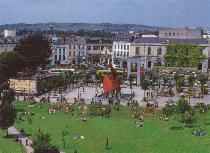
Eyre Square (renamed John F Kennedy Park) ; an open green park where on
can relax or view the many attractions, including
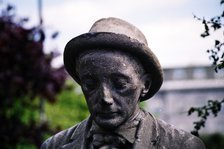
the Statue of Paraic
O’Connaire ; erected in 1935 in memory of the writer who travelled the
roads with his horse and cart.
Best remembered for M’asal Beag Dubh.
Died 1928
Kirwan's Lane - Galway
City
Kirwan's Lane (off Quay Street) is one of Galway's last remaining late
Mediaeval Lanes and has been recently redeveloped as
a residential area.
It was here that the Galway MP Richard Martin built a 100-seater theatre
for his actress wife in 1783. Among
those who acted there was the
republican patriot, Wolfe Tone.
Clifden in West Galway
The location of the landing of the first Trans-Atlantic air crossing by
Alcock and Brown.
A very scenic part of Ireland.
Kinvara – Galway Hooker Boats
Kinvara hosts an annual festival to celebrate those unique sea boats each
year. Always a selection of the old style Hooker
boats on view. Those
boats were used to transport turf in bygone days.
Portumna Castle
The great semi-fortifed house at Portumna was built before 1618 by Richard
Burke or de Burgo, 4th Earl of Clanricarde.
There are exhibitions in the
castle and Gate House.
Coole Park
Located close to Gort, on the Galway Road, the former home of Lady
Gregory, a founder of the Abbey Theatre and friend
of William Butler Yeats.
The house no longer stands, but the estate is now a national nature
reserve. The garden of the house,
with its yew walk and autograph tree is
preserved. Carved on the autograph tree, among others are the signatures
of John Masefield,
George Bernard Shaw and Sean O'Casey. Attractions
include nature trails, walks, a lake and turlough.
Thoor Ballylee
Once the former summer home of W.B. Yeats this restored Norman tower house
was purchased by Yeats in 1916. In 1965 the
tower was opened to the
public. An audio visual presentation and push button audio narratives in
the rooms are available in the
tower, which is open to the public from
Easter to October.
Turoe Pet Farm
Located close to Loughrea, in a beautiful rural setting, Turoe Pet Farm
provides great attractions for young and old, native
and tourist!
Excellent facilities are provided catering for individual, family and
group needs
Dunguaire Castle
Located in Kinvara, Dunguaire Castle was built by the O'Hynes in 1520. The
clans association with the castle dates
back as far as 662AD when their
ancestor Guaire, King of Connnacht, ruled his kingdom from an earthwork
rath close to the
present castle site. Richhad
Martyn, Mayor of Galway, acquired the castle in the seventeenth century
and it was subsequently
purchased by Oliver Saint John Gogarty. During his
tenure the castle was the venue for meetings of the literary revivalists,
led by
W.B Yeats. The bardic tradition which Yeats believed in, is
reflected in the Medieval Banquet held every night.
Mill Museum - Tuam
Located in Tuam, this is the last surviving corn mill in the Tuam area. It
closed as a working mill in 1964 - its machinery is
still in place,
however, so visitors can view the old milling process.This mill played a vital part in the life of the local community and a
voluntary committee opened it as a museum in 1974. It also serves as a
seasonal tourist information office.
Heritage Sites
Athenry Castle
Athenry is one of the most notable medieval walled towns surviving in
Ireland, owing its foundation to Meiler
de Bermingham who built his Castle there c.1250. The great three-storey
tower, surrounded by defensive walls, is entered
at first-floor level through an unusual decorated doorway. Recently
re-roofed, the interior contains an audio visual room and exhibition.
Aughnanure
Castle Galway - Oughterard
Built by the O’Flahertys c. 1500, Aughnanure Castle lies in
picturesque surroundings close to the shores of Lough Corrib.
Standing on what is virtually a rocky island, the Castle is a
particularly well-preserved example of an Irish tower house. In
addition,
visitors will find the remains of a banqueting hall, a watch tower, an
unusual double bawn and bastions and a dry harbour.
Dun Aonghasa -
Inishmore, Aran Islands
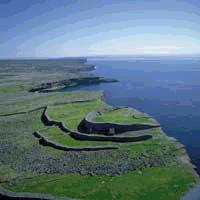
Perched spectacularly on a cliff overlooking the Atlantic ocean, this is
the largest of the prehistoric stone forts of the Aran Islands.
It is enclosed by three massive dry-stone walls and a "chevaux-de-frise"
consisting of tall blocks of limestone set vertically into the
ground to deter attackers. The fort is about 900m from the Visitor
Centre and is approached over rising ground.
Teach an
Phiarsaigh (Patrick Pearse's Cottage) Rosmuc
A small restored cottage used by Patrick Pearse (1879 – 1916) leader
of the 1916 Rising, as a summer residence. The interior, although
burned during the War of Independence, has been reconstructed and
contains an exhibition and a number of
momentoes of Pearse.
Interesting Links
Tuam
Golf Club
eBookIreland
Western
Webs
Portal
Pages
email
- [email protected]
Photos
|