 A Country Rag Appalachian Home A Country Rag Appalachian Home
"[The internet] will also redistribute power and wealth, if only to deepen the gulf between the haves and have-nots. If the Internet is the proverbial onion in need of peeling, then -- in the grand scheme of things -- the hype is just the thin brown skin. What's inside will bring tears to your eyes." -- Eric W. Pfeiffer for Forbes ASAP
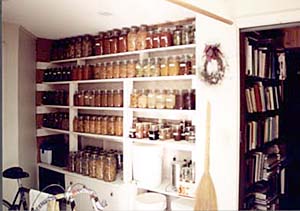
graphic: Home canning and book shelves, photo by Frances Lamberts
"On Reducing our Personal Waste Footprint"
by Frances Lamberts
Dr. Lamberts is a retired psychologist who maintains extensive organic gardens and domestic animals on a one-acre homestead in Jonesborough TN.

Graphic: Parrot, oil painting by Suzan Ertuman, VCU BFA student, Richmond VA
"At the event, the
[American Anti-Trust]
institute honored Assistant Attorney General Joel Klein
with its first annual "Level Playing Field Award" for his work on antitrust
cases over the past five years, including his ongoing pursuit of Microsoft.
"An emotional Klein, who received a personalized referee shirt along with his
award, devoted his remarks to thanking Reno and Justice Department lawyers
for battling corporate America. 'The work that we do necessarily intersects
with the titans of the American economy,' he said."
-- Reno Says: Beware Technology,,
Wired News
|
Two recent books suggest significance of personal decision making
regarding waste, in messages whose sense seems all too plain, but
effectuation far less easy: Waste makes want, yet some waste practices
have much more impact than others.
Historian Susan Strasser recounts, in Waste and Want a house servant�s
reproach of her mistress, on receiving orders from the latter for
grocery shopping while pantry shelves are still loaded with remains
from a sumptuous feast:
Don�t you know that wilful waste makes woful want?
Michael Brower and Warren Leon, authors of Practical Advice [for
effective environmental choices], a guide published by Union of
Concerned Scientists document need for priority setting. In nearly all
areas where our daily actions may leave tangible garbage or
environmental pollution�from household operations, transportation, food,
or personal goods�some do so with especial magnitude or harm. Energy use
(and related air pollution) of an average computer pales in comparison
to that of an average refrigerator. Environmental harm from use of
paper napkins is insignificant compared to that from a gas guzzling car.
Unfortunately, the ways and extent of wastefulness in industrialized
countries, the U.S. especially, are now so pervasive as generally to
elude our conscious awareness. Virgin instead of re-used materials make
up our goods, packaging encloses them in layers of more materials, food
and other consumer items are �cheaper by the dozen,� packaged and sold
in multiples unrelated to buyer need. Personal space, housing size and
storage need expand with greater numbers of goods, energy use expands as
more space is heated and cooled and longer distances covered as travel
destinations grow farther apart. The materials use of the average
American, as Gardner and Sampat calculate in State of the World, 1999,
is tantamount to daily truck delivery to the house of 101 kilos, the
load including wood, chemicals, plastic, metals, stone, gravel and
unseen minerals but still excluding food and fuel. Materials flow
through the extraction-production-use-disposal cycle is so unprecedented
in volume and rate that, in their words, �an extraterrestrial observer
might conclude that conversion of raw materials to wastes is the real
purpose of human economic activity.�
As Strasser documents extensively, this state of affairs did not come
about fortuitously but through deliberate planning by the business
interests which create and market the goods. While technologies of
mass production make these cheap to buy, technological and stylistic
obsolescence coupled with nonrepairability assure continued demand. Ease
of disposal�mechanically or through municipal and other, organized
collection eliminates the labor and unpleasantness of dealing with waste
directly. Advertising equates disposability of goods with an array of
presumed desirable results: convenience and household labor efficiency,
cleanliness and public-health improvement, modernity of outlook, and
�better-class� social status which can imitate carefree lifestyle of the
wealthy. Although the nomenclature characterizing our throw-away
society is relatively recent, businesses began to market disposability
as means of prompting consumer spending, nearly a hundred years ago.
Strasser quotes an advertising agency executive�s statement in 1924,
that �the products that I like to advertise are those that are only used
once.�
Few households today have the good fortune of a thrifty servant who
preaches virtue and need of �making do,� of recycling usable materials
and, through conscious purchasing choice, lessening the squandering and
�hiding� of our material resources in landfills and incinerators. Our
generation can still draw on memories and example from earlier times,
however, when re-using, adapting, and recycling were common, when
prevailing ethos reflected respect for materials and their source of
origin�the natural world�and care of things and respect for the skill
and labor of their makers.
I have often felt fortunate for many memories of early life on a
self-sustaining farm, its gardens and livestock, forge for tool making
and horse shoeing, spinning wheel, grain threshing, wild berry or
broom-materials collecting, food preserving and instrument making, and
other aspects of rural family and community life. These recollections
have enticed retention or experimentation with practices of materials
use which seem to help to make it possible to constrain waste while
maintaining beauty and quality in life. The municipal sanitation truck
empties my garbage bin at most ten times a year and the recyclable
materials bin at most every three or four weeks.
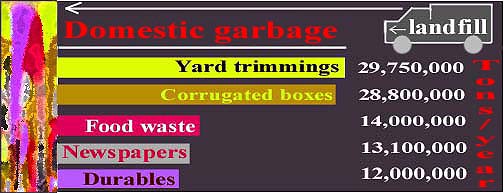
An NEA graphic showing current national disposal figures for household
waste categories suggests usefulness�if an own yard or garden is
available�of materials practices from earlier times toward a goal of
residential waste reduction. Below are some �field-tested� things which
I have found to work for me.
- Garden and yard with shrubs and trees absorb just about all paper and
cardboard packaging, which help retain soil moisture and constrain weeds
(under leaf mulch layer on top of paper).
- Brush piles and compost bins accommodate all yard materials and food
scraps, weeding, pruning, and blow-down refuse while giving home and
cover to many wild, garden-helper residents (rat snakes, chipmunks,
numerous birds).
- Thicker branches and tree stumps left lying to weigh down leaf mulch
eventually make fine compost and provide for myriad earth worms,
beetles, colorful fungi and micro life forms.
- A wood stove largely eliminates need for curbside brush removal.
- Water-frugal appliances; supplement them with a bucket to collect
kitchen-used (vegetable and dish washing) water for the back-door shrubs
and herb beds.
- Perhaps most effective of all, a canning pantry to preserve the
garden�s bounty; it enables one to practically never need to purchase
canned goods.
- Cloth instead of paper items (handkerchiefs, towels, table napkins and
linens) avoid much garbage and feel and look good in personal and
household use.
- Trashed paper (from library recycling boxes) does service for most
unofficial computer printing; xeroxing/printing on both sides of sheets
should be a personal must.
- Basket, cloth totes (and foldable totes in purse) eliminate need for
one-way �shopping bags.�
- Bags of all kinds are re-usable many times, including to take to
stores for refill.
- Clothing items from and to thrift shops.
The above is the short list. As individuals, we can find many more or
other ways to recycle and re-use things, and to save raw materials and
energy. Doing so often entails expenditure of time, however, which the
current, consumption culture tries to persuade us is too valuable to
�waste.� Saving or spending time, or the earth�s resources instead, in
many individual decisions is our personal call to make.
When I decide to fashion a pillow case from material that earlier served
as a curtain, and wash and fluff my sheep�s wool to fill it, I spend
hours but avoid some cost of depleting and polluting the planet�s
natural systems which would attend purchase of a new cushion.
Ongoing--perhaps threshold--decline in many of these systems seems to
bear out the frugal house servant�s warning of �woful want� for the
planet from �wilful (materials) waste� by too many of its human
inhabitants.
|
Graphic: Domestic garbage in tons per year; source: Environmental Protection Agency
"Almost anywhere you look, the air and water are being polluted, habitat is being destroyed, species are going extinct, the climate is changing and indigenous people are facing cultural genocide."
Action Resource Center -- "In defense of earth, human rights and social justice" National website tracks planned protests and "provides resources, training and coordination for organizations and activists working on these issues."
Green Party of Tennessee -- A new political party in the volunteer state, vote on-line to participate in primary. Their issues/platform: "conserve and recycle; improve public schools; abolish the death penalty; enact universal healthcare; improve air and water quality; develop renewable green energy; protect our forests and natural areas; raise wages and ensure safe workplaces; support small businesses and small farmers; provide more and better low-income housing; promote public not corporate campaign financing; give local people more say in road construction projects; make taxes fairer (lower) for low- and middle-income families; stop subsidizing corporations with tax breaks and public funding."
Honor Ride -- "For five hundred years, the native Americans of this country have been on the decline - in numbers, in lost tradition, in dignity and in the respect due us as the first people of this continent. This must change. Since the coming of the white government and settlers, we have lost much; our people have been killed in the name of progress; our land stolen and earth mother ravaged; our traditions lost, or nearly so; and the histories written from the point of view of the victors."
Save The Rain Forest -- Click on this site, sponsored by environmental organizations and companies, once a day and save 24.9 square feet of irreplaceable land and plants and animal species that are vital to survival on the earth. Register as a member and easily triple your impact, saving 74.7 square feet per day.
Reform Party -- Democratic process depends in part on alternative political parties for lively debate on issues of public relevance, including government ethics, environmental and social concerns, and due process. The platform of the Reform Party and registration for voting in its primary are available on-line.
Wilderness Society -- "High Knob [Wise County, VA] has been declared one of the 15 'most endangered wildlands' in the United States by The Wilderness Society, making the list with the likes of the Arctic National Wildlife Refuge in Alaska and the Grand Canyon in Arizona." (Kingsport Times-News)
In all states except North Carolina, citizens may register to vote: on-line at www.fec.gov/votregis/vr.htm, or at resident county Board of Elections offices, or at any Department of Motor Vehicles office.
|
|


text � Frances Lamberts, computer graphics � Jeannette Harris, July 2000. All rights reserved.
|
 Links To Appalachia