
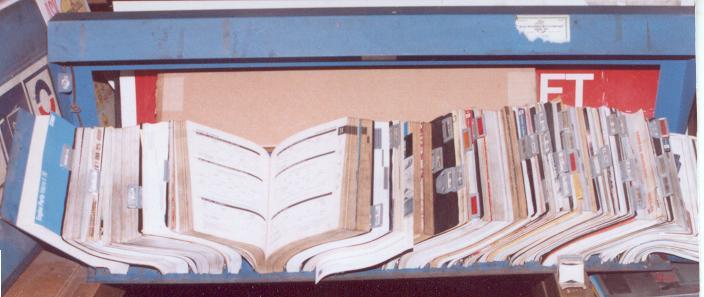
What's more, on any one day in a typical automotive parts store, it is estimated that only about one-third of the material in a conventional catalog rack is going to be used in making sales and serving customers. The other two-thirds will usually con- sist of catalogs that are rarely used; indeed some of them are almost never used. So in the name of efficiency, appearance and ease of handling, why not get these monsters off the counter?
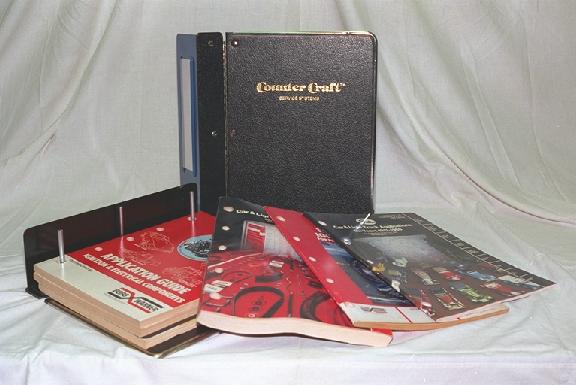
COUNTER CRAFT Service Systems & Products, Inc. of Lombard, IL. (a suburb of Chicago) has designed a manual catalog system that eliminates antiquated counter top catalog racks, whereby catalog and price sheets are kept in specially designed binders that can be stored in any convenient location, such as under the counter or on shelves behind it. In designing the system, which the developers say took seven years of research, COUNTER CRAFT to a great extent relied upon the expertise of the owners of automotive parts jobbing establishments, counter personnel, store managers and other industry professionals. In fact, the company says, the system was refined from one a jobber developed for his own use. The jobber, who employs four full-time counter persons, uses only one and one-half sets of parts catalogs and no counter top catalog racks at all.
According to COUNTER CRAFT, the catalog system reduces the number of catalog and price sheets required to service customers by 50 percent; reduces catalog maintenance by as much as 90 percent; and provides anywhere from 25 percent to 85 percent more room on the counter. Furthermore, the company claims, not only does the system work equally well with or without computerized cataloging, but when installed "after computer cataloging it completes the cylcle that in part computer cataloging was designed to do but doesn't." It provides a "back up set of catalogs recommended by computer catalog companies..."
Catalog and price sheets are inserted into COUNTER CRAFT post binders, which are color-coded to conform to the same major automotive groups now used in catalog racks. Black refers to all domestic stocking lines; red to all import stock- ing lines; blue to all stocking PB&E lines, and green to all reference materials. Each post binder is expandable to 150 percent of it's stated capacity to handle any number of parts catalogs.
In most cases, COUNTER CRAFT points out, one to one and one-half complete sets of parts catalogs in the system can replace two to three complete sets of parts catalogs in conventional counter top catalog racks. The company estimates that two to four counter employees can operate effectively with one and one-half to two complete sets of parts catalogs in the system. If needed additional binders-- which are available in 2-,3-,4-, and 5 inch expandable capacities-- can be easily obtained from COUNTER CRAFT.
