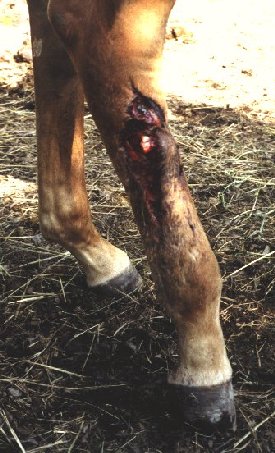
Ben was a 6 month old QH colt that was injured 8/5/99. One of the tendons along the front of the right hind leg was severed. The severed tendon is visible in the picture above, near the very center of the wound. The tendon was reattached, but it later detached on day 4. Our vet in consultation with another surgeon, decided that attempting to reattach the tendon once more would be for naught. The expectation was that the colt would learn to compensate with the remaining tendons enough to recover and allow for a moderately normal life.
I kept a diary so interested well-wishers could be kept apprised of the "progress". I snapped a few pictures as we went along.
"At the present time (8/22/99) we have been changing pressure bandages daily for 2-1/2 weeks. We are now starting hydro therapy prior to rewrapping the leg each day. The expectation has been set for a few more minor "surgeries" to knock back the proud flesh while allowing the deepest part of the wound to fill in."
"Presently Ben is able to move his leg up under his body and get around quite well. If he does not reach forward far enough under his body, then his toe will catch the ground and the fetlock is flexed and "walked on" rather than the bottom of his hoof. There is some worry that he will not be able to compensate completely for the severed tendon and that normal mobility may be compromised."
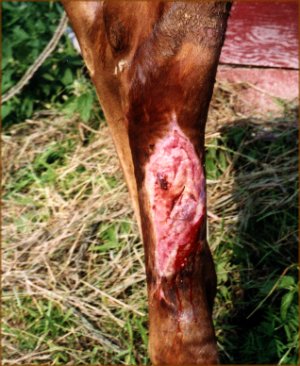
"Proud flesh was removed on 8/24/99. The photo above (8/25) shows the leg after soaking the bandages off. This photo is taken 20 days after the wound occurred. "
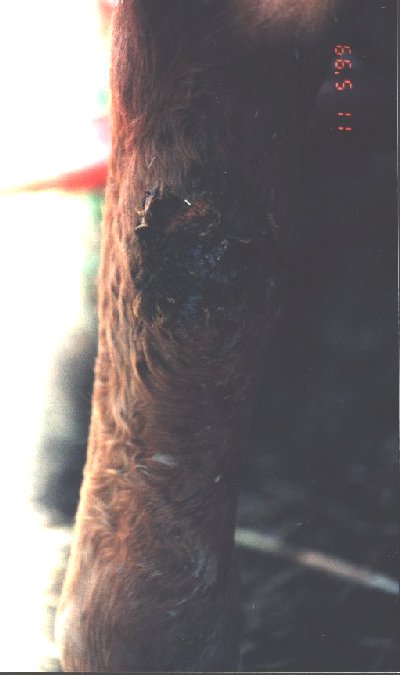
"The photo above (11/5/99) shows the leg which has healed flush with the surrounding leg/skin and now seems to have little concern for proud flesh growth. We are presently alternating with some days of pressure bandages and a day of no bandage and leaving the wound open to dry with just a liberal coating of Icthamol or Furacin. This photo is taken exactly 3 months after the wound occurred and the wound appears black due to the Icthamol salve. "
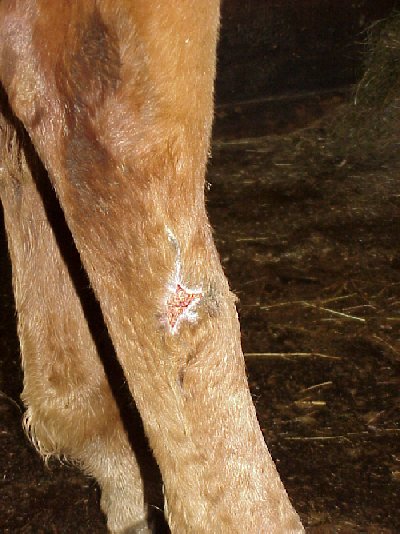
"The photo above (4/00) shows the leg 9 months after the wound occurred. The leg was unwrapped daily and the wound was treated; hydro-therapy, caustic salve to reduce proud flesh or normal salve to keep a moist environment for the growing tissue. Normal pressure bandages were used during the early healing process (3-4 months). Later in the treatment the wound would go for two+ days with milder pressure bandages which continued through-out the winter. Remarkably there has been no affect to the mobility of the leg and certainly no affect on this colts normal activity as he can run and buck with the best of them."
We give our heartfelt thanks to our vet Joe Klopfenstein (and the staff at Vergennes Animal Hospital that support him), who cared for this wound from day one, tracked down other experts in surgical and wound care for consultation, and went above and beyond all reasonable expectations while caring for this colt. It would have been far too easy to have become discouraged during the care and healing process without his support. Many thanks!!! Sue