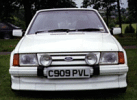
ESCORT RS TURBO SERIES1
1984 was the year the first front wheel drive
turbocharged RS was produced. It was also the fastest production
RS so far and Ford Europes first production turbocharged car.
The car was based on the RS1600i before it on the popular front
wheel drive Mark III XR3i Escort.
For its day this was a remarkable car. A front wheel drive Ford
car producing 132 bhp! This car could be purchased from any Ford
dealer and would shame many a larger, so called fast car. Being
turbocharged though the car did suffer from turbo lag, but after
3000rpm the power increased quickly. From then on the engine went
into self destruct mode, since being turbocharged it becomes a
positive feedback system. Drivers had to be careful not to hit
the rev limiter, set at 6500 rpm, in the lower gears. Another
safety feature was the turbo over boost control. Maximum power
was produced at 6000 rpm, while maximum torque at 3000 rpm.
The engine was based on the old faithful in-line 4 cyclinder 1600cc
CVH SOHC (Single Overhead Cam Shaft) configuration, which had
already been used previously in the Mark I XR2, Mark III XR3 and
XR3i, and of course the RS1600i.
The engine featured a Garrett AirResearch TO3 turbocharger boosting the already good CVH output power to 130 bhp. This turbocharger was located at the front of the engine, behind the radiator, of an already cramped engine compartment. The turbo was oil cooled and utilised a waste gate, actuated at 0.5 bar (7 psi) by a mechanical actuator. Due to the addition of the turbo the car developed a distinctive whistle as the turbo spinned up at between 3000 and 3500 rpm.
The engine featured an air to air intercooler
located next to the radiator, the intercooler was used to reduce
the temperature of the compressed air being fed to the engine.
The air box used a conventional flat paper type filter.
The suspension was also uprated, with a separate front tie bars
and anti-roll. The front springs were set at 98 lbs while, the
rear at 102 lbs, using independent transverse arms. The dampers
were Girling gas-filled monotube items front and rear.
The RS Turbo had great potential for tuning. The more common engine
modifications were:
· A modified engine management computer, commonly known
as "chipping" the car.
· Increasing the turbo boost pressure
· A modified turbo waste gate actuator
· Addition of a turbo alloy dump valve
· Addition of a fifth injector
· Replacement of standard air filter or box with a high
flow item or Induction Kit
· Replacing the exhaust with a more free flowing system
· Improved intercooler
By increasing the boost pressure , using a
modified actuator and a "chipped" Bosch/Motorola engine
management system (to allow higher boost pressures), most tuners
claim up to 175 bhp, (which is an increase of over 40 bhp on standard).
To achieve more power than this the intercooling normally needs
to be improved to stop the engine pre-igniting (pinking) or detonating
(knocking) at the higher boost pressure. Also mechanical engine
modifications are needed, including uprated head gasket to cope
with any further increase in turbo boost pressure. It is also
recommended that for tuning above this power level the brakes
and suspension are similarly uprated.
The car was originally only available in white, with the exception
that one was produced in Black and two in Red by Ford. As with
most of the XR and RS range these cars where all produced in Köln
(Cologne), then West Germany. Althought made in Germany only RHD
(right hand drive) UK models were ever produced!
The power was delivered with a 200mm diamter clutch to a Limited
Slip Differential (LSD) to: 6J x 15 inch cast aluminium wheels
and which were shod with either Michelin MVX 195/50 x 15 VR or
Dunlop D4 195/50 x 15 VR low profile tyres. These alloys were
a seven spoke design similar to the ones used on the RS1600i.
The front suspension used a 18mm anti-roll bar. The rear suspension
featured an anti-roll bar, which was also a first for a Ford Europe
production car.
The LSD was a Ferguson-patented viscous coupling
which had been previously developed for 200 bhp race works Fiestas!
This made steering the RS much easier under full power in the
lower gears.
Some of the standard Series I RS Turbo equipment included:
· Colour coded aerodynamic spoilers front and rear, and
side skirts improving the airflow over the vehicle.
· Long range driving lights, mounted above the front bumper.
· The interior trim was from the Ghia with the following
changes:
· Front Recaro (Monza fabriced) bucket seats, with adjustable
head restraints and extending leg supports.
· Three spoke steering wheel from the XR3i
· The additional Custom pack included: Tilt and Slide FFSR
(Factory Fitted Sun Roof), Electric windows, Central Locking,
and Tinted Glass.