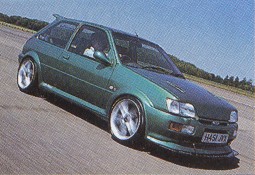
The Fiesta RS Turbo was based on the Ford Mark
III Fiesta two door hatchback shell used on the Ford Fiesta XR2i.
The engine was based on the already successful and proven Escort
RS Turbo Series 2 CVH configuration.
This was the first turbocharged Fiesta produced by Ford and also
the first Fiesta to sport the coverted RS badge.
Ford were now producing three RS vehicles:
· Escort RS Turbo Series 2
· Fiesta RS Turbo
· Sierra Sapphire 4WD Cosworth
The Fiesta 1600cc CVH engine and gearbox had the following differences
over the Escort RS Turbo Series 2 unit:
· The engine utilised the smaller Garrett AirResearch TO2
turbo.
· Different engine management settings with full EFI and
EDIS unlike the Escort
RS Turbo KE-Jetronic system.
· Different ignition settings and spark plugs.
· Lower overall gearing.
· The Limited Slip Differential (LSD) system was not retained.
With these various engine differences, the engine produced 132
bhp at 5750 rpm.
The tuning methods listed for the Escort RS Turbo Series 2 still
applied to this Fiesta RS Turbo, but in comparison the potential
for tuning was more limited. Alot of tuning specialists claimed
lower power outputs for this CVH Turbo engine.
One of the complaints of this RS was that the engine bay was very
cramped, making the engine hard to work on. This also contributed
to the fact that when driven hard the car could easily overheat.
The suspension, brakes and chassis components were based on the
Ford Fiesta XR2i, with the following changes:
Suspension settings were:
· Front and rear springs, 135 lbs at the front and 291
lbs at the rear.
· 24mm front and 16mm rear anti-roll bar.
· The suspension was 1" lower all round than the XR2i
with stiffer springs, shortened rear dampers and the addition
of a rear anti-roll bar.
The front brakes were 260mm x 24mm discs, the
rear brakes were drum brakes sized 229mm x 44mm. The front braking
system also included a mechanical Anti-Lock Braking System (ABS).
The cast alloy wheels were of a striking new
threee spoke design (unique to this Fiesta) shod with 185/55 x
14 VR low profile tyres on 6J x 14 inch wheels. The standard equipment
tyres were Pirelli P600's.
The car also sported a colour matched rear
spoiler and wheelarch trims. The vehicle was only available in
non-metallic colours:
· White
· Red
· Black
· Grey
Both a cosmetic addition and practical one
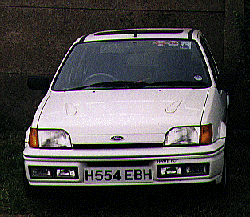
were the twin bonnet vents. From the images these can be seen
to be of a slimmer design to the Escort RS Turbo Series 2 ones.
These helped improve the air flow into the engine compartment
and were also a nice styling feature.
Standard equipment for this Ford Fiesta RS
Turbo also included:
Colour coded aerodynamic front spoiler, and side skirts improving
the airflow over the vehicle.
Unlike previous RS Models, the RS1600i being
one example, decals were kept to a minimum on the Fiesta RS Turbo.
The back tail gate sported a discrete RS Turbo label.
Fog lights mounted within the front spoiler.
Front Recaro bucket seats, with adjustable head restraints.
Manual Tilt FFSR (Factory Fitted Sun Roof), Electric windows,
and Central Locking.
Optional extras included:
· Front wheel ABS
· Rear colour coded spoiler
The Fiesta RS Turbo never seemed to gain the
popularity the Escort RS Turbo Series 2 had gained in the UK.
This may have been one of the reasons that the Ford Fiesta RS
was only produced until 1992. To date, this was the first and
sadly the last production turbocharged Fiesta that Ford produced.
Althought the Fiesta again entered the RS stable as the Ford Fiesta
RS 1800.