An introduction to string quantum cosmology
Let us summarize how the previous quantum cosmological models were constructed. One starts with general relativity as a classical and deterministic theory of gravitation. This theory can be formulated with different choices of variables. Quantization is done according to Dirac's canonical quantization procedure and the different choices lead to very different consistency conditions and thus to different theories. In canonical quantum cosmology the space of classical solutions is reduced before quantization and the Dirac quantization procedure is applied on variables that describe a homogeneous and isotropic space-time. In loop quantum cosmology it is searched for homogeneous and isotropic representations of the algebra required for the Dirac quantization procedure.
In case of string cosmology the situation is different already from the beginning. The classical theory is already different from general relativity as its space of solutions is greater. Quantization of such models can be done according to different quantization procedures but, as we will see, it is not very well understood. There are very complex and difficult models for string quantum cosmology, with/without supersymmetry, with more or less complex effective actions, etc. Our goal here will be to understand the most simplest model.
String theory
The basic postulate in string theory is the existence of fundamental one-dimensional objects, strings, that vibrate on space-time producing matter and gravitation. As any other physical system it can be described by an action which, when minimized, provides the equations of motion. The string action describes matter as well as gravitational degrees of freedom. For low energies the string action can be reduced to an effective action. This effective action does not describe a string as a fundamental object, but fields that arise as an effective description of the physics of the string at low energies. Depending on the type of effective action that is chosen the resulting classical theory it is different.
We will be interested in two different classes of effective actions:
- Those that give rise to the models of pre-big-bang, in which space-time has 3+1 macroscopic dimensions.
- Those that give rise to the brane models, in which the space-time has more than 3 spatial dimensions.
The effective action for pre-big-bang cosmology
The development of the pre-big-bang models has been specially lead by Gabriele Veneziano and Maurizio Gasperini. The pre-big-bang cosmology is probably the most prolific regarding published papers among the models of quantum cosmology. The effective action for the pre-big-bang models follows of some assumptions like (i) the restriction to sufficiently low energies (ii) additional dimensions are already compactified (iv) neglect the anti-symmetric tensor field, etc. To obtain more complete models it is necessary to relax some of these assuptions, but we will concerned with the most simplest scenario.
For the simplest model the simplest action contains a scalar field called dilaton and the gravitational field. If one wants to consider matter fields with this effective action, they have to be introduced by hand. This action is similar to the action of the Brans-Dicke theory of gravtation, and like in that theory, the action is invariant under conformal transformations that rescale the metric and the dilaton. This leads to the existence of two different frames that are equivalent to describe the physics (which however are not connected by a coordinate transformation):
- The Einstein frame. In this frame the pure gravitational action takes the standard Einstein-Hilbert form. The Planck length is fixed in this frame while the string length is dilaton dependent.
- The Jordan frame or string frame. This is the frame appearing in the fundamental action for the string. Classical, weakly coupled strings sweep geodesic surfaces with respect to this frame.
The pre-big-bang regime
Let us consider the Friedmann equations that describe the classical evolution of the universe according to general relativity. They are invariant under time inversion t -> -t. This means, if a(t) is a solution of the equations, then a(-t) is also a solution that describes a contracting universe, since the Hubble parameter changes its sign under time inversion. In general, for expanding classical cosmological solutions that are valid for t_p < t < oo, the Hubble H parameter is in a one-to-one unique relationship with cosmological time t.
The equations of motion that follow from applying the principle of least action to the effective action for pre-big-bang cosmology also have a symmetry under temporal inversions. However, they have another additional symmetry. Letting the dilaton transform freely, the equations are invariant under the transformation:
a(t) -> 1/a(t)
This symmetry is known as scale-factor duality and is a special case of T-duality. Applying a temporal inversion and the scale-factor duality together, it is possible to associate to a solution a(t) another solution a(a) -> 1/a(-t). This enlarges the classical space of solutions of general relativity. Note that the dual solution is not a contracting one but also an expanding one. With more detail one can show that for a classical matter dominated and decelerated expansion with
a' > 0, a'' < 0, H' < 0
the dual solution is an accelerated, superinflationary expansion with growing Hubble parameter
a' > 0, a'' > 0, H' > 0
This phase is known as pre-big-bang and it leads to a natural inclusion of an inflationary phase in string cosmology. Remember that the ability to produce a phase of inflationary expansion is considered today to be a key consistency criterium for models of quantum cosmology.
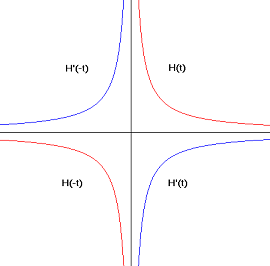
Different branches in pre-big-bang cosmology.
Primes here do not denote time-derivatives as above, but dual solutions (also in blue)
We see that the different branches are, however, separated. But up to now we have considered only the classical theory. It is believed that quantum effects are responsible of connecting different branches. For an expanding solution the relevant branches are the upper ones. Thus the branch on the left shall be connected to the branch on the right.
Brane cosmology
Not available.
Some further reading
- M. Gasperini, http://www.ba.infn.it/~gasperin
- M. Gasperini, Pre-Big-Bang In String Cosmology, hep-th/9211021
- M. Gasperini, Elementary Introduction to the Pre-Big Bang Cosmology and to the Relic Graviton Background, hep-th/9907067
- T. Battefeld, S. Watson, String Gas Cosmology, hep-th/0510022
- G. Veneziano, String Cosmology: Concepts and Consequences, hep-th/9512091
- D. Blaschke, M. P. Dabrowski, Conformal relativity versus Brans-Dicke and superstring theories, hep-th/0407078
[Home]