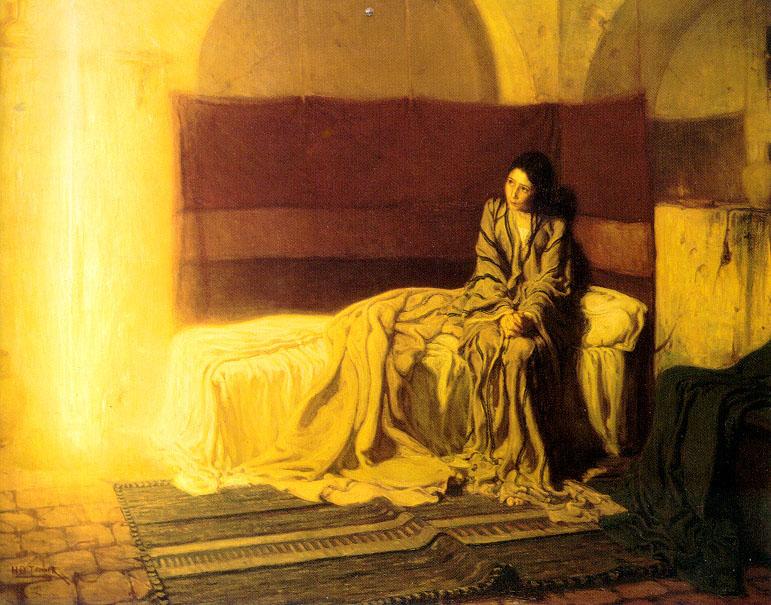
| One evening about sundown, before Joseph had returned home, Gabriel appeared to Mary by the side of a low stone table and, after she had recovered her composure, said: "I come at the bidding of one who is my Master and whom you shall love and nurture. To you, Mary, I bring glad tidings when I announce that the conception within you is ordained by heaven, and that in due time you will become the mother of a son; you shall call him Joshua, and he shall inaugurate the kingdom of heaven on earth and among men. Speak not of this matter save to Joseph and to Elizabeth, your kinswoman, to whom I have also appeared, and who shall presently also bear a son, whose name shall be John, and who will prepare the way for the message of deliverance which your son shall proclaim to men with great power and deep conviction. And doubt not my word, Mary, for this home has been chosen as the mortal habitat of the child of destiny. My benediction rests upon you, the power of the Most Highs will strengthen you, and the Lord of all the earth shall overshadow you." All that night Mary was restless so that neither of them slept much. By the break of day the pangs of childbirth were well in evidence, and at noon, August 21, 7 B.C., with the help and kind ministrations of women fellow travelers, Mary was delivered of a male child. Jesus of Nazareth was born into the world, was wrapped in the clothes which Mary had brought along for such a possible contingency, and laid in a near-by manger. In just the same manner as all babies before that day and since have come into the world, the promised child was born; and on the eighth day, according to the Jewish practice, he was circumcised and formally named Joshua (Jesus). The children were always welcome at the repair shop. Jesus provided sand, blocks, and stones by the side of the shop, and bevies of youngsters flocked there to amuse themselves. When they tired of their play, the more intrepid ones would peek into the shop, and if its keeper were not busy, they would make bold to go in and say, "Uncle Joshua, come out and tell us a big story." Then they would lead him out by tugging at his hands until he was seated on the favorite rock by the corner of the shop, with the children on the ground in a semicircle before him. And how the little folks did enjoy their Uncle Joshua. They were learning to laugh, and to laugh heartily. It was customary for one or two of the smallest of the children to climb upon his knees and sit there, looking up in wonderment at his expressive features as he told his stories. The children loved Jesus, and Jesus loved the children. That night after they had retired, Ganid could not sleep. He talked a long time with his father and finally said, "You know, father, I sometimes think Joshua is a prophet." And his father only sleepily replied, "My son, there are others--" Jesus and Ganid spent much time in the museum during their stay in Alexandria. This museum was not a collection of rare objects but rather a university of fine art, science, and literature. Learned professors here gave daily lectures, and in those times this was the intellectual center of the Occidental world. Day by day Jesus interpreted the lectures to Ganid; one day during the second week the young man exclaimed: "Teacher Joshua, you know more than these professors; you should stand up and tell them the great things you have told me; they are befogged by much thinking. I shall speak to my father and have him arrange it." Jesus smiled, saying: "You are an admiring pupil, but these teachers are not minded that you and I should instruct them. The pride of unspiritualized learning is a treacherous thing in human experience. The true teacher maintains his intellectual integrity by ever remaining a learner." The journey to Nicopolis was pleasant but slow as the wind was not favorable. The three spent many hours recounting their experiences in Rome and reminiscing about all that had happened to them since they first met in Jerusalem. Ganid was becoming imbued with the spirit of personal ministry. He began work on the steward of the ship, but on the second day, when he got into deep religious water, he called on Joshua to help him out. At last the day came for the separation. They were all brave, especially the lad, but it was a trying ordeal. They were tearful of eye but courageous of heart. In bidding his teacher farewell, Ganid said: "Farewell, Teacher, but not forever. When I come again to Damascus, I will look for you. I love you, for I think the Father in heaven must be something like you; at least I know you are much like what you have told me about him. I will remember your teaching, but most of all, I will never forget you." Said the father, "Farewell to a great teacher, one who has made us better and helped us to know God." And Jesus replied, "Peace be upon you, and may the blessing of the Father in heaven ever abide with you." And Jesus stood on the shore and watched as the small boat carried them out to their anchored ship. Thus the Master left his friends from India at Charax, never to see them again in this world; nor were they, in this world, ever to know that the man who later appeared as Jesus of Nazareth was this same friend they had just taken leave of--Joshua their teacher. In India, Ganid grew up to become an influential man, a worthy successor of his eminent father, and he spread abroad many of the noble truths which he had learned from Jesus, his beloved teacher. Later on in life, when Ganid heard of the strange teacher in Palestine who terminated his career on a cross, though he recognized the similarity between the gospel of this Son of Man and the teachings of his Jewish tutor, it never occurred to him that these two were actually the same person. Thus ended that chapter in the life of the Son of Man which might be termed: The mission of Joshua the teacher. The third day they passed by two villages which had been recently built by Herod and noted their superior architecture and their beautiful palm gardens. By nightfall they reached Jericho, where they remained until the morrow. That evening Joseph, Mary, and Jesus walked a mile and a half to the site of the ancient Jericho, where Joshua, for whom Jesus was named, had performed his renowned exploits, according to Jewish tradition. |
 |