|
|
|
|
|
Director
|
Lori
Bales
|
|
Set
Designer
|
Brian
J. Marshall
|
|
Costume
Designer
|
Jana
Henry
|
|
Lighting
Designer
|
Alina
Bayer
|
|
Dramaturg
|
Angie
Balsamo
|
|
|
|
|
|
Judith
Bliss
|
Jessica
May
|
|
David
Bliss
|
Luke
Frydenger
|
|
Sorel
Bliss
|
Sierra
Boggess
|
|
Simon
Bliss
|
Andy
Bero
|
|
Myra
Arundel
|
Jennifer
Tullock
|
|
Richard
Greatham
|
Jeff
Farber
|
|
Jackie
Coryton
|
Lily
Emerson
|
|
Sandy
Tyrell
|
Erik
Floor
|
|
Clara
|
Ellie
Satter
|
|
|
|
|
|
|
Stage
Manager
|
Dawn
Akelis
|
|
Assistant
Stage Manager
|
Derek
Bertelsen
|
|
Assistant
Costume Desinger
|
Stephanie
Paradiso
|
|
Technical
Director
|
Charles
Chapman
|
|
Assistant
T echnical Director
|
Matt
Willer
|
|
Sound
Designer
|
Dawn
Kenseth
|
|
Sound
Engineer
|
Jason
Hauslein
|
|
Properties
Master
|
Megan
Stadick
|
|
Hair/Makeup
Designer
|
Krissa
Lent
|
|
Dialect
Coach
|
Tamara
Philbrick
|
|
Master
Electrician
|
Brandon
Wilson
|
|
Asst.
Master Electrician
|
Andrew
Fay
|
|
Costumer
|
Jana
Henry
|
|
Costume
Crafts
|
Lauren
Dowd
|
|
Wardrobe
Supervisor
|
Melissa
Pleiss
|
|
Paint
Charge
|
Vicki
Podlin
|
|
|
|
|
The
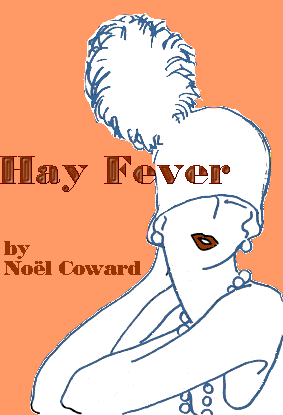
Bliss family is ultra-Bohemian. Mother is a retired actress who makes
a crisis out of every scene and father is a novelist. The daughter and
son are handsome and ill-mannered. One weekend each invite a weekend guest
to their country house without informing the others. The promise of an
idyllic and peaceful weekend for these guests is quickly trounced by the
ensuing comedic flirtations, exchanges, mix-ups and matchups. While this
1925 "comedy of bad manners" reveals the peril behind the seemingly
simple little games that people play, the antics and drama of the Bliss
family make for an evening of just plain fun.
|
|
|
|
|
| From the
Director: Lori Bales |
I didn’t
know until I began my research that Noel Coward was considered the first
"superstar." And he created this role for himself, just as
he created drama, song and film. When asked how he would be remembered
by future generations, Coward replied, "By my charm." Through
charm and quick wit, Coward cast a spell of enchantment that enabled
him to "manipulate the world while keeping [his] individuality
well-defended." His social persona was carefully developed and
controlled; personal flair was his mask.
"Coward updated the drawing-room drama by introducing both a new
pace and a new people. His characters are still rich. They are still
elite; but their status comes not only from birth but also from some
exceptional quality of mind. A talentocracy mixes with the aristocracy.
They use manners, but they are not bound by them." In Hay Fever
the Blisses substitute "the rules of the bohemian world for those
of the bourgeois world. To be interesting, to abhor dullness, to disdain
normality, to indulge the self and its self-expression, to worship accomplishment
are the rules which govern the Blisses’ manners."
Manners, as an "unspoken contract between the individual and the
society," allow for social efficiency and harmony. The Blisses’
four unsuspecting guests arrive for a quiet weekend in the country and
find themselves, like Alice in Wonderland, lost. Lost, because in the
Bliss household where talent reigns and manners are optional, the poor
guests don’t know where they are. Noel Coward knew about social
embarrassment and wrote it brilliantly in Hay Fever.
Given Coward’s grand plan to become a "personality" through
artistic achievement and a façade of diligent charm, it’s
fitting to me that this early play looks at the initiation of the curious
outsider lured by charm and fame into the world of the bohemian artist,
a world where excess of artistic temperament causes an "allergic"
reaction in the sensitive and unsuspecting "guests". (All
quotes taken from Coward The Playwright by John Lahr.)
|
| |
|
|
| From
the Dramaturg: Angie Balsamo |
World War
I taught Britons that very little in life was sacred. In a time
when typhoid fever, malaria, and yellow fever were rampant,
Europeans were paranoid and aware that illness was everywhere.
Emerging from the war, as if from a dream, the twenties, by
contrast, were seen as less "roaring" and more "careless"
by many in Europe. The Victorian era of constraint was left
far behind and replaced by what would later be termed a "Cowardesque"
attitude. For the "bright young things" of Britain,
manners were unnecessary and androgyny embraced. Tutankhamen’s
tomb was discovered, cross-dressing was prevalent, and the bohemian
lifestyle thrived. Amidst the chaos, Noel Coward found inspiration
for his comedy on "social sins." Hay Fever
is based on Coward’s interactions with the family of Laurette
Taylor, a popular and talented actress at the time. Her husband,
son and daughter, a carbon copy of the Blisses, "adopted"
Coward. It was with them that he gathered the character information
eventually leading to his first true comedic endeavor. Taylor’s
parties were infamous in both New York and British circles mainly
for their "eccentric" parlor games including "In
the Manner of the Word," made known through Coward’s
play. Laurette had a dramatic tendency, as the following passage
confirms. "On Sunday evenings... we had cold supper and
played games, often rather acrimonious games, owing to Laurette's
abrupt disapproval of any guest who turned out to be self-conscious,
or unable to act an adverb or a historical personage with proper
abandon. There were also, very often, shrill arguments concerning
rules. These were waged entirely among the family, and frequently
ended in all four of them leaving the room and retiring upstairs,
where, later on, they might be discovered, by any guest bold
enough to go in search of them, amicably drinking tea in the
kitchen."
Hay Fever is brilliantly written. As a viewer, one evolves
from the curious spectator, watching the outrageous activity
of the Blisses, to actually developing the appreciation that
in each of us there is an ingénue, a vampire, and a temperamental
child. A vivid representative of its time, Hay Fever
acted as a necessary cushion between the two World Wars easing
Europe into the new bohemian renaissance with memorable characters
and witty text. Instead of vanishing into obscurity, Noel Coward’s
words find willing ears still today. (Citations available upon
request.) |
|
| xxx |
|
|
|
|
|