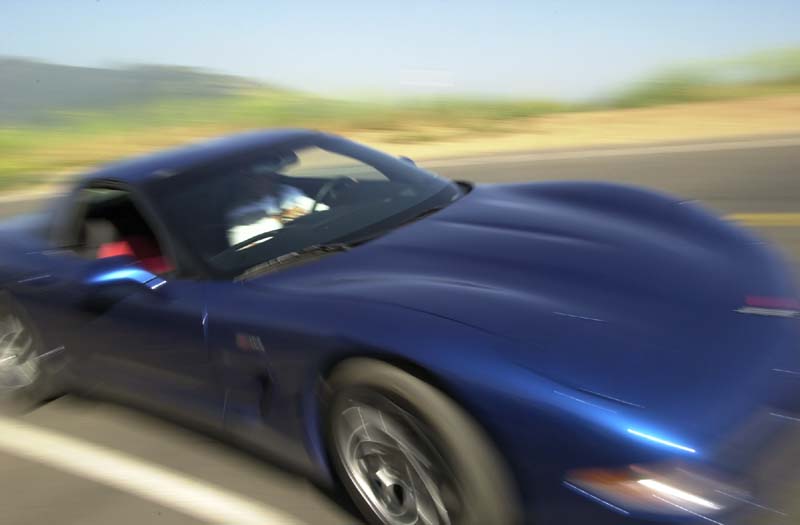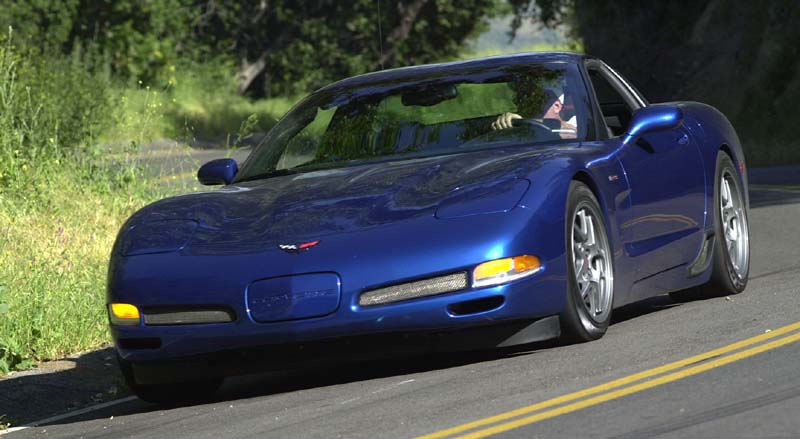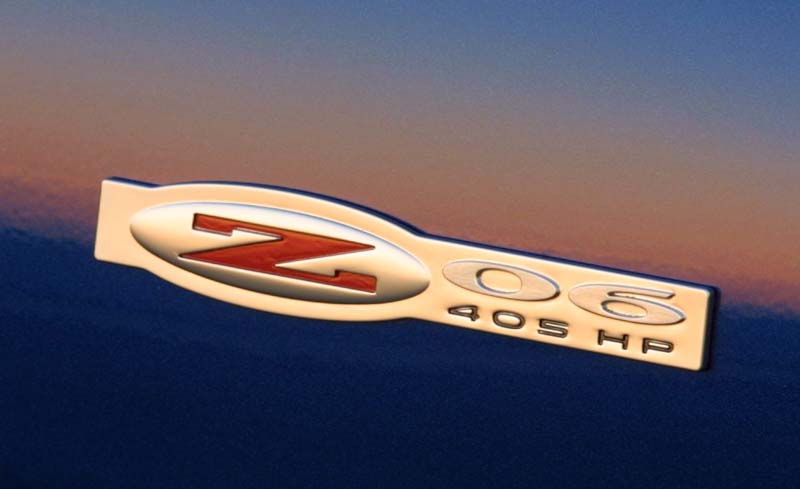



It was just too much fun! For 12 minutes or so, at a not-just-illegal, but an obscene rate of speed, I ripped up the tight turns and short straights that make Glendora Mountain Road. After eight miles, faster than I’ve ever made this run before, I reached the overlook above Morris Reservoir which I consider the top of "GMR". I parked, got out and stood back 50 feet, studying this Electron Blue rocket. A little breathless as the adrenalin still pumped, I thought: Whoa! What a ride! Last year’s Z06 was awesome but this one’s got more power and is just a bit better off the turns. So–is it "beyond awesome"? As I gazed at a Corvette for which I’d sell my soul, I reflected on what Corvette Chief Engineer, Dave Hill, said in an interview the day before. "We always try to make the Corvette improved over our previous best and, in that respect, the 2002 Z06 is certainly a noteworthy car. It is a difference you really can feel. It makes a 10th of a second improvement in 0-60 and two tenths of a second in quarter mile. On a race track, it’ll do a half second quicker lap time than an ’01 Z06 and that’s a combination of the additional power and the suspension tweaks which enable you to exit a corner quicker." After the drive I just had, I didn’t need Hill to convince me. I was already a believer. The Corvette Team developed the ’02 Z06’s half-second-per-lap improvement at Grattan in western Michigan, and the Bragg-Smith Advanced Driving School near Pahrump, Nevada. Both are short, challenging road courses often used by GM to tune Corvette’s ride and handling. Rupert Bragg-Smith’s track is kind of like Glendora Mountain road in that it’s narrow, its turns are tight with no two the same, and the track’s straights are short. Still high on my thrill drive, I thought: I’m a gawd-darn, gnarly terror on GMR in a blue, Z06. Maybe I ought to try ole Rupe’s school so I can be even faster. Glendora Mountain Road is home turf. Just 20 minutes away from my office, it’s the closest place for a driving workout. It links the town of Glendora, California, northeast of Los Angeles, to recreation areas along the east fork of the San Gabriel River in the Angeles National Forest. It’s a perfect hang-out for those "extreme performance enthusiasts" whom Dave Hill claims are the target market for the Corvette Z06. Glendora Mountain Road confronts the sporting driver with an almost immediate challenge. A mile or so up, there are three 160-180 degree hairpin turns. Each is at the end of a short straight. You come flying up to these hairpins at the top of second gear or in mid-third-gear then brake to ABS while heel-toe downshifting to first. Having Active Handling’s Competitive Mode enabled is mandatory. You want the safety margin of AH2’s brake intervention but, while it’s not the fastest way off a turn, you might want to use the throttle to play with the car’s yaw angle, so you don’t want traction control.
With the Z06’s superb brakes and Goodyear Eagle F1 Supercar tires, coming into corners like this at high-warp speed is a deceleration rush never generated by any Corvette that’s gone before. In fact, few other cars stop like this and the ones that do cost as much as two or more Z06es. I usually don’t trail-brake C5s. The car is more neutral and tends to rotate easier than, say, my own ZR1, so once I turn-in; my braking is done. Around the apex, I keep the car balanced but, as I exit, I roll on the throttle and, as a test of the better shock valving, I got pretty aggressive in doing that. At this slow a speed in first gear, the ’02 Z06 wants to power oversteer a little but I do feel that the back end is better controlled than the ’01 and I can get the power full-on maybe a little sooner, more rapidly and with more confidence. The rear suspension takes the punishment in spite of this being a rougher surface characteristic of a tertiary public road and not a much flatter race track. After these three hairpins, there are esses, two more hairpins, then a long, fourth-gear straight. You exit onto this straight from a second-gear, right-hander. You accelerate, using all the LS6’s top-end power and shifting at 6500 rpm, through the rest of second, third and well into fourth gear. Can you feel the difference in power from the ’02 Z06? Hell yes, but only if you’re driving the car as it’s supposed to be driven: as hard and as fast as you can. With the throttle "WFO", the LS6 working hard and closing on its 405 horse, 6000 rpm peak, you’ll see a left-hand sweeper approaching rapidly. Off the gas. Onto the brake. Back a gear and into the sweeper. After that, there’s a 90-deg. right, some esses, another hairpin, all linked by short straights and, finally, you arrive at the parking area above Morris Dam. As I stood looking at that Electron Blue Corvette, I considered a recent "mission" to do the three meanest roller coasters at Six-Flags Magic Mountain theme park here in California. Trust me–they’re a bore. Screw roller coasters; gimme a Z06! Ok. Enough of GMR. Let’s talk straight line acceleration. The LS6’s extra power is all up top and it makes the ’02-car the quickest production Corvette ever. While GM did not allow timed, acceleration testing of the prototype I drove; it did supply data claiming, 3.9-sec., 0-60 time and a 12.4 sec. quarter mile pass. Some good intel I’ve developed about ’02 Z06 performance shows a potential for an astonishing, 3.85 sec. 0-60 and quarter mile performance at 12.45/118.0 mph. That’s using timing with no roll-out (rather than drag strip clocks), on a typical road surface and at the hands of a driver who understands how to launch in a manner that won’t run afoul of the "anti-powerhop" algorithms programmed into the engine controls software.
|
 |
 |
 |
 |
 |
 |