
if you live in a cold & wet climate
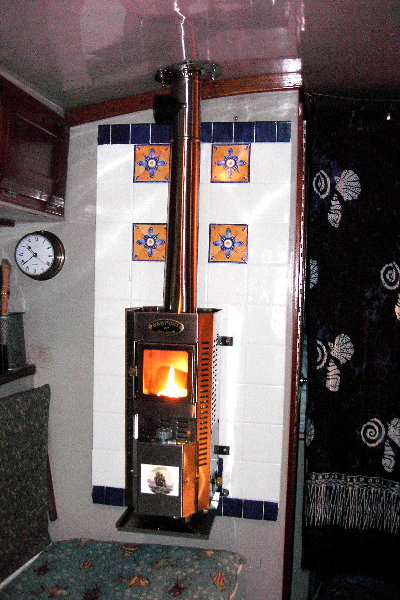
Before we got this diesel heater, we used a small powerful electric heater (from an industrial supply store), which did heat well, but only in the direction you pointed it to. We let it run day and night during the winter time, but in the morning all the windows would have condensation. Because to keep the boat warm, we had to keep the ports closed. Sometimes we thought we live in a luxurious Tupperware container!
But now with the diesel heater running, temperature is very uniform throughout the boat and the air is amazingly dry. There is no condensation on the windows, when we open the curtains in the cold winter morning. It is all dry.
It uses 10 gallons of diesel fuel a week, running 24/7 on "low". If the setting is on "low", the boat stays in the 70's even in freezing weather.
The fuel is supplied from either of two diesel tanks, which also supply the boats diesel engine.
A small low-pressure pump provides the fuel to the heater for now, but in the future we will install a small gravity day-tank so that the pump only needs to run just a few minutes a day to fill the day-tank from one of the main tanks.
Right now, as I write this, and every day and every night, we hear a little "thump" every 4 seconds. We got very used to it and have to consiously listen to it to hear it, but sometimes it does bug us!
The day-tank will provide the fuel by gravity, so it will be silent and use no power.
We have 5 fans running and two ports (looking into the cockpit) open 24/7.
Ventilation is the key to a warm and dry boat.
We have 5 fans throughout the boat, which run CONSTANTLY (and others for backup).
The picture shown above actually does not resemble a normal day-to-day on our C35. The blue curtain to the left of the heater is usually always pushed to the side, so the air can freely move. Attached to the bulkhead, at the highest point in the opening to the V-berth, is a clamp-on fan (not seen in the pic), pointing into the V-berth. It actually blows warm air into the V-berth!
As rather new boat owners we didn't expect condensation to run so rampant. One rainy winter made us realize that we do something wrong, if every surface on the inside is wet, but the boat doesn't leak anywhere.... We had to change something!
First, we threw out all our foam and old upholstry, which was the source of 30 years of bad smells -- a mixture of mildew, diesel, spilled beer and sailors wet clothing and who knows what!
Next was the bed in the aft cabin -- we threw away the queen sized matress and built a twin-sized bunk from port to starboard, with the sides just above the pin-rails. The secret is to not let any sleeping surface (matress or foam) touch the fiberglass or carpet -- if you do, it gets soggy and wet during wintertime.
The raised bunk bed is of course not suitable for an adult; headroom is limited and one would have to slide in and out. But for a child it is just perfect. And the area underneath is the dog's favorite spot!
The V-berth also had a condensation problem. Because the V-berth is an issue in itself, we are discussing it on a seperate page (V-berth). I can tell you that during 6 months of a rainy cold winter we do sleep on the dry!
But as said, ventilation is the key to a boat without condensation.