God made rainy days so
gardeners could get the housework done.
~Author Unknown
Nasturtium
Canap�s
Here's
a special way to celebrate your garden! Thanks
to Brenda Hyde of Seeds of Knowledge for this recipe.
Ingredients:
8 ounces cream cheese,
room temperature
3 tablespoon finely chopped chives
3-5 tablespoons milk
2 loaves bread of your choice (see below)
Nasturtium blossoms
Mix the cheese with the chives and 3 tablespoons
of milk until smooth. If this is too thick add more of the milk. Using a
serrated knife, trim your bread. You can use a baguette and slice
thinly, leaving the crust. Or use a hearty wheat, honey wheat or even
oatmeal bread and remove the crust then cut into small squares. Spread
the cream cheese over your bread piece, not quite to the edges. At this
point you can place on baking sheets and chill for up to 6 hours, or use
immediately. Pick your nasturtium blooms and gently rinse. Place one
bloom on each piece of bread, or careful separate the petals and arrange
in a design on top of the cream cheese. You can also add small herb
leaves, such as thyme, oregano or chive stems to decorate. Serve your
canap�s on a pretty plate or platter lined with a paper doily.
These are great for summer tea parties! |
|
|
by Chris
Hansen, Director of Horticulture, Wayside
Gardens
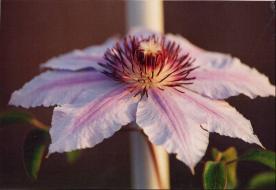
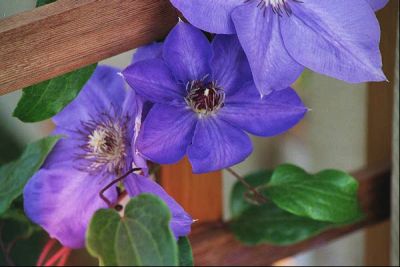
Pruning Your Clematis* -- A perennial
vine, it can grow just a few feet tall (great for containers!), climb an
arbor, or take over the place, depending on your preference, selection
of varieties, and skill with the pruning shears. Let�s look at the
pruning process hinted at by the ominous-sounding Group I, II, or III
designations you always see in catalogs.
- Group I: Prune after flowering if needed. The
key words here are "if needed." Some of the great ramblers
are in Group I, including the fragrant C. montana var. rubens
'Odorata', which began spiralling up my lamppost three years ago and
has now taken a 3-foot leap into the nearby Dogwood tree and is
eyeing the carport roof. I COULD prune it, but until the house
crashes down under the weight of the vine, why should I? It blooms
in early summer, and I�m not ready to slash back all that
lovely foliage right after it quits, so I�m always in for
another year, bigger and better than the one before it! Not all
Group I Clematis are runaways -- the magnificent dwarf 'Blue Light'
is in this category... but then again so is satiny-pink 'Mayleen',
another C. montana that just won�t quit!
- Group II: Every March, cut back the vine 6 to 8
inches to a pair of strong buds. Cryptic, isn�t it? What
constitutes a pair of strong buds, and will you be able to find them
in March, under all that snow? Most Clematis we offer here at
Wayside are in Group II, so I can report with confidence that what
you do is this: In late winter or early spring, grab your favorite
pair of bypass pruners and snip off the growth that appeared after
flowering last year. If you can�t tell the new from the old,
take off the recommended 6 to 8 inches, cutting just above the
branching point of a stem (where you should, with any luck, see a
couple of bumps you can imagine to be "strong buds"). That�s
it. There are so many lovely Group II varieties that I will limit
myself to bragging about 3: 'Snow Queen' -- Among the most
floriferous I have ever seen, all summer long! Just 7 to 10 feet
tall, and it blooms on both new and old wood, so how can you go
wrong with pruning it? 'Will Goodwin' -- Huge blue blooms right into
fall. The vine can reach 12 feet tall, so plant one on either side
of an arbor and let them meet in the middle. 'Belle of Woking' -- An
heirloom double you will fall in love with. Appleblossom-white
blooms mature to silver, appearing to glow at dusk. Grow it on the
patio where guests can rhapsodize about it over dinner! 'Niobe' --
Okay, I couldn�t resist! I said I would just stick to 3, but I
can�t leave out this midnight-red, with large blooms that open
nearly black, then blaze an unforgettable ruby in the summer sun.
- Group III: Every March, cut back vine to 12
inches from the ground. Yes. You�re going to need some courage
for this one. Your rare and choice C. x durandii, 10 feet tall and
with last summer�s huge bounty of blooms still festooning its
stems in your mind�s eye, must be mercilessly whacked to a foot
from the ground. You have to do it! Group III Clematis won�t
bloom on old wood. Here are a few "must-have"s in Group
III: 'Sugar Candy' -- Peppermint-striped pink blooms blanket the
vine first in early summer, then again in fall. Unbeatable for
flower power, and it prefers a bit of shade, opening new garden
areas to the joy of Clematis!
*Source:
Wayside Gardens
January 2002 newsletter
|
|
 |