| Quick
Links |
|
|
|
| Mother Board Processor
Video Card
Hard Drive
Case
|
 |
| The
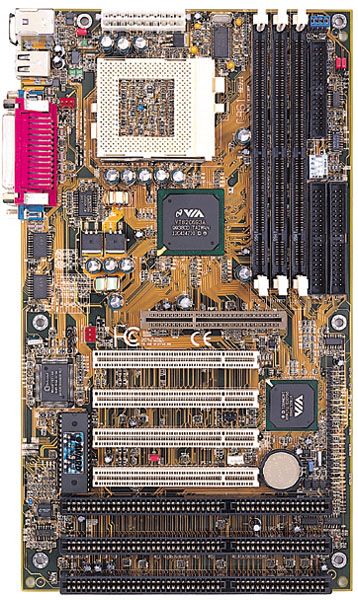
Motherboard is the backbone of the
computer. the main circut board
controling all the major aspects of the
hardware attached to it, including the
processor, memory, hard drives, and
expansion cards. The bus communicates
information between the processor and the
other componants attached to the Mobo.
For increased speed get a motherboard
with a high bus speed (266mhz). The Bios
(Basic Input/Output system) is in an
EPROM (Erasable
Programmable Read Only Memory) chip on
the Mobo. A reusable memory chip that can
be programmed electrically and erased by
exposure to ultraviolet light.(Also
called Electrically Programmable ROM). |
| There are different types of
motherboards wich accept different
processor types |
| Socket A |
| Socket 478 |
| Socket 423 |
| Socket 370 |
| Dual Socket A |
| Dual Socket 370 |
| Which motherboard you buy
will dictate which processor you will
need. |
|
|
|
| |
 |
| Central
Processing Unit.The CPU controls the operation of
a computer.Units within the CPU perform
arithmetic and logical operations and decode and
execute instructions.In microcomputers, the
entire CPU is on a single chip. |
|
|
| |
 |
| A video adapter
(also called a display adapter or video
board) is an integrated circuit card in a computer or, in some
cases, a monitor that provides digital-to-analog conversion, video RAM, and a video
controller so that data can be sent to a
computer's display. Today, almost all
displays and video adapters adhere to a common
standard, Video Graphics Array (VGA). VGA describes how data -
essentially red, green, blue data streams - is
passed between the computer and the display. It
also describes the frame refresh rates in hertz. It also specifies the
number and width of horizontal lines, which
essentially amounts to specifying the resolution of the pixels that are created. VGA
supports four different resolution settings and
two related image refresh rates. In addition
to VGA, most displays today adhere to one or more
standards set by the Video Electronics Standards
Association (VESA). VESA defines how
software can determine what capabilities a
display has. It also identifies resolutions
setting beyond those of VGA. These resolutions
include 800 by 600, 1024 by 768, 1280 by 1024,
and 1600 by 1200 pixels.
|
|
|
| |
|
Hard Drive - The
primary computer storage device. Like tape, it is
magnetically recorded and can be re-recorded over
and over. Disks are rotating platters with a
mechanical arm that moves a read/write head
between the outer and inner edges of the
platter's surface. It can take as long as one
second to find a location on a floppy disk to as
little as a couple of milliseconds on a fast hard
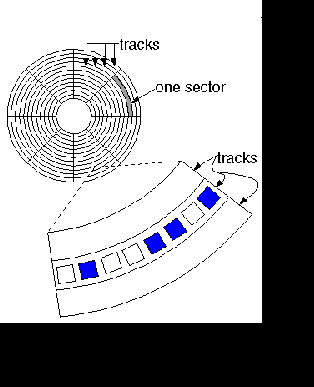
disk. The disk surface is divided into concentric
tracks (circles within circles). The thinner the
tracks, the more storage. The data bits are
recorded as tiny magnetic spots on the tracks.
The tinier the spot, the more bits per inch and
the greater the storage. Most disks hold the same
number of bits on each track, even though the
outer tracks are physically longer than the inner
ones. Some disks pack the bits as tightly as
possible within each track.
Tracks are further divided into sectors, which
hold the least amount of data that can be read or
written at one time |
|
|
| |
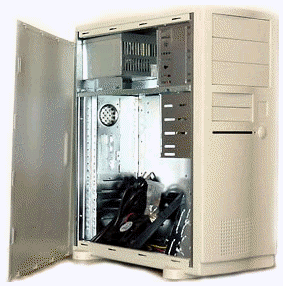 |
| In a computer, the chassis
houses the main electronic components, including
the motherboard (with places to insert or replace
microchips for the main and possibly specialized
processors and random access memory (RAM) and
places for adding optional adapters (for example,
for audio or video capabilities). Typically, room
is provided for a hard disk drive, CD-ROM drive
and power supply. |
|
|

 [email protected]