
What's needed for wakeboarding is basically the same as for waterskiing, plus a wakeboard itself. The good news is that you can get away with slower cheaper boats, use less fuel (because you're going slower) and have more fun in the process.
The Boat...
The boat must be able to pull the skier steadily out of the water. Compared to a waterskier on a mono-ski this is easy and requires much less power because the wakeboard has a much greater surface area, so it doesn't dig in like a waterski. A wakeboard planes slower than a waterski which helps because the wakeboard will be skiing at a much slower speed when a mono-ski would still be dragging throught the water. A boat which does not have sufficient power to pull a mono-skier from a deepwater start, but which can pull a skier on two skis, will probably be able to pull a wakeboard deepwater start. A wakeboard start is quite slow and progressive so the boat doesn't even have to accelerate especially fast.
Typically a small (16 or 17 foot) boat would require a 50 hp to 90 hp outboard depending upon the boat weight and number of passengers. A bigger (18 to 19 foot) boat probably needs a 115 hp outboard or 135 hp inboard or more.
The first important criteria for a wakeboard boat is to be able to pull consistently and slowly (dedicated competition ski boats are still best at this). A wakeboarder should ski at about 18 mph or as slow as 15 mph to learn surface tricks, but some boats have trouble maintaining this speed as it's actually too slow for many speedboats because they are not properly planing until over 20mph which is way too fast! A high torque engine, which generally means bigger capacity, will usually be better at maintaining slow speeds. Huge American V8 engines (as found in tournament ski boats) with 250+ hp excel.
The second important criteria is the wake itself. Against all previous waterski requirement a wakeboarder wants a decent sized and shaped wake. This means if your boat is a dory type hull it will be useless for skiing or wakeboarding (sorry), but it is good news for owners of V hull sports boats. Flat bottomed professional ski boats are sometimes too flat (remember waterskiers want no wake at all) and do not produce sufficient wake even at slow wakeboard speeds (some do and this wake will decrease as the boat speeds up to mono-skiing speeds of 30 to 36mph, this is the ideal ski boat!).
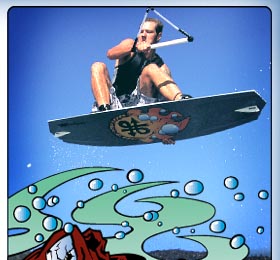
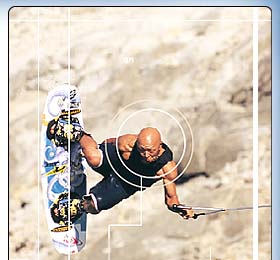

The Wakeboard is the second most importand piece of equipment, next to the boat. Well they are both important, you can't have one and ignore the other. The wakeboard should be thin so you can use its edge to carve turns, light so jumps and air moves are easier and strong so that it doesn't break!
If you're a beginner you may wish to consider a slightly larger surf shaped board. The larger size will help with starting and balance. The surf shape will allow you to learn surf moves on the wake. When you're able to ride fakie
(backwards by spinning round 180 degrees on the surface of the water and continuing to ride with what was your rear leg out in front) you might like to try a twin tip.
Advanced riders nearly all ride twin tips. The board is as good fakie as forwards. By combining this type of board and a completely sideways stance you are able to ride fakie and normal just as easily (theoretically at least). Most twin tip boards are able to take fins at both ends so the boards are completally symetrical.
Other Wakeboard Equipment...
Wakeboard equipment is pretty simple. In addition to the boat and board you need a good quality rope and mounting, preferably a centre mounted ski pylon (the U bolts in the rear transom are really a very poor solution, as with waterskiing). You may choose to wear gloves, a wetsuit if it's cold where you ski and a PFD or ski vest (very good for protection... oh, and floatation too). You should not ski in bathing suits or trunks alone (... for your own protection).


