
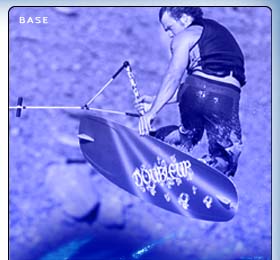
Congratulations... you've decide to give wakeboarding a try, you won't regret it. Having studied what is wakeboarding and what's needed to wakeboard you already know what you're trying to accomplish.
A good starting point.
If you can already waterski then you can almost certainly wakeboard. Wakeboarding is only slightly more difficult than waterskiing on two skis (to begin with...). If you have never waterskied and have access to a good pair of waterskis it may be easiest to try to learn to waterski on two skis before trying the wakeboard. If you can surf or skateboard or windsurf or snowboard this will also help.
Wakeboarding really is easy (to begin with...) so don't worry.
Selecting your wakeboard.
If you already have a wakeboard then you've made your selection. If you haven't got one then maybe try and borrow one, or go skiing with someone who can already wakeboard. They will be able to help a great deal. If you're still reading this far then what you probably need to know is that the board should preferably be one of the larger surf shapes (there's no reason why you can't start on a quite advanced twin tip board, it will just be a little harder, but not all that much, so don't reject a top board because that's all you have available. If you do try a twin tip make sure the foot bindings are set in a beginner position).
If you are going out to buy a board consider how good you really are (be honest) and how good you think you'll get (don't read like to get). If you just want to enjoy the skiing and for the whole family to ski and particularly when there is a large weight difference between the various skiers a surf shape will be more forgiving and actually better fun. If you're confident you'll be riding backwards (fakie) and jumping from a backwards stance (switchstance) you'll want a twin tip so you may as well buy that straight away.
I can't decide, so I have (and use) both. Lately I prefer my BAFF twin tip.
You probably have purchased a standard 75 foot ski rope. This is too long for wakeboarding and should be shortened to between 45 and 60 feet. Begin at 60 feet, if you find that you're not wakeboarding where the wake is the 'best' shape (at 18 mph) shorten the rope down to get closer to the better wake shape nearer the boat. Too far back the wake has flattened out and may be full of white water. Too far forward and you'll be skiing in the boat spray or even in the rooster tail of the wash. You should try to ski where the wake has a good height, smooth curl up to the wake crest and hopefully not too much turbulance or white water.
The ideal rope length will vary from boat to boat and also with the speed you're wakeboarding at.

If you mono-ski, surf, skateboard, snowboard or anything similar then you already know your lead foot (the front foot when going foward normally) If you don`t then determining which foot forward you are is fairly important when it comes to Wakeboarding - in fact your going to have a difficult time if you are trying to wakeboard the wrong way around. Heres a couple of ways of working out which foot forwards you actually are.
Obviously you can be either left foot or right foot forward. Left foot forward is considered normal or regular whereas right forward forward is know as 'Goofy' - anyone know why?
Method 1
Stand with both feet together and close your eyes. Ask someone to gently push you forward from behind. Which ever foot goes forward first to catch your balance is the one you should try putting forward.
This is most effective if you have someone who is asking which foot to put forward and you tell them to stand with their eyes closed and then you take them by surprise and push them forward. This way they can't subconsciously choose which foot to put forward.
Method 2
Another way is to watch which way a person puts pants or a wetsuit on. The foot that they put on first will normally be there front foot for wakeboarding.
Starting for the driver is as important as for the skier. The driver should ensure they know the area they are skiing in. Starting in a straight line ensure all slack is taken up by pulling forward slowly so that the ski rope is in tension and skier, rope and boat are all in a single line. When the skier/wakeboarder is more proficient the driver is able just to leave the boat in gear and idle forward to maintain tension in the ski rope, for beginners this often causes the skier to become unbalanced and even end up being dragged headfirst, so the whole starting procedure has to be begun again.
When the skier is ready they should indicate to the driver to 'GO' (by shouting, normally). This is where it helps to
already be idling in gear (if you're not then put the boat into gear, this may jerk the skier which is not good, but one way or the other you have to get the boat moving!). Accelerate slowly and progressively to a throttle position that would normally put you boat on the plane, if your boat is small or skier heavy then this may have to be increased to compensate for the extra load.
Hold this throttle setting until the boat begins to plane at which time gradually reduce the throttle to maintain the boat on the plane at about 18 mph. For learning surface tricks slow down to about 15 mph, never go above 22 mph.
If your observer indicates that the skier has fallen circle and collect them or try again.
The deepwater start. (or refer to getting up.)
After getting into the water and putting your feet into the board's bindings or straps, you're ready to start. Collect the ski handle, or have it passed to you. Grip the handle with both hands the same way, palms down.
The deepwater start has to be accomplished before attempting any other kind of start (which I don't intend to cover). Begin by lying on your back in the water, feet and board out in front of you and with the board perpendicular to the ski rope (the rope should be pointing towards the boat). The rope should pass over the top of the board. At this point you may use your arms to stabilise yourself, but don't let go of the ski handle.
Many people try to put the board underneath them, or bend their legs, or point the board towards the boat, all of which will unbalance you as the board itself is buoyant. If you are wearing positive floatation from a wetsuit or ski vest this will help the floating. Practice floating in this position if you find it difficult.
If it's windy try starting and skiing directly into the wind if this is possible.
When you are stable and if the ski rope is not taught indicate to the driver to 'take up the slack'. The driver and observer are probably trying to do this anyway. When everything is lined up and you are ready to go indicate to the driver to 'GO'. At this point you may still have your legs straight and the board perpendicular to the rope and on its edge (the people in the boat can see the underside of the board).
Many people will tell you to bend you legs and point the board 45 degrees towards the boat. This position is less stable and although it works fine for boarders who can already deepwater start, if you're a first timer it is likely to unbalance you and result in an aborted start. Keep lying on your back until the boat pulls.
As the boat pulls bend both legs up to your chest, this way you take all the strain on your chest and not through your legs. Keep your arms straight out in front and the wakeboard on the surface of the water. Don't try to stand on it yet.
The wakeboard on edge presents a large drag in the water, this is what enables you to bend both legs up to your chest as it pushes against you while the boat pulls you. As soon as you have your legs bent and are feeling the push from the wakeboard and the pull of the boat you should flatten the board out slightly and rock forward so that you come up onto the board. At the same time begin to point the board about 45 degrees towards the boat.
It often helps to roll the board a little, around the axis of the rope, so that the tip is now higher in the water than the tail, this will ensure the tip does not nose dive and helps the whole motion of rolling out of the water onto the board.
You may have to brace yourself in a position while the boat pulls so that you do not stand up too soon. In this case you probably should have one arm either side of your leading leg and hold the pull through this leg onto your chest. If you can't hold this position you probably have something wrong. From this position starting is easy.
As the board flattens out on the surface of the water roll forward onto the board. If the board sinks you were going too slowly or moved too soon, hold the pull a little longer before rocking forward. You still don't actually need to stand up, you can rock forward and get into the skiing position without standing up at all, that should be the last move after you point the board towards the boat and are wakeboarding.
It will probably take a few goes to co-ordinate all the moves as they all happen almost simultaneously. A bit like driving a car, to begin with balancing the brakes, clutch, gears and steering as well seems to be impossible, but we all learn.
Once you're up you'll have to find how to balance on the wakeboard, how to make it go in a straight line (people often find they tend to steer towards the direction of their lead foot) and then how to make it turn (by applying weight towards or away from your toes, called frontside or backside (heelside)).


