Before you start, please PRINT THIS PAGE to write your answers on.
What in the world is a fractal? Well, you are about to find out!
There are many ways to define a fractal. We are going to look at three.
1. First go here.
A fractal
is a s_______ made up of smaller c_______ of itself. The copies may be
e______ or d__________ in some way. The Sierpinski gasket is a good illustration
of this feature of self-similarity.
2. Next, go here.
A fractal
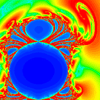
is an i________ that is generated by a computer using complex n________.
Fractals can
also be found in nature (you will see some examples in a few minutes).
3. Finally, go here.
The word FRACTAL
was invented by Benoit Mandelbrot.
Fractals are
interesting because as you z_______ in closer, the pattern is just as beautiful
and complex as when you s________.
Now go to the Fractal Gallery. Scroll down to find the small images of fractals.
Pick 6 and click on them to view them larger. Write their numbers here: ________ ________ ________ _________ __________ _________
Which fractal was your favorite? ________ Why? ____________________________________________________________________
Then check out "Fractal Generator 1". Click and drag on each image to zoom in. You should notice that the pattern repeats itself. Fractal Generators 1, 2, and 3 all work basically the same, but check out Fractal Generator 2 and Fractal Generator 3 as well.
Click on and check on Fractal Generator 4.
This is a completely d_________ type of fractal. Mathematicians have found that they can mimic t________, c_________, m____________, just about everything in n___________ with fractal mathematics. Touch or drag your cursor on this applet and watch the tree grow.
Check out Fractal Generator 5. Be sure to click and double-click and watch how it changes.
Which fractal generator was your favorite? _______ Why? _____________________________________________________________
Click your back arrow to get back to this page.
So why in the world should we study fractals? Go here to find out.
What's so hot about fractals, anyway?
1. They're ___________!
Most math you study in school is _______ knowledge. For
example, the geometry you study about c_________, s___________, and t___________
was organized around __ __ __ B.C. by a man named Euclid. Fractal
geometry, however, is much newer. Research on fractals is being carried
out r________ n______ by mathematicians.
2. You can u_________________ them.
Much research in mathematics is currently being done
all over the w__________. Although we need to study and l_______ more before
we can understand most modern mathematics, there's a lot about fractals
that we can understand.
3. Fractals often look like objects in n___________.
Many objects in nature aren't f__________ of squares
or triangles, but of more c__________ geometric figures. Many n__________
objects - ferns, coastlines, etc. - are s__________ like fractals. This
picture is actually an e___________ of a fractal.
Computers make the more complex, colorful fractals we see and that people use as art work. Use any of the websites above, The Fractal Art Gallery, or doing your own search, pick 6 fractals to copy and paste into Microsoft Word or AppleWorks. When you are done, save them and let you teacher save them on the flashdrive as well.
You will then present your fractal collage to the class on the overhead projector and tell why you chose the fractals you did (for example, did you like the shape, the color, etc.).
This whole project is worth 50 points, so be sure to
do your best work!