 |
 |
 |
 |
 |
 |
|
 |
 |
|
 |
|
 |
 |
| THE SERIES |
| Boopin' It Up |
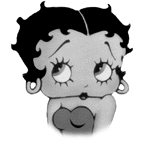
| Over 65 years ago, with a wink and a wiggle (and more than a flash of thigh) a spit-curled, squeaky-voiced siren called Betty Boop sashayed across the screen for the first time, captivating all who crossed her path. And she's still got legs today. This cheeky charmer, with her endearing wide-eyed innocence - and potent cartoon sensuality - remains a glamorous and pwerful Hollywood icon, setting a standard for the Marilyns and Madonnas that camer after her. From her earliest beginnings at the hands of famed animation pioneer Max Fleischer, right through her post-Hays Code career, this Jazz Baby's confident sexuality, vaudevillian shenanigans and above all, her irresistibly irrepressible "Boop-Oop-A-Doop," continue to enchant audiences on a variety of levels. |
| ORIGINS |
| A Boop Is Born |
| The beautiful Betty surprisingly began her career as a curvaceous canine cabaret singer in Dizzy Dishes, registered on August 9, 1930. According to Fleischer Studio animators, Betty was originally designed as a girlfriend for Bimbo the dog, modeled after a french poodle. At the hands of these Times Square-based animators, Betty achieved an unusual degree of realistic feminine motion, said to be patterned after the exaggerated strut of the area's "ladies of the evening." And though as many as five women did vocal chores for her early film appearances, the voice audiences most closely associated with Betty was supplied by Mae Questel from mid-1931 through the series' end. The 1932 short, Any Rags, marked her debut as a full human with the dog ears turning into her now trademark earrings and saw Bimbo in more of a supporting role as her constant companion. Audiences were crazy for the gutsy little gamine, and her star rose accordingly. Sassy and independent, Betty achieved the unique distinction of being the only female cartoon character who never served as a foil for a male. But as the Hays Office gained more influence over the "moral" content of filmed entertainment, a more prim Betty emerged. By 1934, Betty was showing far less leg and minimal cleavage. The lecherous suitors and racier situations vanished as well, leaving the lovable Grampy and her cute pet pooch Pudgy to propel the storylines, up through Betty's final appearance in 1939's Yip, Yip, Yippy. |
| THE CHARACTERS |
| Boop And Beyond |
| Betty had a cavalcade of co-stars to aid in her comic misadventures, one of which was Bimbo, a daring dog and Max Fleischer's answer to Disney's Mickey Mouse. But his solo starring days wer numbered with the emergence of the sexy siren. And though Betty became fully human by 1932, Bimbo remained in canine form throughout. Another of Betty's co-stars was Ko-Ko the Clown. The first star out of the Fleischer stable in the 1920s, Ko-Ko was the headliner in the early Out Of The Inkwell shorts. These early cartoons featured a bold inking style and storylines that had Ko-Ko emerging from Max Fleischer's inkwell and getting into some sort of mischief, before being driven back in. Betty also maintained a menagerie of talking animal pals including Stella Stork, Gus Gorilla, Harry Horse, Molly Mule, Dora Duck, Kasper Kangaroo, Ferdinand Frog, and more. But by 1934, these characters disappeared, and from then on, her only animal buddies were mute pets. Grampy, a wacky professor and inventor, and Pudgy, a per puppy dog, were her compainions and co-stars through the end of the series. Grampy, whose endless stream of crackpot inventions always landed Betty in one loopy adventure after another, was a favorite of the Fleischers because of their shared interest in all things mechanical. He appeared in over ten of Betty's cartoons. |
| STYLE & SUBSTANCE |
| The Fleischer Studios |
| Betty was a product of the pioneering Fleischer Studios. Run by Max Fleischer and his brothers, they were children of immigrant parents in serach of the American Dream, but faced with the sometimes harsh realities of life in New York City. From their perch atop Times Square, the Fleischer brothers' work reflected the gritty, edgy, urban world just outside their windows, earning them a reputation as the "Anti-Disneys." In the constantly "morphing" universe of the Fleischer cartoons, objects of all types lead vivid, aggressive lives of their own. Gags about poverty, death and electric chairs are juiced-up by loopy creatures, night frights and other surrealistic flights-of-fancy. In the words of Dave Fleischer, who directed most of the studio's product from 1929 to 1942, "If it can be done in real life, it isn't animation." The Fleischers' innovation extended even further. They infused their cartoons witha jazz sensibility, helping to popularize the new art form, and boosted the careers of such African American superstars as Cab Calloway and Louis Armstrong. Other live-action guest stars including Ethel Merman, Maurice Chevalier and Rudy Vallee appeared frequently. And the subject matter also set their cartoons apart, ranging from vaudevillian gag-driven laughfests, to downright macabre, surrealistic explorations of the nation's subconscious. Inventor as well an artist, Max Fleischer is responsible for a number of animation "firsts" that set the pace for an emerging industry. The "bouncing ball" sing-a-long cartoons was a Fleischer invention, as was the Rotoscope device, which provided a method for tracing live-action film to create the more fluid, sophisticated motion that characterized his studio. And perhaps most significantly, the Fleischer "Talkartoons" were among the first to use sound technology to enhance their characters' appeal. But as painstaking as the hard work of animation was, it was leavened by a sense of camaraderie that resulted in expressions of the animators' lusts and fantasies - not to mention loads of inside jokes and Yiddish references in the final product. Thus, buried inside each and every Fleischer Studios "Talkartoon" are tiny gems just waiting to be discovered by the watchful viewer, to be enjoyed time after time. |
| This Boopliography from an insert in Betty Boop: The Definitive Collection copyrighted by Republic Entertainment Inc. |
 |
| Betty Boop, Pudgy, Bimbo, Koko, and Gramps are owned by, copyrighted by, and licensed trademarks of KING FEATURES SYNDICATES, Inc. and FLEISCHER STUDIOS, Inc. |
|