The Breur low-cost 3/4inch Ram pump
La bomba hidr�ulica de Breur:
Cuando el agua puede correr hacia arriba.
Una bomba hidr�ulica es una bomba impulsada por agua corriente.
Dicha bomba utiliza la energ�a de una gran cantidad de agua que corre
desde una peque�a altura, para bombear una limitada (10%) cantidad de
agua
a una gran altura.
Existen muchos dise�os de bombas hidr�ulicas. En el a�o 1772 se hizo el
primer
dise�o te�rico por J. Whitehurst. En 1797 dicho dise�o lo perfeccion�
J.M. de Montgolfier y consigui� una patente.
A pesar de que se comercializo las bombas hidr�ulicas, y que
existen otros dise�os para que las personas mismas las
construyan, no se utilizan en gran escala, por los costos altos y la
instalaci�n complicada.
Por esta raz�n Gert Breur dise�o una bomba hidr�ulica (Breur-ram)
peque�a y
simple para el uso en terrenos peque�os. Esta bomba se construye de
piezas ya existentes en las ferreterias y por lo tanto es relativamente
econ�mica.
Breur baso su dise�o en los 10 principios del Prof. J. A.
Eytelwein. Por ejemplo que el tama�o de la v�lvula de impulso,
debe ser un poco m�s grande que el di�metro del tubo de
conducci�n; y la campana de aire debe ser un poco m�s grande
que el volumen del tuvo de subira del agua (opvoerleiding).
El rendimiento de la bomba hidr�ulica de Breur, es relativamente alto.
Esta bomba hidr�ulica se puede utilizar para el uso dom�stico,
como tambi�n para irrigaci�n o para peque�os abastecimientos de agua
potable para el ganado.
Para alcanzar grandes distancias o grandes alturas se puede hacer una
conexi�n entre varias bombas. Para llegar a varios lugares se
puede hacer una conexi�n en derivaci�n donde cada bomba
hidr�ulica tiene su tubo de desag�e propio, (afvoerleiding) y
un tubo de conducci�n com�n (aanvoerleiding). En este caso se
puede desconectar bombas cuando hay menos agua disponible o
cuando se debe hacer mantenimiento, sin paralizar todo el
sistema.
Funci�n
Aceleraci�n (+/- 900 millisecundos):
El agua corre por el tubo de conducci�n (drive pipe) y se escapa por la v�lvula vertical (impulse valve) abierta para tomar velocidad; cuando esta velocidad es bastante grande se cierra esta v�lvula;
Compresi�n (+/- 2 millisecundos) y entrega (Delivery) (+/- 50 millisecundos):
Por el cierre r�pido de la v�lvula se forma temporalmente una sobrepresi�n (waterhammer) que es m�s grande que la presi�n en el campana de aire. Por esta raz�n se abre la v�lvula horizontal (delivery valve). Cuando la presi�n en la campana de aire se vuelve m�s grande que en la bomba, se cierra la v�lvula.
Rebote (recoil) (+/- 50 millisecundos):
El agua que esta en el tuvo de conducci�n, choca contra la
v�lvula horizontal y se devuelve un poco en direcci�n del tuvo de
conducci�n. Por esta raz�n se crea una baja presi�n y por lo tanto
la v�lvula vertical se puede abrir de nuevo. En este momento
se chupa aire, por un orificio de 1 mm de di�metro situado cerca
a la v�lvula vertical. Este aire se transporta a la campana de
aire en el pr�ximo ciclo y as� retorna el aire que se
desaparecio en cada movimiento de la bomba.
Esto ultimo no es necesario, cuando se utiliza una campana de aire en un
espacio cerrado (contained air) como una llanta de bicicleta.
El aire comprimido en la campana de aire, al recuperar su
volumen original, empuja el agua en un chorro constante hasta su
objetivo.
Existen tres tipos de Breur-ram:
a) la bomba hidr�ulica Breur 3/4" es apta para uso dom�stico y
peque�a irrigaci�n y se puede utilizar perfectamente como
modelo educativo.
b) la bomba hidr�ulica Breur ROC Oost Nederland 1" Se utiliza
para peque�a irrigaci�n y es ideal para conecciones en
paralelo.
c) y la bomba hidr�ulica Breur ROC Oost Nederland 2" es
funcional para aprovisionar de agua a todo un pueblo.
Est�n disponibles del publico los dibujos t�cnicos de los modelos a y c.
For more info on Ram pumps, go to the WOT homepages: WOT - Working group on Development Technology.
Shopping List (soon in Spanish as well):
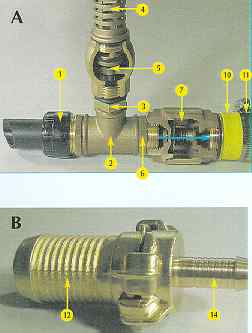
1. Clamp-connection SIMPLAST WISA 25 x 3/4inch thread
2. T-joint brass 3/4 inch inside thread
3. Brass reducing coupling 1 inch to 3/4 inch outside thread
4. Foot valve brass 1 inch inside thread (ball shape and used in reverse direction)
5. O-ring nitrilrubber 6.0 mm x 1.5 mm (to regulate pump frequency)
6. Brass reducing coupling 1 inch to 3/4 inch outside thread
7. Spring-loaded check valve brass 1 inch inside thread "EUROPA"
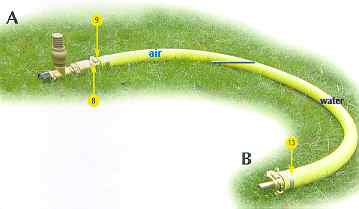
8. (optional) brass quick-connect coupling "GEKA" 1 inch outside thread
9. (optional) Hose quick-connect brass coupling "GEKA" 1 1/4 inch
8+9 may be replaced by brass converter from 1 inch thread to 1 1/4 inch hose coupling.
10. Pressure tube TRICOFLEX 1 1/4 inch x 150 cm (more than 10 bar)
11. Hose clamp "JUBILEE" stainless steel 30-40 mm
12. Hose quick-connect brass coupling "GEKA" 1 1/4 inch
13. Hose clamp "JUBILEE" stainless steel 30-40 mm
14. Hose quick-connect brass coupling "GEKA" 1/2 inch
Not numbered items: Enflontape 12 mm x 0.1 mm or fibre "WURTH" (like for central heating installations)
Further the drive-pipe is not specified, this is either a rigid (metal!) pipe or (easier and therefore preferred) tylene tube, also used in drinking water installations. The diameter must be at least as much as the ram, so 3/4 inch. The length is expected to be several meters, from water-supply to ram.
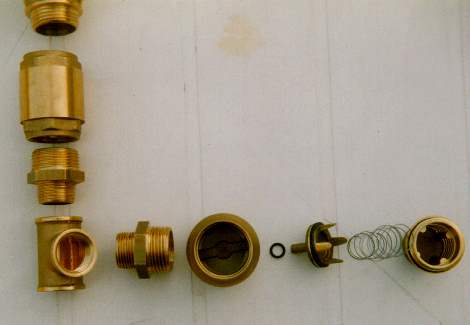
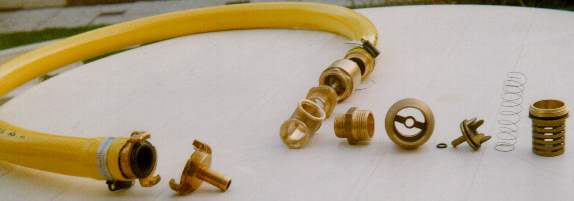
Considerations: If the water comes out the dilivery in sharp pulses, then there is no air in the thick pressure tube. Disconnect it and fill it with air, the ram will run more efficient and smooth.
The drive heigth should be at least half a meter, but the ram cannot pump up high in that case. No more than 10 meter supply is recommended, or the pressure might get too high when the delivery is blocked.
If the ram doesn't start when water runs through it or it doesn't seem to be very efficient, the O-ring on the stem of the waste valve might be changed (taken away or one more added). Another reason can be that the waste-valve must point upward, or you must spring-load it. Otherwise the valve doesn't open itself. Some experimenting is required to get the best operation.
Multiple rams might be connected parallel (each have its own drive pipe and a common delivery, connected at B) and this will increase both delivery and reliability. Also when the amount of input flow decreases (season), some rams can be shut down while still some water is delivered by the others. One big ram will completely stop. Another important factor: maintenance can be done one ram at a time.
WARNING! If the ram is used to pump more than 20 meters high, the thin delivery tube must also be able to withstand this pressure! Be careful when disconnecting the delivery output, because the full pressure is present even when the ram has stopped! Drain the delivery tube or make (add) a pressure release valve that can be opened safely.
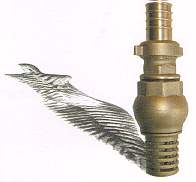
Pictures above can be downloaded as zipped bitmaps: ram.zip (warning: 1331 kB!)
Last update: July 26, 1999
Webmaster: Cor van de Water
