| Activity Title: |
Fractions, Fractions, Fractions Grade Level: 4 |
|
Rationale: |
Students will use and encounter fractions in their everyday lives. This lesson will reinforce the concept of equivalent fractions. It will allow students to comprehend that like fractions do not have the same names, but are still “equivalent.” |
|
Goals: |
Students will apply knowledge and number sense including numeration and operations. Students will also investigate, report, represent, and solve problems using number facts and their properties by solving one and two step problems involving fractions. |
|
Objective: |
Students will identify equivalent fractions at the symbolic level and explain the equivalence. |
|
Readiness/Pre-assessment: |
Students should know how to add, subtract, multiply, and divide. Also should understand the concept of “equal.” We have been working on these concepts since the beginning of the year, and I know most students have adequate skills in these areas. Students should have encountered fractional vocabulary in third and fourth grades. Their fractional encounters should also have been with the concepts of adding and subtracting fractions with like denominators. Plus they will have encountered the concept of fractions being parts of a whole. |
|
Materials and equipment needed: |
Fractions strips (attached). |
|
Introduction: |
Provide each child with fractions strips like those provided with this lesson. Begin this lesson by discussion what we as a class have learned so far about the concepts of 1/2, 1/4, 1/3 etc. Ask the class what it would mean to fold a piece of paper in half and demonstrate this concept with a fractions strip. Tell the class now we are on a discovery journey of what it would mean to divide the fractions strips into other parts and then we will discuss what patterns and concepts that we might notice along the way. |
|
Instruction: |
First, have students to divide into pairs or groups of four. Have each student take a fraction strip and divide it into half. Ask the children to discuss why this is one-half. Have them label the each side of the strip 1/2 or one-half which ever helps them to understand the concept the best. Then ask the students how you could take a strip and make it into four equal parts. See is the students can figure out that they would simply need to fold a strip into halves and then simply fold it again to create fourths. Continue with the lesson by having them fold it into thirds and see if they can recognize the patterns of 6ths, 12ths, etc. Let students continue with the strips and see what they discovery on their own. After they have folded their fractions strips continue with the discussion of what they notice about the 1/2 strips when they compare them to the 1/4 strips. This will allow the children to understand that two of the 1/4 are equivalent to one of the 1/2 strips. Have the children discuss what other equivalencies they notice with their fraction strips. Next, provide the manipulative that I have made for the class. Let the children compare this manipulative to the strips in which they have made. Ask various questions of what would the equivalent fraction be for 2/6 or 4/8 and see if they can demonstrate this with the class manipulative I've created. Be sure to use this manipulative throughout the equivalent fraction lesson in order to give the students two ways of looking at the lesson. |
|
Evaluation of Lesson: |
I will want to see if this lesson would stay within the time frame allotted for it. Did the students meet the objectives of understanding of dividing the strips into equal halves, thirds ? What questions did they ask? Did I answer knowledgeably so as they could understand? Did I give clear, concise demonstrations and directions? Did I have all the materials available? Did the way I had students participate work well or do I need to review this part of the lesson? Did the students grasp the understanding of equivalent parts of one fraction being the same as a different fraction (ex: 1/2 equivalent to 2-1/4’s)? |
|
Of students: |
I need to ask questions throughout to make sure the students understand the concepts of folding the strips into 1/2, 1/4, 1/3, etc. Next, I need to be sure that each student grasps the concept of the word equivalent and understanding that it does not necessarily mean “equal to.” Also, I need to evaluate that students do see how the fractions are equivalent and why. Do they understand that it is a concept of division (something they are familiar with)? I need to record all of their questions. I will also include some similar work in their journals and see if they can demonstrate this concept individually. If I see any problems with the demonstrating of this concept, I will further develop this lesson to extend it for their understanding through my individual math conferences each week. I will also assign a sheet of different squares that are divided up (see example below) and have the students color them into halves, fourths, sixths, etc. I want them to realize that it can be done whatever way they want as long as it is equivalent. 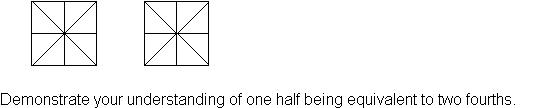 |
|
Individualization: |
Remediation: Have the student work with water or rice again to see if this will help with further conception of equivalent fractions. Seeing that it does actually take 2-1/4 cups to fill 1/2 of a cup will help with this realization of equivalency. . |
|
Enrichment: Have the students come up with plans to help students that are having trouble grasping this concept of equivalent fractions. Their ways of explaining the concept might be on the level needed for those students having difficulty. |
|
|
Special Needs: Make sure to work individually with these students. Also make sure groups include a peer that usually grasps new concepts quickly in order to help with demonstrating. Have the resource teacher give the student squares divided into halves, fourths, etc. and let the color in the shapes, then cut apart. This way they can place the fourths over the halves. This will demonstrate the fact that the fourths are equivalent to the halves. |
|
|
Self-Reflections: |
_____________________________________________________________________ _____________________________________________________________________ _____________________________________________________________________ _____________________________________________________________________ This section will be to reflect on how the lesson went with the students and if I would have any changes etc. the next I would use this lesson. |