








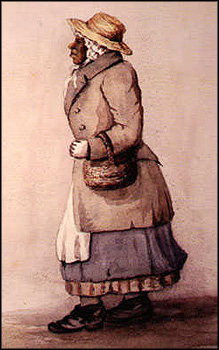
ROSE FORTUNE born into slavery in the Southern United States in 1774. She was owned by
the Devone family, but her family escaped to the Nova Scotia (Canada) town of Annapolis Royal
from New York City. Fortune's family were "Black Loyalists."
Black Loyalists were excaped slaves & free Blacks who joined the British army during the
American Revolution, not because they opposed the beliefs of the revolutionaries, but to find
liberty. The British army promised any slave freedom in return for their loyalty.
In the late 1700's she appointed herself policewoman of the Annapolis Royal, located on the
north shore of Nova Scotia. Although Fortune carried no badge, she had a unique way of dress.
Her dress was later adopted by many of the Black Pioneer women when they went to market.
Fortune died in 1864 at the age of 90. Her funeral was held at St. Luke's Anglican Church in
Annapolis Royal. It is presumed she is buried in the church's cemetary.
Today, Fortune is remembered through scholarships awarded by the Association of Black Law
Enforcers. One of Fortune's descendants, Dr. Daurene E. Lewis, became the first Black female
mayor when she was elected mayor of Annapolis Royal in 1984.

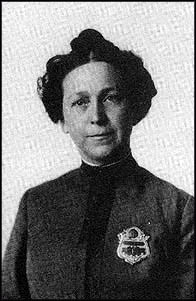
ALICE STEBBINS WELLS, a graduate theology student, & a social worker, joined the L.A.P.D.
as the nation's first sworn policewoman.She secured sinatures of many prominent citizens in
a petition to present to the City Council. She was officially appointed a police officer on 9-12-1910.
She was 1rst assigned to Leo Marden in juvenile probation, after being issued abooks for 1rst aid,
the rule's, a Gamewell key (a telephone call box), & a man's badge. Later she would be issued the very 1rst badge for a woman, ("Policewoman's Badge Number One.") She would later talior her
own uniformin a dark drab blue, & uniforms for more formal occasions.
She pioneered preventive protection principles concerning youth. Her duties included inforceing
laws in dance halls, skating rinks, penny arcades, movies & anyplace where women & children
attended recreational activities. Some of her other responsabilities included searching for missing
persons,discrminating billboard displays, & general information for women seeking advice w/in
the scope of her police duties.
In 1911. the position of women police in L.A. was placed under Civil Service control. By October
1912, there were 3 policewomen, & 3 police matrons in the department. Mrs. Wells prompted
nationwide publicity, & by 1916, her efforts in showing the need for female police officers resulted
in the hiring of policewomen in 16 other cities & in several foreign countries.
In 1915, Mrs. Wells founded the International Association of Women Police. Thru her course of
Law Enforcement career, she was named the 1rst president of the Women's Peace Officers
Association of California, (now known as UCLA), to offer the 1rst course specifically for the
training of females in Law Enforcement. The course was 1rst introduced in 1918 by the school's
Criminology Department for the summer session.
Mrs. Wells fought for the idea that women, as regular members of police departments, are well
qualified to perform protective & preventive work amoung juveniles & female criminals.
Our present day juvenile bureaus & crime prevention units can be directly traced back to the
foundations laid by her.By 1937, L.A. had moved female officers to the rank of 39 officers,
& 5 reserve officers.
Mrs. Wells toured the nation starting in 1915, promoting the hiring of women police officers. In 1934 she was appointed the historian of the L.A.P.D., by this time she had retired after serving for
30 years w/ the department in 1940. She had toured more than 100 cities in the U.S. & Canada,
promoting the belief that women could play a vital role in Law Enforcemnet. The results found
most cities hiring women to there departments, as New York & Maassachusetts went so far as
to enact policies requiring towns w/ populations in excess of 20,000 to employ at least 1 woman
in there department.
Mrs. Wells died in August of 1957, laying her to rest in Forest Lawn Memorial Park. Today her International Association Of Police Women reoranized & changed it's name to International
Association Of Women Police. She lived to see the changes & rebirth of the organization.
Before 1969, women were never issued a uniform or allowed to patrol. Through (IAWP) these
changed, along w/ the continued discrimanations of thte 1900's.

THE PRESENT & FUTURE
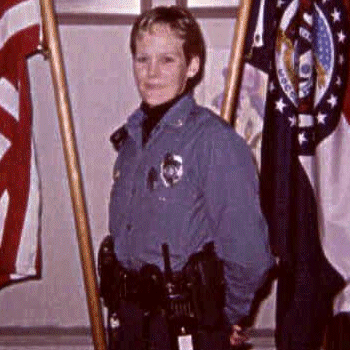
It has now been more then 2 centries since Rose Fortune declared she was a policewoman,
& the death of Mrs. Wells. Dureing that time women have proven time & time again that
we not only have the ability to perform the duties, but also the courage to be in Law
Enforcement.
From 1900 to 2000, the number of full-time sworn policewomen increased 2.5 percent,
according to preliminary numbers released in February by the Bureau of Justice Statistics
in Washington D.C. According to the Bureau, 10.6 percent of local police, or 46,000
officers were women as compared to 8.1 percent in 1990. Some municipalities report
numbers as high as 15.9 percent.
Women have made great strides in 200 years, but greater things lay ahead in the future.
In the road of life policewomen have only begun taking their 1rst steps, in which I am
thankful to Rose Fortune, & Alice Stebbins Wells for setting up the stepping stones for
women in Law Enforcement.