�Aerated Water and Cordial Manufacturers of Gundagai
By Micheal Baverstock
Part 1
1852-1882
NOTE - THE FOLLOWING CONTAINS SOME ERRORS
The first mention of aerated waters to be found in this district was in the Government Gazette dated 1st January 1852, when Dr. Nicholson described part of the boundary of his Mingay run, as being with Ginger Beer Shop Station. This was situated approximately 10 km north of Gundagai. There is still a creek by the name of Ginger Beer in that district.
Advertised in the Adelong Mining Journal on the 20th November 1858 was a cordial maker named W Tindall, who relocated his Gundagai business to Adelong.
From inconclusive information gained from the Wynyard Times I believe that Jacob Myers, Cordial Manufacturer of Tumut, also had factories in Gundagai and Adelong during the 1863 - 1864 period.
By December 1868, Mr. F Hanson, lemonade and soda water manufacturer had set up a factory in Gundagai. In the Gundagai Times dated December 11th 1869, Mr. Hanson advertised for a steady man to work at his lemonade factory. He was still operating this factory in 1870, but was out of business by 1872.
In November 1869 Augustus Jeremias had imported from Victoria a machine for making aerated drinks. By the beginning of December 1869, he advertised that the machine made lemonade, soda and tonic waters at the usual price. I assume that before this, he was hand making these products. Jeremias was selling his beverages for two shillings a dozen in February 1870.
Augustus Jeremias was born on 25th May 1832 at Dresden, Germany. He came to New South Wales in 1853. He married Janet Millar Marshall at Pyrmont, Sydney on 4th June 1863.
Jeremias later tried his hands at various occupations, one being bee keeping, in which he was involved for many years. His honey was well known in the district. Augustus was a known carpenter and sold his furniture in a shop that he owned. He also rented out several houses.
During April, 1873, Augustus Jeremias disposed of his machine for making aerated waters to Myers and Emley for L74(74 pounds). The payment was made in two installments, the first on 4th December 1873 and the next on 4th March 1874. Myers and Emley did not buy the factory or the land.
Mr. T H Fairey, a cordial manufacturer of the Royal Hotel, Gundagai was advertising in October, 1872 for empty bottles (wine, ale or spirit) and was willing to pay one shilling a dozen.
Myers and Emley in September 1873 commenced the manufacture of their effervescent drinks. On the 30th September 1873, Mr. Emley, whilst delivering beverages to the Miner�s Arms Hotel, Spring Flat, found out what can happen when bottles touch. When passing a crate of soda water through the trap door to Mrs. Bourke, two bottles came in contact with each other and exploded. A piece of glass inflicted a severe wound to Mr. Emley�s right temple.
Mr. Emley had another mishap in December 1873. On returning from Spring Flat, he reached the top of the hill, driving his spring cart, when the haim strap broke and the horse bolted. The wheel of the vehicle came into contact with a log and capsized the cart. The horse plunged itself free and headed for home. Mr. Emley was not hurt when he came into contact with the ground, but the same could not be said for the bottles of cool drink.
In the middle of March 1874, Eaton and Lincoln (William Seymour Eaton and Samuel S Lincoln) of Wagga Wagga purchased the factory from Myers and Emley. Mr. T J Webster managed this factory.
Eaton and Lincoln in October 1874 acquired a new machine for the commodious and conveniently fitted out new factory, as the old machine was found inadequate to supply the demand of beverages. This new machine was to be worked by horsepower. During October they were able to start supplying cordials and liquors.
Some time in July 1875 Eaton and Lincoln had sold out to Collins and Belford. Collins and Belford made a complete change to this factory, as it was thought to be incomplete. The business was called the Gundagai Mineral Water and Cordial Works. Mr. Crozier was the aerated water manufacturer in charge of the factory. Some of their products were quinine wine, raspberry balm, lime juice cordial and seltzer water.
During March 1876, Patrick Kenny and Robert Dear of Adelong acquired the building nest to the Royal Hotel, Sheridan Street Gundagai. They shipped new machinery from Melbourne, for their branch cordial and aerated water factory. Called the Vice Regal Aerated Water Factory. They employed a practical man with many years service within Schweppes�, Sodawater Factory, Derby, England.
By the end of 1877 Thomas Belford was in business by himself. On the 4th January 1878, he advertised his factory in the local paper as there had been reports circulated trying to injure his business. He employed an aerated water and cordial manufacturer, with many years metropolitan experience. Thomas� brother, William, and a lad by the name of John Alt, were both, also employed by him.
Belford came to Australia in 1872 for mining purposes. He lived in the Ovens district for some years, and then moved to Adelong, before settling in Gundagai. Belford was also known to have been in Queensland at some stage.
Mr. Belford was well known by June 1878, for his very refreshing ginger ale. On 13th January, 1880, due to atmospheric pressures, Mr. Belfords factory became dangerous, as corks were flying and bottles were bursting.
Thomas Belford was known as a keen fisherman. One of his other interests was running. In February, 1879, he had a three-event contest with Mr. M T Canty. The events were 100-yard, 150-yard and 200 yard sprints. Mr. Belford won and received L5 (five pound) from Mr. Canty as per their bet.
In mid July 1880 Thomas Belford advertised by tender for the pulling down and rebuilding of a slab stable, and also for covering the factory with iron.
During May 1881 he again advertised by tender, this time for the sinking of an underground tank, 12 x 14 feet in the clear, with pump, contractor to find all materials; clay sinking, no rock.
On Tuesday, February 14, 1882 Thomas Belford, while driving his cart home from doing his normal South Gundagai deliveries, capsized his cart and was killed. Mr. Belford left for South Gundagai at 9.30am for the purpose of delivering goods to four hotels. John Alt accompanied him.
The first point of call was at Mrs. Deighton�s Royal Oak Hotel, where he stayed about half an hour then it was off to George Woodbridge�s Eagle Hotel, here he was known to be drinking brandy and soda with George Woodbridge. They then moved to John Potter�s Junction Hotel. Thomas ordered a dark brandy and soda, on tasting and realising it was rum, he threw the drink to the floor. Mary then served him a pale brandy and had a ginger ale herself.
On the way back into South Gundagai, they again stopped at the Eagle, this time to pick up the empty bottles. The last point of call in South Gundagai was William Fuller�s bridge Hotel. While here Thomas Belford drank Three Star brandy and soda with Joseph Webb. William Fuller and his wife both had tonic water.
At about half past one Belford and Alt headed for home, across the river and back towards Gundagai, with Belford at the reins. On crossing a blind creek (Morley�s Creek), he misjudged the cutting and the cart tipped over and landed on him. John Alt jumped clear and was not hurt. Thomas died about half an hour later at Jeramiah Leary�s Criterion Hotel under the observation of Dr. Marshall.
An inquest was held into his death and the coroner gave the verdict of accidental death.
Thomas was given a full Masonic burial.
The four publicans were all charged with supplying liquor to a person in a state of intoxication. Only William Fuller was found guilty, he was fined L2 5/- (two pound, five shillings) with L1 3/- 6d (one pound, three shillings and sixpence) witness expenses and L1 11/- 6d (one pound, eleven shillings and sixpence) professional costs.
After Thomas Belford�s death, his wife Ellen carried on The Steam Mineral Water Works, Gundagai. John Alt was still employed by her.
On the 19th September 1882 William Belford, took his sister-in-law to court for unpaid wages amounting to, L103 6/- 6d (one hundred and three pond, six shillings and sixpence). The verdict was given toward William for the sum of L68 (sixty-eight pound), of which L48 (forty-eight pound) was paid in court.
Many other companies were known to have sold their aerated water products in Gundagai, including:
� Tweedie and Burgoin, Adelong, 1868 (Henry Tweedie and Alphonse Burgoin)
� Tweedie and Co., Adelong, 1869
� E Brown, Parramatta, 1869, operating from fry�s Gundagai Hotel
� Tweedie and Kenny, Adelong, 1872
� Schweppes, 1873, operating from Fry�s Hotel
� Kenny and Webster, Adelong, 1874 (Joesph Webster)
� Kenny and dear, Adelong, 1874
I do not know of any bottles that exist from the above factories, including the Gundagai factories, excepting Schweppes.
Other known Aerated Water and Cordial manufacturers of Gundagai to be covered in part 2 are:
� William Belford and James Menzies 1882
� John Alt, Cordial manufacturer, 1885
� James Menzies, Excelsior Aerated Water and Cordial Manufactory, 1890�s
� Charles McCabe
� Charles Goodsall
� R G Thomas
� W G Brannock
� T S Bell
� J T Jones
No bottles are known from William Belford, John Alt or James Menzies either
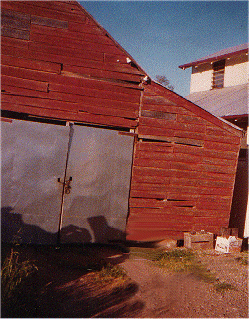
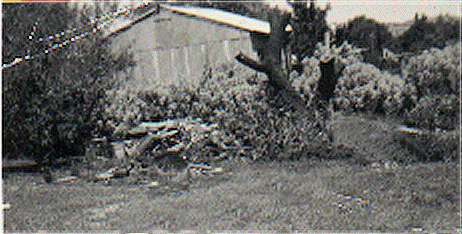
(Photos and information courtesy of J. Jones - daughter of J.T. Jones)
The coloured one shows the 1885 McCabes. To the left you can see the 1910 two story cement rendered extension that included the making and syrup rooms. In front of this facing the same direction as the 1885 section, was a long steel framed fibro building built in 1953 where the bottle washer, dirty and clean bottles etc and office were. The large door in the 1885 building was put in in 1954 so that the delivery truck could reverse in. Before that there was a small door there. In the left front of this building was a label room. Behind that was the old wooden bottle washing trough that was still used to wash the dirtier bottles before they went in on the machine. The rest of the area was where the made drinks were stored. Across the back inside of the building was a cement florr with the other floor areas being timber. This cement floor had machinery bolts in it so was where the old machines were. The wide back door p
ossibly contained a treadmill operated by horsepower. This factory was probably Belfors etc as well as McCabes. The old wooden bit was a bit shabby but the other two buildings were quite smart.
The black and white photo is of Brannocks, (in my back yard), taken from next door. You can see the old wormwood hedge, (absinthe). This building was just a large (purpose built), barn like, iron clad, timber framed shed with a cement floor which again had machinery bolts in the floor and a wide covered doorway possibly for a horse, near where the machinery stood.