Many breeders selected the Redbone because of it's solid red, vibrant coloring. Today, many breeders not only select these dogs for their color but also for performance. Redbones are also known to be excellant swimmers and are known for their agility in lowlands and rocky terrains.
Their barks are generally clear or have a steady clear chop and with a changeover when treeing. Walkers are competitive because of its speed but may leave an original track when picking up a stronger scent.
Traditionally, Plotts were used to track, or tree big game such as bear, boar, and mountain lion. Many are still used for that purpose in addition to coon hunting. Plotts are aggressive trailers and are good on rocky terrain.
Blueticks are known to be long, hard, intelligent treers. They are able to stay on difficult tracks with a steady chop running voice and a steady course choppy one at the tree.
They are known to be determined hunters and to stay on a trail no matter how faint the scent or how bad the hunting conditions. Black and tan coonhounds are also known to be a friendly and loyal dog.
Today's American English are swift, competitive, and hot-trailing dogs. They possess tremendous speed and a strong voice.
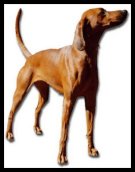 Redbone
Red Irish Foxhounds were originally brought to America by Scottish immigrants in the late 1700's. By the late 18th century hunters wanted to breed faster dogs for locating and treeing reccoons. By using hot-nosed Irish hounds for breeding purposes the Redbone Coonhound was eventually recognized as a well-respected breed before 1900.
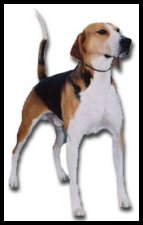 Treeing
Walker Coonhound
Treeing
Walker Coonhound
Treeing Walkers were developed from the Walker Foxhound. These dogs were descendents of English Foxhounds that were brought to America. Walkers are known to be fast and sensible hunters.
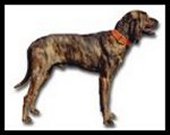 Plott
Plott
In Germany, the Hanoverian Schweisshund is a respected bloodhound known for its ability to locate wounded animals even after the trail is a week or more old. In 1750, two brothers left Germany and immigrated to America. They brought three brindal and two Hanoverian Hounds. One brother died on the way but the other, sixteen year old Johannes George Plott, settled in North Carolina. He settled, raised a family, and bred the dogs. Over the next 200 years, seven generations of Plotts, the mean bred the dogs and hunted bear and boar. Soon other mountain families bred the dogs using the Plott family name.
Looking for a better breed of Plott a Plott breeder by the name of Gola Ferguson choose another respected family hound, a tan, black saddled Blevins, and bred the two. The Plotts breed was revitalized. Members of the Plott family even used these dogs in their breeding program causing some brindle Plott hounds have a black saddle.
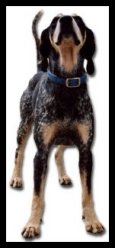 Bluetick
It is believed that the modern Bluetick is a descendent of the Grand Bleu de Gascogne (French Staghound) and English Foxhounds. It has also been recorded that George Washington owned one of these dogs and enjoyed their "musical singing." They were originally classified as English Coonhounds until Bluetick breeders broke away from English breeders in 1945. Breeders were proud of their larger breed and wanted to maintain their hunting style even if it produced a slower dog. Hence, the break between breeders.
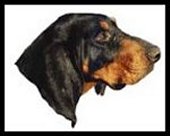 Black and Tan
The Black and Tan Coonhound is believed to have descended from the St. Hubert Hound. The Black and Tan Coonhound evolved from excellent trailing and cold-nosed Foxhounds with treeing instinct, with black and tan color pattern.
Originally owned by scouts and Indian fighters in the late 1700s, Black and Tans were the first coonhound to be considered a separate breed from the American Foxhound. They were recognized by the AKC in 1945.
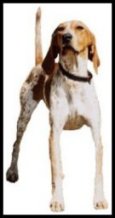 American English
The American English Coonhound evolved when descendants of English Foxhounds, also known as Virginia hounds, were bred to adapt to rough terrain. They were originally named the English Fox and Coonhound due to their ability to hunt fox by day and coon at night.