|
Before the arrival of European settlers, the Koori people (white settlers called them "Aboriginals") and Torres Strait Islander peoples inhabited most areas of the Australian continent, each speaking one or more of hundreds of separate languages, with distinct lifestyles and religious and cultural traditions in different regions. Adaptable and creative, with simple but highly efficient technology, Indigenous Australians had complex social systems and highly developed traditions reflecting their deep connection with the land and the environment. Their Dream-time is incredible and passed from generation to generation - that's how their heritage is still alive today.
Sparsely populated Australia is the only country on the planet which occupies an entire continent. Most of the 19 million Australians live near the coast and about 40% of the country live in Sydney (3.8 million) and Melbourne (3.3 million).
In 1770, British Captain James Cook claimed the entire continent for the British Empire and continued on his fated journey. The independence of the thirteen American colonies led the British to begin colonizing the Australia in 1788 as a penal colony (the American colony of Georgia had previously served that purpose for England). Transportation of prisoners ended in 1868. Australia is the second-driest continent in the world - Antarctica's the driest.
Australia is approximately the size of the 48 continental United States. With temperatures ranging from above 50°C (120 F) to well below zero, there are many extremes of temperature and climate throughout Australia from floods, cyclones and severe storms to the extreme hot weather and bushfires. Summer (December to February) can get uncomfortably hot just about anywhere, even sometimes in Tasmania. If you're in the southern states during these months it's great beach weather. Up north, this is the wet season, when it's very, very humid and when the sea is swarming with box jellyfish. On the upside, the Top End is beautifully green and free of tourists at this time. Some Aussie Facts
Country- Commonwealth of Australia Australia in area, it ranks as the sixth largest country and the smallest continent. Lying between the Indian and Pacific oceans south- east of Asia and forming, with the nearby island of Tasmania, the Commonwealth of Australia. Australia is often referred to as being "down under" or "southern land" because it lies entirely within the Southern Hemisphere. The name Australia comes from the Latin word "australis", meaning southern. The Commonwealth of Australia is made up of six states - New South Wales, Victoria, South Australia, Tasmania, Western Australia, and Queensland - and two territories - Northern Territory and the Australian Capital Territory. It measures about 4,000km (2,485 miles) from east to west and 3,700km (2,300 miles) from north to south, with a coastline extending 36,735km (22,826 miles) long. Over 75% of the continent is generally referred to as "the outback". Australian seasons are the opposites of those in Europe and North America. It's hot in December, and midwinter in July and August. Summer is (December, January, February), Autumn (March, April, May), Winter (June, July, August), and Spring (September, October, November). ~~~
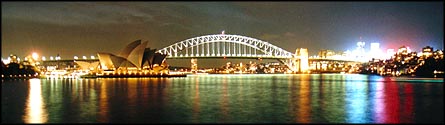
Sydney's hosting of the 2000 Olympic Games allowed the entire country to bask in the world spotlight. It certainly showed the world what an exciting, civilised, fun-loving and friendly place to be. A special moment in the history of the Commonwealth of AUSTRALIA and were declared by IOC head Juan Antonio Samaranch the best Games ever!! Info.@ Year 2000.
The "Crocodile Hunter" - Steve Irwin. Come visit
Don't forget to visit my Kitchen for some Aussie Recipes.... Graphics from aussie images. Visit Virtual Australia to learn more about our culture, language, etc..... Or Visit New South Wales and see what our country has to offer you ! More wonderful sites to visit are The Great Outdoors and Postcards. Or read more at Lonely Planet.
E-mail me with any questions or requests and I'll see what I can do..... Any time is a good time to be in Australia !
|



 ~~~
~~~  ~~~
~~~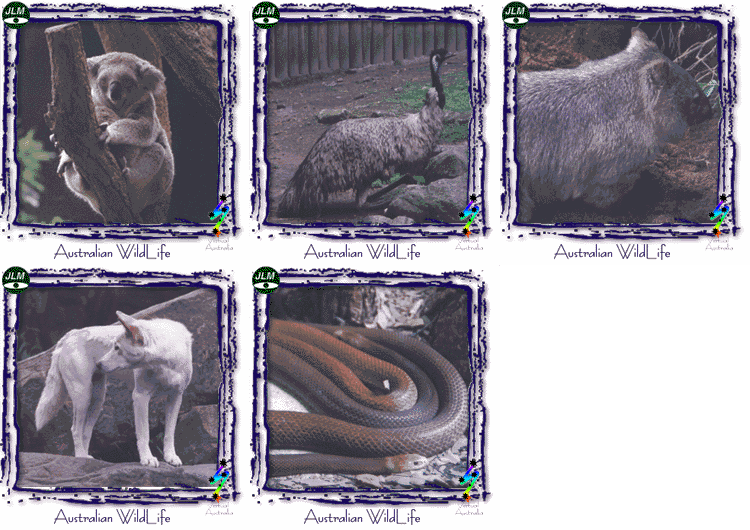 Some of our native animals include: Cockatoo, Crocodile (saltwater), Dingo, Echidna, Emu, Frilled Necked Lizard, Kangaroo, Koala, Kookaburra, Platypus, Possum and Wombat....