
|
|

 |
The Asian Arowana or better known as the 'Dragon Fish', has been regarded as one of the Kings in Aquatic World due its immense popularity, value and great looks. The unique shape, large mouth and scales, and air of mystery have made Asian Arowanas so special that they have stolen the heart of many hobbyists. With its close resemblance to the China Ancient Dragon, many Chinese all over the world believed that 'Dragon Fish' symbolizes luck, wealth, prosperity and strength. There are mainly 4 major different types of Arowanas:
Cross Back Golden Arowana There are several names for it, some calls it Cross Back Golden, Malayan Bonytongue, Taiping Golden, Electric Blue Golden and the Malaysian Gold. These are basically referring to the same type of fish - the Golden Arowana. It will have golden color completely crossing its back when the fish is matures. The main reason for so many terminologies is because Cross Back Golden Arowanas can be found in various parts of Malaysia such as Perak, Trengganu, Bukit Merah Lake and Johor. 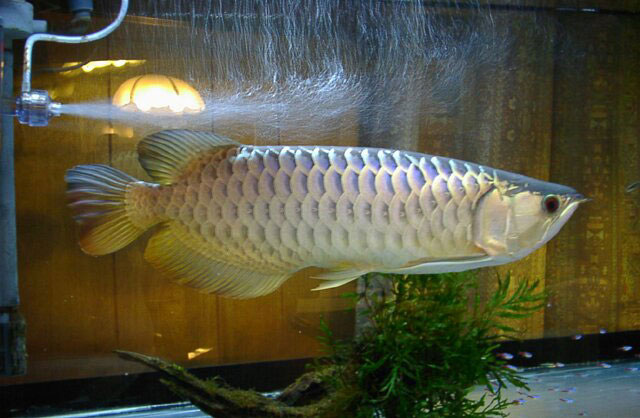 Due to its relatively low supply and great demand in the market, it is currently one of the most expensive Asian Arowanas. The main reason for it high price is due to its scarcity as well as lesser number of successful spawn. Currently, only Malaysia and Singapore farms are breeding the Malaysian Golden. Cross Back Golden is further classified into Blue-Based, Purple-Based, Gold-Based, Green-Based and the Silver-Based types, implying the core color of the scales. The terms Blue-Based and Purple-Based are being used interchangeably by some breeders since this Cross Backs Purple Core when viewed at an angle but appears totally blue at another. Gold-Based is one of the Cross Back with a flourish golden color at its scales right to the core of the scales instead of one that is blue or purplish in colors. The Golden-Based variety seems to have color crossing its back earlier than the rest. This is one type of Arowanas that is most stunning to look at since a mature fish is able to achieve the much dreamed about 24K gold color which other golden varieties are incapable of! Just imagine 2 footer Arowana, fully wrapped with golden scales swimming majestically, making occasional turns with ease and confidence to show that is it indeed the King of Aquarium. Of course, there are also the exotic Green-based and Silver-Based types which have green and silvery cores on its scales respectively. |
|||||
| Super Red (Red Arowana) | ||||||
|
This is the red colored type of Asian Arowana. It originated from various parts of Western Kalimantan province in Indonesia. The most famous waters are the River Kapuas and LakeSentarum where the Super Reds (Chili and Blood Red) are from. It is also one of the more popular fish among Asian Arowanas, largely because of their auspicious color and more affordable prices as compared to Cross Back Golden. Furthermore, with its full red fins even when young and red lips and barbells, no hobbyists will be able to resist the temptation to own one of them. When approaching adult size, these red colors will also start to appear on the other part of the body like the gill plates and edges of the scales, making the whole fish red in color. |
||||||
| ||||||
| Red Tail Golden Arowana | ||||||
| ||||||
| Green Arowana | ||||||
 The Green Arowana is another type of Asian Arowana. It is commonly found in Thailand, Malaysia, Myanmar, Indonesia and Cambodia etc. Due to its wide dispersion in the region, there can be differences in its appearance and color. Most of the Green Arowana found here has a grayish green body with a dark striped grayed green tail. Shape of this variety is a big difference as compared to other varieties with its head or mouth portion being larger and rounder. It is one of the cheapest types of Asian Arowana, apart from Yellow Tail. However, one particular type of Greens (those with a dark purplish core) are as exotic as any other varieties. The Green Arowana, together with 1.5 or 2 Grade Reds, is popular among countries like Thailand and Philippines because of its low price. Beside this, many Japanese students also find it more affordable to own them for the purpose of admiring the beauty and for experimental breeding of these exotic fish. | ||||||
| Australian Arowana
There are commonly 3 varieties of Australia Arowanas: Pearl, Spotted and Red. Australia Pearl Arowana is Quite a beautiful Arowana and it is quite similar to the Asian Arowana. Except that the Australia Pearl Arowana have a smaller and more scales with red spots. Asian Arowana has 5 rows (horizontially) of scales whereas the Australis Pearl has 7 rows or scales. The color range from coppery-gold to gold color. The Pearl Arowana have cresent-shape colored scales and the tail are usually black color with small gold spots. It is normal to see the Arowana gulping at the surface. The Australia Arowana are known to be very aggressive than any other Arowana. It is not a protected species. |
||||||
| ||||||
| South American Arowana
Silver Arowana 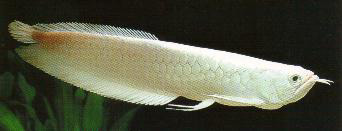 Silver Arowana come from the South America's Amazon River. It is quite similar to the Black Arowana having the same tapered tail. Its scales and fins are silver. It is not a protected species. There are extremely rare Red-tail Silver Arowana and Snow Silver Arowana. It is not a protected species. Silver Arowana can grow to about 47 inches which is the longest Arowana of all. The silver Arowana is said to have a very large appetite and also known to be the most gentle of all Arowanas. |
||||||
| Black Arowana | ||||||
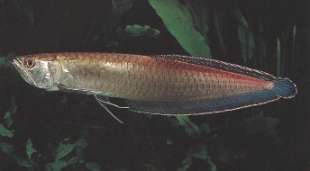 Black Arowana comes from the South America. When the Black Arowana is young, its scales and fins are black with whitish to yellow strips. But as it matures, the Black Arowana will slowly lose its color and turn to grayish color. A Black Arowana can grow up to 40 inches if possible. It is not a protected species. |
||||||
African Arowana
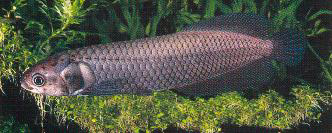 African Arowana originated from Africa and it is the most common Arowana available. The African Arowana has a rounded head with smoother and rounded jaws. The scales and its caudal fin (tail) are smaller, similar to that of the Silver or Black Arowana. it is a filter fish which eat mainly plankton, algae and even small fishes. When keep in aquarium, the African Arowana will eat shrimps, fish pellets, bloodworms and other tiny feeder fish. However, when fully grown, it look more like a Catfish than an Arowana. It is not a protected species. |
||||||
| Back to top |

