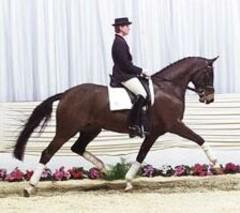
"In common with so many other horse-breeding enterprises, the developement of the Hanoverian at Celle was adversely affected by war. By the end of the eighteenth century the stud had over 100 stallions, but by 1916, after the Napoleonic wars, a mere thirty remained. To help make up for these losses, more outside blood was brought in, especialy Thoroughbred. But the time came when the breed was tending to become to light for the work required of it and this influence was accordingly reduced.
After world war II, however, the Hanoverian had to be adapted to a new way of life if the breed was to survive and Thoroughbred blood was again introduced, along with Trakehner, to produce a warmblood suited to the demands of the leisure-horse market.
The modern Hanoverian is lighter and less coarse that of old and is noted for its good, honest temperament. In common with other German warmbloods, stallions are only licenced if they pass the required veterinary inspection and, after licensing, must pass ridden performance tests. Hanoverians are among the world's most sought-after sports horses, their strength and athlectcism making them especialy suitable for dressage and show jumping. |