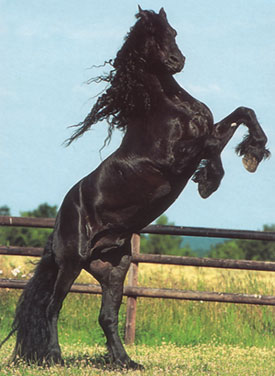
" The Friesian is ine of Europe's oldest horses and down the centuries it has had an influence on a number of other breeds, notably the Oldenburg in Germany and Britain's Fell and Dales ponies. The breed's homeland is Friensland, in teh north on the Netherlands. The remains of an ancient coldbood type of heavy horse have been unearthed there, from wihich the modern Friesian is beleaved to be descended. Eastern blood, introduced into the Netherlands during the time of the crusades, had an influence on the developement of the Friesian, as did the Andalusian during the Eighty years'war, when the Netherlands were occupied by the Spanish. The friesian horses which thuus developed was an active all-rounder, suitable for work on the land but, because of its ability to trot at speed, also useful as a harness horse and for riding.
During the Nineteenth century, wen trotting became extremely popular, breeders sought to improve the Friesian's already active, high-stepping trot, by outcrossing to trotters. This led to the Friesian becoming lighter in build and less useful as farm horse. By the beginning of World War I its number were seriously depleted and the decline continued between the wars. However, lack of fuel during Wold War II led to a revival in the breed's fortunes as farmers once again turned it for draught work.
During the second Half of this century there has been a resurgence of interest in the breed and it is now very popular as a cariage horse. A well-balanced horse with proud bearing, the Friesian looks exeptionally attractive when pulling a traitional High-wheeled Friesian gig. The Breed is noted for its kind temparament." |