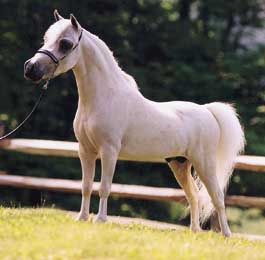
"The Falabella Developed during the 19th century in Argentina. The breed takes its name from the Falabella family, who spent years establishing the breed at ther ranch outside Buenos Aires. Althought the Falabella family developed the breed, the initial idea of producing a miniature horse came from an Irish man living in Argentina, Patrick Newtall. He spent years forming a herd of small "horses" tha stand under 9hh, and he passed his knowledge and expertise to his son-in-law, Juan Falabella, in 1879. This was the begining of the Falabella which was produced by crossing shetland ponies with the herd established by Newtall. There were then further infusion by a very small English Thoroughbred and a small Criollo. To keep reducing the size of the Falabella, the smallest and best of the progeny were repeatedly inbred until the average size was below 30 inshes at the withers. There is interestingly, a degree of spanish blood in the Falabella, since Newtall's original herd would have been largely founded on small Spanish horses, and then the later infusion of Criollo would have added to this.
"The original intention were to produce a tiny, miniature horse and not a small pony. It is hard to tell quite what the perceived function for developing this breed was, when considering how tiny and inbred they are. However, the Falabella is extremely strong for its size and has been used in a light harness capacity, and has been ridden by small children. The conformation of the breed, with its straight shoulder and tiny size, does not put it among the great ranks of children's ponies. They do have very good temperaments, are intelligent and friendly, and perhaps ther best role is as an ornamental and unique pet." |