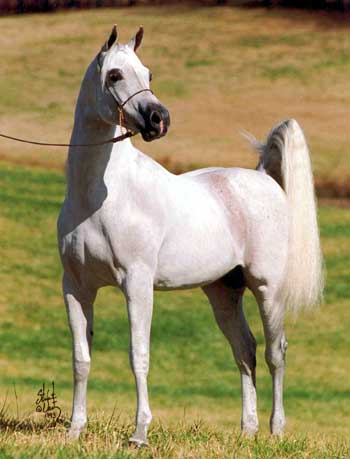
| " The oldest and purest of all horse breeds, the arab is considered by many people to be the most beautyful equine animal in the world. With its refined head and dished profile, expressive eyes, high spirit and unique, floating action, it is undoubtedly one of the most exquisite of creatures. Although it has certainly been bred with great care for many centuries, its exact origines are unclear. Depiction of horse in ancient art suggest that horses of arab type lived in the Arabian peninsula as long ago as 2,000-3,000BC. Like the desert tribes with whom they have lived for so long, Arab horses became superbly well adapted to life in a harsh environment, having extreme powers of endurance, tremendus soundness and the ability to thrive on the most meagre of rations. More than any other horse, it is the Arab witch has influenced the devlopement of equine breeds troughout the world. Pure-bred Arabian horses are now bred troughout the world. As well as appearing in the show ring, they are particularly suited to the sport of endurance riding witch at the top level involves covering a distance of 100 miles (161km) in a day!" |