| Criscione, |
C. D., C. L. L. Valentim, H. Hirai, P. T. LoVerde, T. J. C. Anderson. 2009. Genomic linkage map of the human blood fluke Schistosoma mansoni. Genome Biology (in press).
|
| Valentim, |
C. L. L., P. T. LoVerde, T. J. C. Anderson, C. D. Criscione. 2009. Efficient genotyping of Schistosoma mansoni miracidia following whole genome amplification. Molecular and Biochemical Parasitology 166:81-84..
|
| Criscione, |
C. D. 2008. Parasite co-structure: broad and local scale approaches. Parasite 15:439-443 (Invited Review).
|
| Criscione, |
C. D., J. D. Anderson, D. Sudimack, W. Peng, B. Jha, S. Williams-Blangero, and T. J. C. Anderson. 2007. Disentangling hybridization and host colonization in parasitic roundworms of humans and pigs. Proceedings of the Royal Society B 274:2669-2677. (supplementary material)
|
| Criscione, |
C. D., J. D. Anderson, K. Raby, D. Sudimack, J. Subedi , D. R. Rai, R. P. Upadhayay, B. Jha, S. Williams-Blangero, and T. J. C. Anderson. 2007. Microsatellite markers for the human nematode parasite Ascaris lumbricoides: Development and assessment of utility. Journal of Parasitology 93:704-708.
|
| Criscione, |
C. D., and M. S. Blouin. 2007. Parasite phylogeographical congruence with salmon host evolutionarily significant units: implications for salmon conservation. Molecular Ecology 16:993-1005. (supplementary material)
|
| Criscione, |
C. D., and M. S. Blouin. 2006. Minimal selfing, few clones, and no among-host genetic structure in a hermaphroditic parasite with asexual larval propagation. Evolution 60:553-562. (supplementary table)
|
| Criscione, |
C. D., B. Cooper, and M. S. Blouin. 2006. Parasite genotypes identify source populations of migratory fish more accurately than fish genotypes. Ecology 87:823-828. (see news releases about this publication)
|
| Vilas, |
R., C. D. Criscione, E. Paniagua, and M. S. Blouin. 2006. Microsatellite loci from the trematode Lecithochirium fusiforme, a parasite of the European conger eel. Molecular Ecology Notes 6:1064-1066. |
| Criscione, |
C. D., R. Poulin, and M. S. Blouin. 2005. Molecular ecology of parasites: elucidating ecological and microevolutionary processes. Molecular Ecology 14:2247-2257 (Invited Review).
|
| Criscione, |
C. D., and M. S. Blouin. 2005. Effective sizes of macroparasite populations: a conceptual model. Trends in Parasitology 21:212-217.
|
| Vilas, |
R., C. D. Criscione, and M. S. Blouin. 2005. A comparison between mitochondrial DNA and the ribosomal internal transcribed regions in prospecting for cryptic species of platyhelminth parasites. Parasitology 131:839-846. |
| Criscione, |
C. D., and M. S. Blouin. 2005. Eleven polymorphic microsatellite loci for the salmonid trematode Plagioporus shawi. Molecular Ecology Notes 5:562-564.
|
| Criscione, |
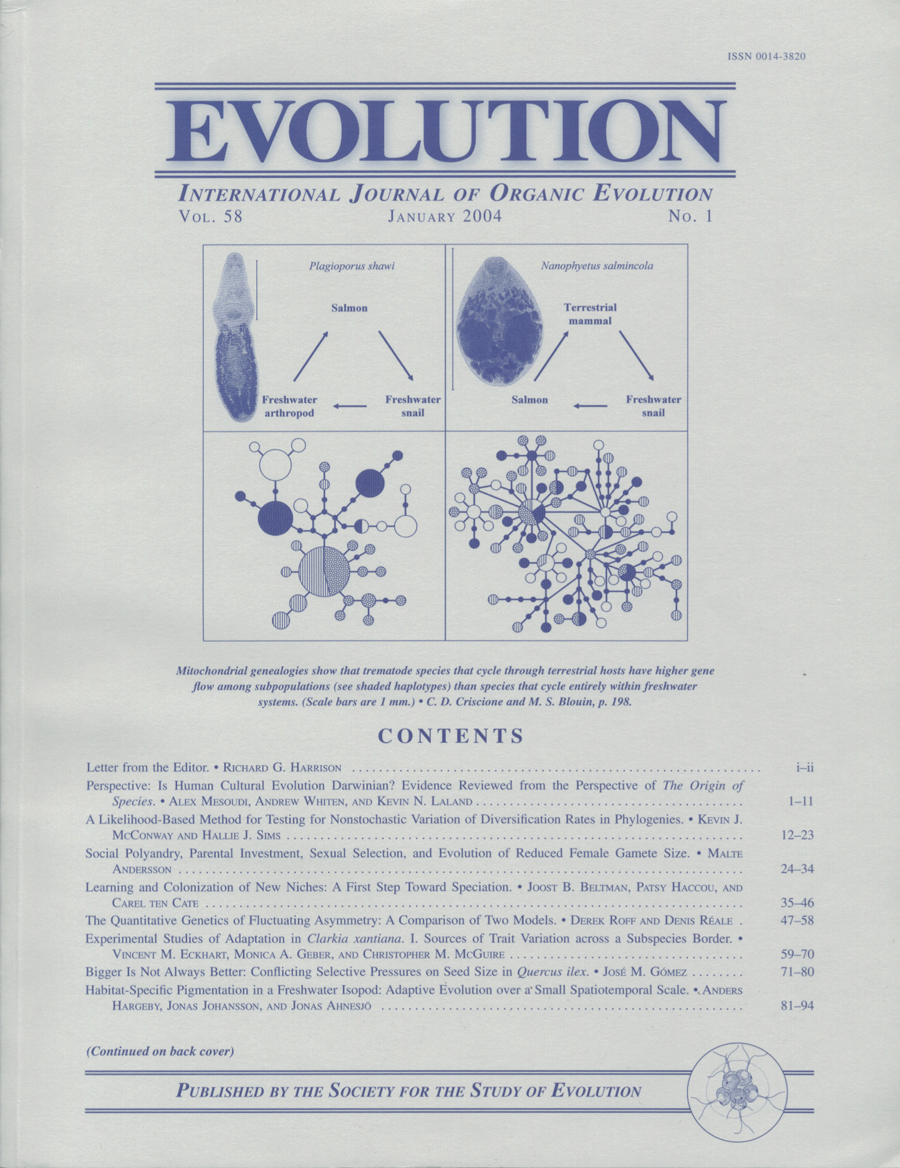
C. D., and M. S. Blouin. 2004. Life cycles shape parasite evolution: comparative population genetics of salmon trematodes. Evolution 58:198-202. (cover illustration we made for this issue)
|
| Kent, |
M. L., V. Watral, C. M. Whipps, M. E. Cunningham, C. D. Criscione, J. R. Heidel, D. L. Curtis, J. Spitsbergen, D. Markle. 2004. A digenean metacercaria (Apophallus sp.) and a myxozoan (Myxobolus sp.) associated with vertebral deformities in cyprinid fishes from the Willamette River, Oregon. Journal of Aquatic Animal Health 16:116-129.
|
| Criscione, |
C. D., V. Watral, C. M. Whipps, M. S. Blouin, S. R. M. Jones, and M. L. Kent. 2002. Ribosomal DNA sequences indicate isolated populations of Ichthyophonus hoferi in geographic sympatry in the northeastern Pacific Ocean. Journal of Fish Diseases 25:575-582.
|
| Criscione, |
C. D., and W. F. Font. 2001. The guest playing host: Colonization of the introduced Mediterranean
gecko, Hemidactylus turcicus, by helminth parasites in southeastern Louisiana. Journal of Parasitology
87:1273-1278.
|
| Criscione, |
C. D., and W. F. Font. 2001. Development and specificity of
Oochoristica javaensis (Eucestoda: Cyclophyllidea: Anoplocephalidae: Linstowiinae). Comparative
Parasitology 68:149-155. |
| Criscione, |
C. D., and W. F. Font. 2001. Artifactual and natural
variation of Oochoristica javaensis: Statistical
evaluation of in situ fixation. Comparative Parasitology
68:156-163. |
| Criscione, |
C. D., N. J. Anderson, T. Campbell, and B. Quinn.
1998. Hemidactylus mabouia. Herpetological Review. 29:248. |
| 2007-2009 |
NIH 1 R21 AI072704-01 (Tim Anderson, PI; Charles Criscione, postdoc): A linkage map for Schistosoma mansoni. The goal is to develop a linkage map to pave the way for finding drug-resistant and host specificity genes in the human parasite S. mansoni.
|
| 2006 |
SFBR Forum Grant (Charles Criscione, PI): Characterization of the praziquantel drug-resistant phenotype in the human parasite Schistosoma mansoni. ($25,000) - The major goal is to develop a method to measure the drug-resistant phenotype for a linkage map analysis.
|
| 2005 |
Founder�s Council Steves Award (SFBR) - for purchase of stereomicroscope ($5,692)
|
| 2005 |
Cowles Postdoctoral Fellowship (SFBR)
|
| 2003 |
Environmental Protection Agency STAR Graduate Fellowship ($108,000) � Comparative population genetics among trematode parasites of salmonids in the Pacific Northwest
|
| 2003-2005 |
American Society of Parasitologists Marc Dresden Student Travel Grants ($450, $500, $500)
|
| 2003-2004 |
P. F. Yerex & Nellie Buck Yerex Graduate Fellowship (OSU) ($5,000)
|
| 2002-2003 |
Flyfisher�s Club of Oregon Graduate Fellowship (OSU) ($4,750)
|
| 2002-2003 |
Oregon Sports Lottery Scholarship (OSU) ($3,468)
|
| 1999 |
Academic Enhancement Grant (SLU) ($400)
|
| 1999 |
Student Government Association Grant (SLU) ($350)
|
| 1994 |
Louisiana Universities Marine Consortium�s Summer Program Grant ($400)
|
| 1991-1995 |
T. H. Harris Scholarship (LSU)
|
| 1991-1995 |
Honors Scholarship (LSU)
|
| Criscione, |
C. D., D. Sudimack, J. D. Anderson, J. Subedi , D. R. Rai, R. P. Upadhayay, B. Jha, K. D. Williams, S. Williams-Blangero, and T. J. C. Anderson. 2008. Landscape genetics reveals focal transmission of Ascaris lumbricoides. American Society of Tropical Medicine and Hygiene (New Orleans, LA).
|
| Criscione, |
C. D. 2008. Parasite co-structure: broad and local scale approaches. Invited Keynote Speaker. Xth European Multicolloquium of Parasitology (Paris, France).
|
| Criscione, |
C. D., D. Sudimack, J. D. Anderson, J. Subedi , D. R. Rai, R. P. Upadhayay, B. Jha, S. Williams-Blangero, and T. J. C. Anderson. 2008. Molecular epidemiology and landscape genetics as tools to examine foci of parasite transmission within host populations. Am. Soc. of Parasitologists (Arlington, TX).
|
| Criscione, |
C. D., C. Valentim, P. T. Loverde, T. J. C. Anderson. 2007. Construction of a linkage map for Schistosoma mansoni. American Society of Tropical Medicine and Hygiene (Philadelphia, PA).
|
| Criscione, |
C. D., J. D. Anderson, D. Sudimack, W. Peng, M. E. Romero-Abal, J. Subedi , D. R. Rai, R. P. Upadhayay, B. Jha, S. Williams-Blangero, and T. J. C. Anderson. 2007. Disentangling host colonization and hybridization patterns in human and pig Ascaris: Is it possible? 1st North American Parasitology Congress (Merida, Mexico).
|
| Valentim, |
C. L., P. T. LoVerde, T. J. C. Anderson, C. D. Criscione. 2007. Evaluating whole genome amplification from small parasites: Typing hundreds of microsatellite markers from single miracidia of Schistosoma mansoni. 1st North American Parasitology Congress (Merida, Mexico).
|
| Valentim, |
C. L., P. T. LoVerde, T. J. C. Anderson, C. D. Criscione. 2007. Linkage map construction in the human blood fluke Schistosoma mansoni. Texas Genetics Society (San Antonio, TX).
|
| Criscione, |
C. D., B. Cooper, and M. S. Blouin. 2006. Parasite genotypes identify source populations of migratory fish more accurately than fish genotypes. 11th Int. Congress of Parasitology (Glasgow, Scotland).
|
| Criscione, |
C. D., J. D. Anderson, K. Raby, D. Sudimack, J. Subedi , D. R. Rai, R. P. Upadhayay, B. Jha, S. Williams-Blangero, and T. J. C. Anderson.2006. Landscape genetics of Ascaris lumbricoides: fine scale genetic structure among human hosts (poster). 11th Int. Congress of Parasitology (Glasgow, Scotland).
|
| Criscione, |
C. D., and Blouin, M. S. 2005. Elucidating parasite transmission dynamics and mating systems: an examination of the within population genetic structure of the salmonid trematode Plagioporus shawi. American Society of Parasitologists (Mobile, AL).
|
| Criscione, |
C. D., and Blouin, M. S. 2004. Parasite population genetics: illustrated uses in the environmental and conservation sciences (poster). EPA Graduate Fellowship Conference (Washington, DC).
|
| Criscione, |
C. D., and Blouin, M. S. 2004. Effective size of macroparasite populations: a conceptual overview. American Society of Parasitologists (Philadelphia, PA), Evolution (Fort Collins, CO), and EVO_WIBO (Port Townsend, WA).
|
| Criscione, |
C. D., and Blouin, M. S. 2003. Life cycles shape parasite evolution as shown via comparative population genetics of salmonid trematodes. American Society of Parasitologists (Halifax, Nova Scotia) and Evolution (Chico, CA).
|
| Criscione, |
C. D., V. Watral, C. M. Whipps, M. S. Blouin, S. R. M. Jones, and M. L. Kent. 2002. Ribosomal DNA sequences indicate isolated populations of Ichthyophonus hoferi in the northeastern Pacific Ocean. The Tenth International Congress of Parasitology (Vancouver, Canada).
|
| Criscione, |
C. D., and W. F. Font. 1999. Helminth parasites from the introduced Mediterranean gecko, Hemidactylus turcicus: ecological and conservation implications for reptiles and amphibians. ASIH (Pennsylvania St. Univ., PA). |
| Criscione, |
C. D., and W. F. Font. 1999. The guest playing host: an examination of helminth parasites in the introduced Mediterranean gecko, Hemidactylus turcicus, with ecological and conservation implications. Southeastern Society of Parasitologists (Auburn Univ., AL). |
| Reviewer |
Proceedings of the National Academy of Sciences (USA), American Naturalist, Molecular Ecology, Trends in Ecology and Evolution, Trends in Parasitology, American Journal of Tropical Medicine and Hygiene, Journal of Parasitology, International Journal for Parasitology, Comparative Parasitology, Journal of Herpetology, Molecular and Biochemical Parasitology, Microbes and Infection, Parasitology, Journal of the Royal Society Interface, Biological Journal of the Linnean Society, BMC Evolutionary Biology, Molecular Phylogenetics and Evolution, BMC Ecology, Biological Invasions, Veterinarski Arhiv, Journal of Helminthology, Proceedings of the Royal Society B, Marine Biology Progress Series
|
| 2009 |
Operating Budget and Funding Priorities Subcommittee (Dept. of Biology, Texas A&M Univ.)
|
| 2008 |
Organizer of symposium at Am. Soc. of Parasitologists (Arlington, TX, 2008): Population genetics of parasites: from geography to genes.
|
| 2007-2009 |
Henry Baldwin Ward Medal Committee (Chair) - American Society of Parasitologists
|
| 2005-2009 |
Membership Committee - American Society of Parasitologists
|
| 2003 |
Invited panel speaker for the Council of Regents (OSU) - special event for university donors
|
| 2003 |
Molecular and Cellular Biology Admissions Committee (OSU)
|
| 1998-1999 |
President Biology Graduate Student Organization (SLU) � raised funds for invited speaker event
|
| 1998-1999 |
Teller�s committee - American Society of Parasitologists
|