
contemporary works / new media
... dreaming Oz ... great southern land
art, music & birth of football in Australia
football code rules written - 1845 Rugby - 1859 Australian football - 1863 Soccer - 1884 Gaelic football
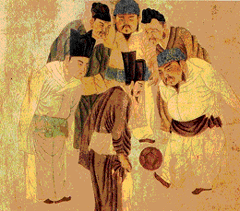
200 BC ancient Chinese documents reveal that a game called Tsu Chu -literally kick ball- was played with two 30ft-high bamboo poles as goals
For over 400 years the Top End of Australia traded with Macassans and Chinese
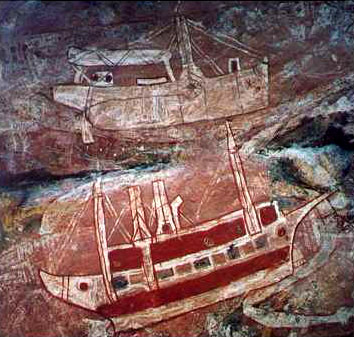
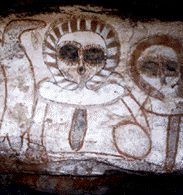

Kimberley paintings of ocean-going boats and Wandjina creation spirit, found on rock walls
The Wandjina have begun turning up on different rock walls in Perth WA the year West Coast Eagles won the Aussie Rules Premiership
Marn Grook is a traditional game played at large corroborees where sides were determined by ‘skin’ or totem. Tjap Wuurong people of western Victoria had their play witnessed by new settlers in 1841 after Major Mitchell had opened a track from NSW to agricultural land in the south. Written accounts refer to players dropping the ball and kicking it with their foot and leaping as high as five feet from the ground to catch it, with taller men having an advantage.
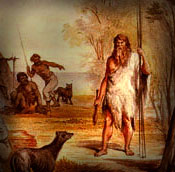
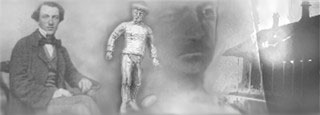
William Buckley was the first person
who unknowingly in the beginning, started Reconciliation with the Wathaurong
people. British authorities wanted useful information for 'opening land' -
they had 'buckleys' of getting information from William. He didn't trust the
government. Some time during the 32 years
William Buckley lived with the Wathaurong, I believe Marngrook and European
football style combined.
Early football in Britain was played by huge numbers of people on vast pitches or tarns with very few rules, much like footy everywhere at the time. Villages were divided into two sides for British Folk Football or 'mob football' where player numbers were unlimited and the rules were vague. William Buckley would surely have been playing village football back in England (records were destroyed by fire in 1890). Having received some elementary education, he was thought to have lost his talent for reading and writing in his later years. Unable or unwilling to tell much about the habits and customs of the Aborigines to eager authorities, who thought him dim witted. Buckley suggested that there be no interference with the customs of Aboriginal people. That statement seems to be very sincere, reflective and insightful. Authorities had 'Buckley's chance' of getting anything of use from him.
William Buckley 1837, "It is not without great regret, that I resolved on leaving the (Victorian) colony, because I had believed my knowledge of the language and habits of the natives, acquired during my sojourning amoungst them, might have led to my being employed by the local authorities during the rest of my life; but, when I reflected on the suspicion with which I was viewed by the most influential white men, and on the probable doubt the natives would entertain in my sincerity after having left them, I thought it best to retire to Van Diemen's Land." Convicts in Tasmania were playing football since 1831, four years before Melbourne’s settlement. Buckley married, had two daughters and died from an accident in Hobart Town, 1856
.
The conundrum academics of Australian football have about the Indigenous game of Marngrook and it's high mark feature contributing to the Australian code is the time frame. That it wasn't acknowledged in the original writing of the code in 1859, Melbourne with Tom Wills has been a stumbling block to realizing an even earlier connection with Marngook. Early Melbourne at one stage was a wild colonial town known as ‘Smellbourne’ with packs of dogs, slaughterhouses, flies and revolvers cracking until daybreak. Football became more popular with the industrial age as leisure time increased for players and spectators.
The 'high mark' as a feature in the Victorian Rules Football would have taken time to circulate the larger population of Melbourne's playing arena and some time before regular footballers would perform the skill adequately. When the metropolitan games began occurring on a regular basis and enough players could achieve the taking of a high mark in the years that followed, the high marking of Australian style football had to be included in the code as it had become a fully recognized feature. Some abilities have to be practiced with time and effort, usually the ones we most desire.
What we know of football from that time, are the similarities in games being played on the mainland Australia and Tasmania. There were also a great many seal hunters trading in the southern seas, including Americans. Influences to football and other skills and knowledge were traded to and fro to Britain and Ireland by convicts returning to their homelands after doing their time here. Buckley certainly seems to be an unrealized link between the Indigenous game and Australian Rules. Presumably he did a bit of yarn telling about his sojourn in Victoria to friendly folk in Tasmania and by all reports, was fit enough to still have played a spot of footy.

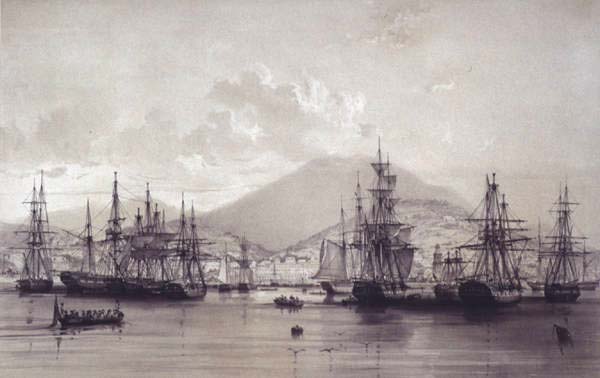
possible influences on football from the north
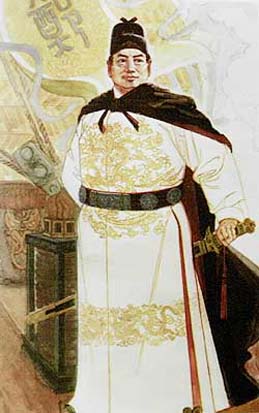
Muslim by birth, Zheng He the Chinese mariner explorer, diplomat and fleet admiral (born 1371) sailed Chinese Ming Imperial Treasure Fleets throughout South Pacific, Indian Ocean, Taiwan, Persian Gulf and distant Africa in seven epic voyages (1405-1433) with the flag ship 146 metres long and the amarda manned by over 27,000 crew. They established Chinese Muslim communities and mosque with chronicler Fei Xin accompanying many of the voyages. Recorded show the treasure fleet reaching Timor, 400 miles north of Darwin - tales of 'Arabian Nights' are said to be of these journeys.
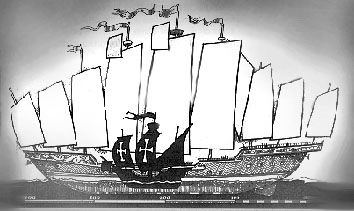
Zheng He's flagship compared with Columbus' St. Maria (85 feet, sailed to America 1492)
Historian Regina Ganter ... earliest external links were with lands close by. A soapstone statuette of the god Shou Lao found Darwin 1879, wedged in the roots of a banyan tree over a metre underground) - From an early period the native people of north-eastern Arnhem Land had continuous contact with Indonesian voyagers, expanding their trade in trepang, tortoise-shell, pearlshell and other marine produce, as well as sandalwood and timber, from the Northern coast. Even the pre-Macassans known as the Baijini people visited their shores. (R & C Berndt - Asiatic Contacts)
(1606 Dutch ship Duyfken - crewmen who came ashore in WA were ambushed and repelled by Wik warriors for abducting two Wik women)
Ogawa Taira in Pearls of Arafura "Japanese Samurai went to New Guinea as early as the 16th century ... and New Caledonia to catch Trepang. This is how our (pearl) divers went to Australia."
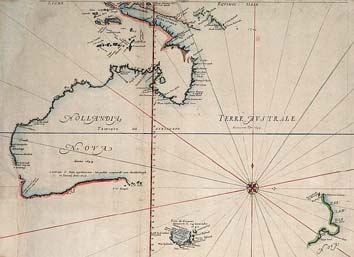
There are indications that Arab explorations off northern Australia took place - map of the Sea of Java of Muhammad ibn Musa al-Khwarizmi 820 CE shows Cape Yorke Pensinsula as a"V" shaped Gulf of Carpentaria and a curved Arnhem Land. A later map - Abu Isak Al-Farisi Istakhari 934 CE, also includes an outline of the northern coast of Australia.
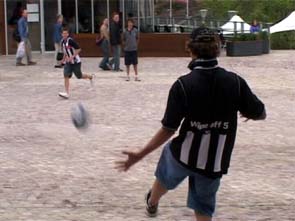
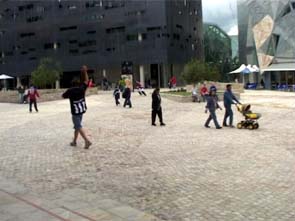
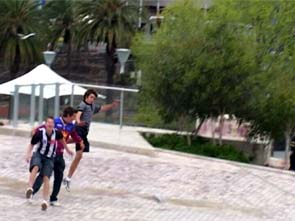


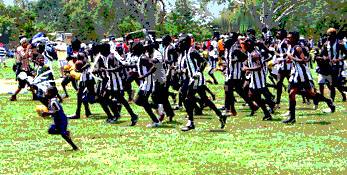
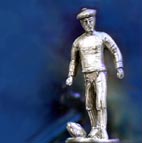
Connections between marngrook and Australian rules football include high marking, a spectacular element of both games and Tom Wills, one of the ‘fathers of football’ growing up near Ararat with Aboriginal children who played marngrook. Aboriginal champions succeed in playing Australian rules football. (G Blainey 'A game of our own: the origins of Australian football' & M Flanagan 'The Call' Tom Wills, Australian Football)
Australian football rules were kept simple and allowing a innovation on the part of players. The game developed as rules such as running with the ball and marking continued to be perfected. A major distinction of the Australian game from other codes of football was the absence of an off-side rule, generally considered to be the “strongest of all impediments” to scoring. The game could easily be understood and played by all people ...
a sense that all are equal on the field of play regardless of class and cultural background and the natural attributes / sense of fair-play in which all are bound to the same laws of the game / admiration for team-work especially in adversity and never ‘let our mates down’ / dour defence is as worthy of our respect and reward as skilful attack / individualism should only be celebrated insofar as it does not diminish cooperative effort and collective achievement - core values - Barry Judd (Centre for Australian Indigenous Studies, Monash University, Melbourne)
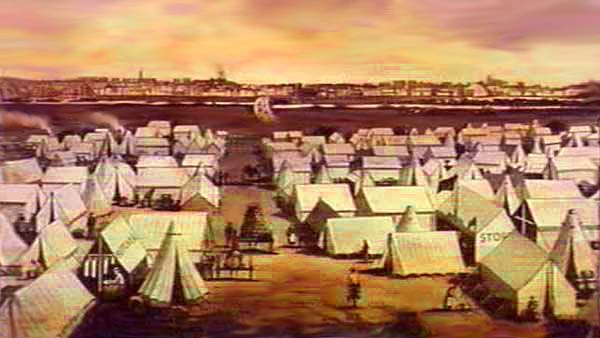
Melbourne was a wild colonial town where packs of dogs roamed the streets and men carried guns and tomahawks in their belts. Bushrangers roamed the countryside around the town and dust, flies, mud, swamps, disease and alcohol caused further aggravation.
1835 Melbourne founded by John Batman - inscription by his neighbour artist John Glover describes Batman as a "rogue, thief, cheat and liar, a murderer of blacks and the vilest man I have ever known". Batman died at 38 from syphilis, contracted in the brothels of Van Diemen's Land (Tasmania).
After 100 hard days at sea, reaching dry land at Melbourne was hardly the paradise many had been waiting for. Marvellous Smellbourne as it was known, where factories polluted the air, slaughterhouses lined the river and revolvers were cracking in all directions until daybreak. Since the 1840's water from the Yarra River have been unsuitable for domestic use.
The first games of Australian rules football were ‘scratch matches’. 31 July 1858 a publican in East Melbourne advertised for people to play a game of football in Yarra Park, promising to provide a football. From the 1880s inter-town rivalries began but rules were often relaxed and players were borrowed by fledgling teams.
1858, Melbourne Grammar played a group of men (St Kilda football club) where the lack of rules caused a fight that ended the game
- the next week a game began between Melbourne Grammar & Scotch College and was played over three weekends, with modified rules drawn from rugby and other ball games.
1870’s and 1880's gold miners from Victoria were on the move playing football as they travelled to newer mines for work. Albert Park, South Melbourne and Geelong draw 36,000 spectators to games and Queensland has over 300 clubs


John Ah Kit (former
NT minister for sport, on the sixties) “We went out of our way to play
sport and to break down the barriers between black and white … we have,
I believe, a sort of unwritten golden rule amongst old Darwinites of my age
- maybe fifty-five and below ... There were Greeks, Italians and non-Aboriginal
blokes that I went to school with who treat me with the utmost respect - I also
share that.”

Monsoon video montage (music M.Muller)
Knowledge of an Australian history cannot be absorbed and retained on the edges of a dry monocultural garden of exclusion. The old international trade relations of Australia's Top End pre European settlement is wonderous and as an illuminating tale, exposing a thorough history.
When cultures merged through agreeable trade and production, there was harmony for many hundreds, possibly thousands of years. Cordial relations strengthened with intermarrying and business based on cooperative production rather than greed. This is a newsworthy and colourful history that throws more light on the selected viewpoints permeating our education today.
History of people in this great south land is as vast as the landscape. Our categorical referencing has to be challenged with newer, fresher viewpoints and informed questioning for a framework to fully appreciate Australia. Standard practices of convenient thinking in education, medicine and commerce shortchanges us our differences in the ways of gathering information and conveying meaning. Just as currents form patterns of motion affecting land and sea, there are energy circuits in the brain affecting thinking patterns. Insightful thinking feeds and retains memory. Lest we forget to inquire sincerely and use our imaginations.
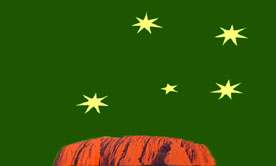
With a clearer understanding of our past, we equip ourselves with a vast referencing source to better inform our Australian identity. Our flag and emphasises the boundless southern sky. God bless the whole planet.
thanks to all website contributers who make available interesting stories and facts
Stories of Australia in the Early Days; Hobart Mercury, 23-05-1907
John Morgan, The Life and Adventures of William Buckley; James Bonwick, The Wild White Man; W. T. Pyke, Thirty Years Among the Blacks of Australia; Marcus Clarke
background

- about Monsoon Multimedia - a coming together of art, music, story and research, based at Ferndale Studios, Newcastle, NSW
Di Smedley (Contemporary Works, born Sydney - formerly known as Di Wright) new media visual arts practitioner and researcher. Self described as an accidental academic embacing an inclusive Australian history and identity using australian football as a focal point for cross referencing shared knowledge for a people's history. (1993-2002) intensive with Dr Brian Birchall , ex UNE senior lecturer on idealism and realism in philosophy. (Australian Hegelian/Andersonian scholar)
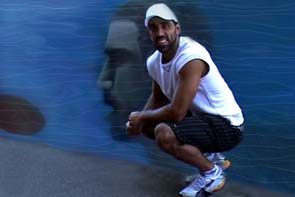
Max Muller, music producer (known as Maximulla when he played with St Mary's first grade, Darwin in the sixties). Originally from South Oz and a musician since the late '60's has original music and stories inspiring the visual telling of tales in oz history using the contemporary medium of digital communication
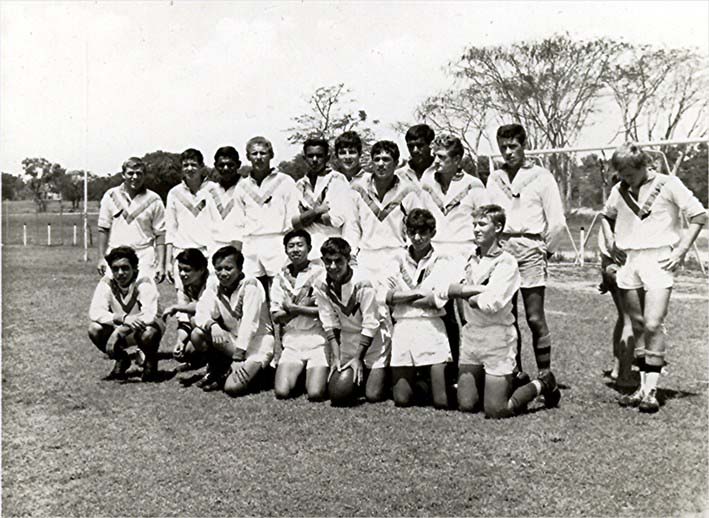 Max
on his knees, mid sixties Darwin
Max
on his knees, mid sixties Darwin
'Why Warriors lie down and die' part of a speech at
the book's launch at Liberty Square, Parliament House Darwin by Dr Evelyn Scott,
Chairperson of the Council for Aboriginal Reconciliation
"... The story is told convincingly from the perspective of the Indigenous
peoples involved, as related to the author by Yolngu Elders and supported by
his own research of historical records. That aspect of "Why Warriors"
is important to me because it provides a new resource for Australians who want
to get a true perspective on the shared history of this continent over the last
couple of centuries. Most of today's adult Australians were denied that perspective
in their formal education, and unfortunately there are still some among out
leaders who deny that such a perspective is important to our prospects for reconciliation
and future unity. It is important, and I thank Richard for his contribution
to making it accessible ..." August 24, 2000
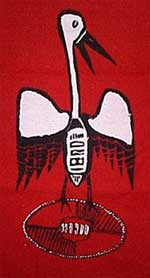
Top End Influences …. trade with China - when monsoon winds blew to the south the prahus (boats) left Macassar, then four months later they sailed back towards the northern equatorial zone, after preparing sea slug or trepang in beach camps ready for Chinese trade. The remains of stone fireplaces and tamarind trees can still be seen. So significant was the Macassan trade that for many years the British tried schemes to make the northern coast into a second Singapore. 1823 - an expedition was sent to northern Australia and Fort Dundas was established on the strait between Melville and Bathurst Islands - the fort was located too far from the trepang fleet's camps to trade and was a failure. 200 miles further Fort Wellington was built but abandoned in 1829. Thirty-four prahus with more than 1000 men had arrived but there were no merchants at the trading post.
- art is found in Northwest Australia 60,000 BC - Groups arrived to form the present Aborigines and Melanesians thousands of years before Mungo Man. Just as human populations merged, multiplied and dispersed from all directions on the planet, so too did football evolve in Australia, along traderoute songlines connecting 500 language groups with Yolngu and Macassans intermarrying.
1906 - Macassan boats were forbidden to return to Australia by the British, severing relationship ties and financial independence for aboriginal people. Colonial Victoria then traded trepang with Macassans.
Aboriginal habitation in Australia - 150,000BC - dated in charcoal remains deep in the bed of the Great Barrier Reef
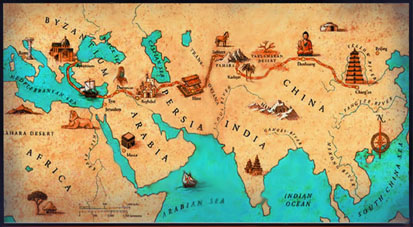
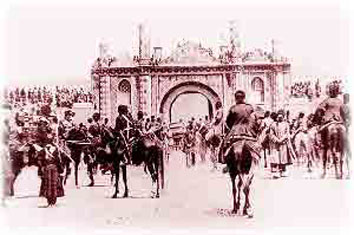
Silk Road - Sites of Buddhism next to Christian churches and monasteries in the countries of Muslim mosques like at Uzbekinstan - once the Buddhist centre of Central Asia. Huge monastery complexes extended down the Amu Darya River, present day border with Afghanistan.
3000 BC Silk first produced
in China
1500 BC Semi-nomadic stockbreeding tribes inhabit steppes
753 BC Rome founded
500 BC Chinese adopt nomadic style, wear trousers and ride horses
551 - 479 BC Confucius born in China
400 BC Greek culture spread into Central Asia
300 BC Roman expansion begins - Qin dynasty unites the entire China for the
first time - Qin Great Wall completed -
200 BC The Huns rise to power and invade Chinese western border regions - Zhang
Qian travels the Western Regions
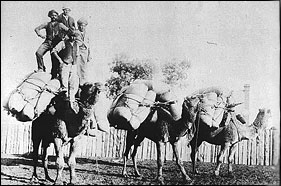
1866 - more than a hundred camels and 31 Afghan cameleers were brought to Australia. They came from differing ethnic groups and different places - Baluchistan, Kashmir, Sind, Rajastan, Egypt, Persia, Turkey and Punjab and were collectively known as Afghans.
In early 1870 the Afghans went on strike and most left Beltana and moved to Blinman. In 1873 Mahomet Saleh, an Afghan cameleer, left Beltana for Western Australia with explorer P.E. Warburton. William Christie Gosse was assisted by three Afghans in his attempt to find a way from the Finke River to Perth. Two years later he assisted Ernest Giles on one of his expeditions. J.W. Lewis, surveying the country north east of Lake Eyre in 1874 and 1875 used camels. Later Thomas Elder's teams carried desperately needed supplies for the starving diggers at Milparinka.
1 AD Buddhism begins to spread
from India into Central Asia - Christianity begins to spread in the world -
100 AD Roman empire at its largest - The first Roman envoy arrives in China
-
200 AD Han dynasty falls and the China breaks up
- Xiongnu invades China and China further dissolved into fragments - Sui dynasty
reunites China
600 AD Tang dynasty rules in China - The
Silk Road reaches its golden age
800 AD First porcelain made in China - Gunpowder invented in China - Compass
begins to be used by Chinese
900 AD Tang dynasty ends - After short abruption, the Song dynasty reunites
China
1100 AD China divided into Northern Sung and Southern Sung - Genghis Khan unites
Mongols
1200 AD Kublai Khan establishes the Yuan dynasty in China
- Marco Polo leaves for the East
1300 AD Third Silk Road route appears in the north - Yuan dynasty ends and Ming
dynasty begins
1400 AD China closes the door to foreigners
2005/06 ..." Venturing into the AFL premiership winners' rooms, Waleed Aly finds delirious scenes and in the losers' rooms humanity... The Sydney Swans have just clinched the 2005 AFL premiership in a classic ... In a narrow corridor, Michael O'Loughlin is interviewed for Salam Cafe, a Muslim panel-based show on community television. We're there because the AFL, which has the most active multicultural project of any sporting code in Australia, is keen on its multicultural outreach, and we're more than keen to oblige. You get the feeling O'Loughlin doesn't mind who we are ...
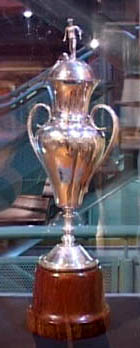
Black Diamond Cup 1888 (Newcastle Museum NSW) - football followed the miners from Victoria
1858 - same year 'the call' for a unified Australian code of football by Tom Wills was publicised, the second largest gold nugget ever found in Australia, the "Welcome Nugget" at Bakery Hill, Ballarat. By the 1860's, the prospect of finding gold in Ballarat East had nearly diminished. The rail came through in 1862.
An exert from Mark Twain's book Following the Equator - Road to Ballarat - Ballarat settlement began 1838 'Balla' 'Arat' was derived from the local Aboriginal inhabitants' dialogue, meaning resting place. Gold was discovered at Poverty Point in 1851, by the following year there were around 20,000 diggers searching in the shafts of the Ballarat Goldfields. In early 1850's Gold Licences allowed miners to search for gold on a specified piece of land. Many of the Goldfields Police were ex-convicts due to a shortage of manpower and the Government allowed them the power to undertake checks.
...On November 11, the Ballarat Reform League was formed with the view of abolishing licences and having the miners released from jail. Frustrated with the authorities, the miners set up a stockade on the Eureka Lead and burnt their licences. On December 3 1854, the miners went into battle after Government soldiers unexpectedly stormed the stockade early that morning. The battle lasted for around 15 minutes and in that time up to 30 miners and six Government troopers were killed. 114 miners were taken prisoner.
While short lived, the Eureka Stockade uprising reverberated throughout the young colony. Within six months, legislation was passed to give miners a fairer deal. The monthly Gold Tax was abolished and miners were given the right to vote. Society had gone from a 'squatocracy' to a democracy. All miners arrested after the rebellion and those sentenced for the burning of Bentley's Eureka Hotel were released. Peter Lalor, who had been in hiding since the uprising could walk free. He became the first member for Ballarat West to be represented in the Victorian Legislative Assembly and later became Speaker of the House.

www.abc.net.au/catalyst/stories/ - eel farming village trading for 8000 years in Victoria
www.shanehoward.com.au - spirit of place
www.yothuyindi.com/ - song ‘Macassan Crew’
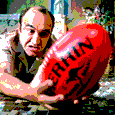 'Bloody
Footy' short film - Vito wants his eldest son to follow family tradition and
play soccer but Mario desperately wants to play Australian Rules football -
15m Director DeanChircop-Producer Defrim Isai-Writer Mario Sinigaglia. Screening
at Berlin Festival- insightful, touching family tension over codes of football
in Oz
'Bloody
Footy' short film - Vito wants his eldest son to follow family tradition and
play soccer but Mario desperately wants to play Australian Rules football -
15m Director DeanChircop-Producer Defrim Isai-Writer Mario Sinigaglia. Screening
at Berlin Festival- insightful, touching family tension over codes of football
in Oz
... the National Indigenous Documentary Fund (NIDF) provides production opportunities for Indigenous documentary filmmakers. The NIDF is financed by a combination of production funds from the Film Finance Corporation Australia (FFC), SBS, the ABC and the state agencies. Innovative production encourages communities to use video + digital media as a cultural development tool and supports community based screen culture practice.
Most documentary makers shoot 20 times what appears on screen and typically would make their films 5 times longer than the TV networks wants. They also have filing cabinets full of research material they don't know what to do with ... For Mabo the writers were editorial and succinct because all the supporting material is just a click away ... available for scrutiny whenever it's convenient for the user (on the net) ... and just received ABC/CineMedia Accord funding to produce a documentary web site with the State Library of Victoria.
800,000BC
early hominids in Asia made it to the island of Flores in the Javan archipelago
-195000BC human fossils in Ethiopia -186000BC ice age
150000BC evidence of Aboriginal
habitation in Australia charcoal remains in the Great Barrier Reef - large migration
of people from Africa to Asia
120000BC Chinese fossil skullcap. The ice age that
began around 186,000BC receded about this time
120000BC 60000BC The Klasies River Mouth fossils, on the southern tip of Africa
although fragmented, indicated early modern man
100000BC spear-like tools are found in eastern Zaire near Lake Rutanzige. Hunters
stalked giant camels in the Syrian desert about this time
100000BC 50000BC 200-pound Genyornis newtoni bird and
the 25-foot Megalonia lizard were among the megafauna that flourished in Oz
53000BC-50000BC migrations to Australia from the islands
of Indonesia and southern China. It is believed that they came in bamboo rafts
51000BC fossil of a Diprotodon (giant marsupial) from this time, was excavated
in 2001 from Cox's Creek in New South Wales
40000BC-2000BC sea level seems to have dropped at least
four times in this period
39000BC a supernova took place about this time at a distance of 250 light years
from Earth - iron rich grains hit Earth 7,000 years later
38000BC Stone-age humans came to Europe, probably from
central Asia and the Middle East in 2 waves of migration
36000BC-34000BC the oldest fossil from an early modern
human to be found in Europe
28000BC Neanderthals persisted at the site of Zafarraya in Andalucia, Spain
28000BC Ainu (aboriginal inhabitants of Japanese islands) had European features,
wavy hair and thick beards before they intermarried
28000BC Homo sapiens (modern). Skull of adult male found at Cro-Magnon, France
1868
Paleolithic 100000 BC - 10000 BC / Mesolithic 10000 BC
- 4000 BC / Neolithic 4000 BC - 2000 BC
80000 BC - Homo sapiens - modern man appears in China. 9000 BC
music video - 'Love is Everything'- Supersonic
music video - 'Going Out' - E.Quinn page (Ferndale Studios)
music video - 'Guitar Man' - G. Meehan page (Ferndale Studios)