> Murder They Wrote
The six Forum candidates wrote some pretty diabolical music, much to the delight of performers and audience alike. CH Loh goes behind the barlines.
A famous composer once likened the work of describing a piece of music to writing about the taste of eggs. It was much better, he said, to eat the egg for oneself than to read about it. Naturally, eggs were a tasty commodity in frostbitten Soviet Union, and to hear the six new works at the Malaysian Composers' Forum is ultimately better than to read about it. Nonetheless, I shall attempt to describe the works in as familiar terms as I can, and I promise, for the sake of Tay Poh Gek, not to mention a certain movie starring Michelle Yeoh.
Tay adopts a folk-based style in An Evening in the Myth that pays tribute to Bartok in many ways, especially in its piquant, angular melodies and the earthy Final romp. In this rhapsodic tone poem she explores the connections that a simple motif G-A-B-A-G has between the Chinese and the Malay characters through a simple shift of a semitone. An idyllic opening on the flute, magnificently scored, sets forth an adventure that outgrows its sixteen-instrument score into something potentially bigger. Full of memorable melodic fragments and pounding rhythmic vitality connected throughout by the bonang, it's a work that demands to be onto a larger canvass. I sympathise with Tay, who had urged the musicians to play louder, that the brass could have given her mythical adventure more rugged oomph.
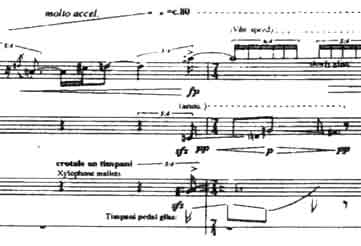
Chong Kee Yong's I hear the wind calling, dedicated to his parents, makes use of every instrumental effect imaginable, from air sounds on the flute to harmonics on the piano strings and everything in between, the sort of experimental sound painting that is bread and butter InterContemporain fare. More than a little startling, if not unexpected, it completes the A-Z experience of the what contemporary Malaysian music might be.
Typically with music of this nature, the score is a fascinating read, but performing it poses many challenges for the sixteen players, who had only three days to get it right from first sight. While I am not a hardcore fan of what some Western audiences call "screechy gates music", Chong did find in his genre some spectacular effects and, more importantly, numerous attractive elements. Snatches of melody dot the painstakingly plotted quadraphonic soundscape; with repeated listening a definite shape takes place, while first impressions leave a whiff of earnest sensuality.
"As a composer I have only one wish, that the music gives people free space to think. As a composer I don't want to convince you that music is beautiful or great, I merely offer you a door. The key to open it depends on you. I don't need to use any melody to convince you [of its beauty], which is why I always work with sound," explains Chong.
This is music to be experienced live, close to the performers. The closing pages, with a finger-tapped heartbeat on the bass drum and a stratospheric cello harmonic disappearing into the heavens, brings a personal touch to the music. Okay, so my door isn't quite open yet, but this is undoubtedly a masterly score and the audience appreciation was notable.
Ahmad Muriz's Bertabuh kala senja is the complete opposite - his gift for melody is its strongest element. Cast in an A-B-A format, it's a highly attractive work based on a simple, very Malaysian motif Bb-Ab-F-Ab-Bb-C set in a feet-tapping 2+2+2+3 rhythm that takes you on a breathless journey. Like a gamelan composition, fragments spins endlessly around the main motif and several submotifs to create a kaleidoscope of melody, and in the style of an American overture, excitement and affection builds steadily to reach a rousing finish. Muriz uses two different types of bonang to create interesting textures in this wonderful miniature.
Vivian Chua's reflections on Water - Moods and Reflections is immediately appealing with her unapologetically diatonic language that recalls a Resphigi or Debussy tone poem. The sensuous opening sets the tone for her very American Jeux D'eau, with more than a whiff of Afternoon of a Faun setting the stage for a series of variations on her dreamy oscillating theme C-D-Bb-F-G. There is plenty of foot-tapping entertainment and some intimate moments of tranquillity - I enjoyed the latter immensely and felt that Water would have benefited from a little more performing time for each segment to fully develop.
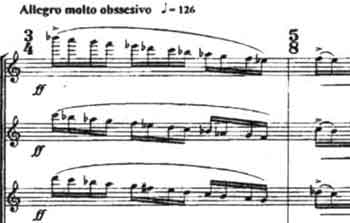
Standing out from the lot was Adeline Wong's Synclastic Illuminations, a quasi-minimalist study in the motivic possibilities of minimal musical resources yielding an exciting score, simply but effectively orchestrated. "I like to use very little material and see how this material develops through emotional and colour changes. I always like to think about the audience and what they look for in my music," says a confident Wong.
A nervous set of falling scales in parallel seconds on woodwinds, lined by the brittle xylophone and piano, immediately grabs your attention and never lets up. An obsessive jazzy rhythm on the key idea, a descending scale on a minor seventh chord, takes over. "Unpleasant sounds" is what Wong calls it, breaking down into a curious hocketting interplay amongst the woodwinds and percussion, diabolically difficult to perform (perfect during the rehearsals but sadly tripping up the ensemble just for a fraction during the actual concert).
The timpani heralds in a "trembling and shaking" brass section, where various muted trills and glissandi lead to a burst of "cascades" for the full ensemble in a very Malaysian glow, achieved very simply by the use of the rising semitone III-IV. This glorious shimmering climax, pushed on with an ingenious use of the drum-kit, dissipates into a deeply touching calm built around the idea on thirds, its sparse, pristine beauty reminiscent of the closing moments of Copland's Appalachian Spring.
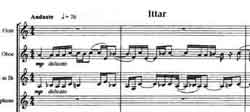
Ittar, an outstanding work of startling maturity from the youngest of the six, finds 24 year-old Johan Othman unearthing the most primeval elements from the depths of our cultural heritage. It harks back the Hindu connection of our Sri Vijayan roots so often forgotten in these politically correct days, and the scent of it permeates the entire work. Scent, after all, is what Ittar is about; "the scent of sound," says Johan after the rehearsal.
The soft-spoken composer confirms my suspicions on the Hindu associations. "I have always been into philosophy. Here I am exploring the Hindu philosophy of Shiva, the Lord of Dance. Although I am not Hindu, I don't see anything wrong here. I am taking the universality of Hindu philosophy and applying it to music. Shiva belongs to everyone, not just Hindus, [in the way that] Shakespeare belongs to all of us, to mankind," he explains.
It begins with a mysterious ritual meditation for oboe and clarinet around the Pelog mode (A-Bb-[B]-C-E), the two instruments curiously mirroring then contradicting each other to interjections by a woodblock, harp and delicious muted string chords. The music explodes into a furiously duelling violin duet, the theme compressed into semitones, building into a ferocious whirlwind of demi-semi-quavers. It's a brilliant orchestral stroke here by Othman, culminating in an amazing alto sax solo that heralds in the final processional. Led by the bassoon against the harp playing an ostinato on a whole tone fourth and a bluesy cello pizzicato, the work closes as abruptly as it begins on a solo viola, a sort of infinite twinkle of the eye.
It's a sensual, brutal, totally compelling, and amazingly rich composition for such a sparse orchestration. "Ittar means perfume, and perfume is a scent normally perceived thru the nose, while this is like the scent of sound. I didn't want to make it so straightforward, like, here's the dance of Shiva and everybody gets this picture 'Oh, we're going to hear Indian music.' It's not one of those cultural displays," says Othman with a laugh. Who can resist poking fun at our cultural mainstay, which for decades consisted solely of a compulsory quartet of Malay, Indian, Chinese, and Orang Asli dances?
Thankfully we now have an alternative, for despite its abstract theme and highly original musical material, Ittar sounds perfectly Malaysian without trying to. With time, more original voices will make their own mark on our music. If you didn't catch these six pioneers then you still have a chance to hear four of them in action next March. Witness the moulding of their new creations during the clinics on 9 - 10 March 2004, and experience the finished product at the premiere concert on 11 March, after which one of the lucky four will be selected to represent Malaysia at the MPO International Composers Award (MPOICA). Mark your diaries!
> Back to Main Article
|