|
It begins inside, doesn't it? The desire to see what you are made of... how far you can push yourself...the need to compete not only with your fellow fighter, but to compete within yourself and find out what you can achieve. When that blow that you've worked on for so many months snaps out and over your opponent's shield... landing decisively and clean. No question. It feels great! Afterwards, the hand to help your opponent up, then off to the sidelines to talk about how the fight went and share that feeling of camaraderie and belonging. Even the times you don't win a fight, you walk away knowing that the NEXT time - you'll have learned more and will do better.
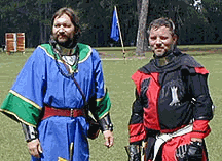
Our Consortium fighters are undoubtedly some of the best in the Kingdom. Seldom do you see anything but the very best of honor and deportment on the field. All the skill and graciousness does not stop at the edge of the field though. The Quarterly fighter practice at Dragonfly Marsh on 30 September 01 consisted of 26 combatants, 26 non-combatants (well, unarmored anyhow... :-)) and at least 15 mundanes attracted to all the commotion in the park. From as far away as 5 hours of driving, members of the Consortium gathered to practice war tactics for the upcoming Panhandle Skirmishes. We also did a skills table, displaying our artisan's skills with leather, thread, ink and other crafts. Vivat! to those who attended and made it such a wonderful day. Food and friendship - what a great combination! I hope those that didn't get a chance to make it are horribly envious and will plan to go to the next Quarterly fighter practice that will be somewhere around the second week of January. We ought to be able to DOUBLE the number of attendees. Please make plans now!
In the field training, we specifically covered basic tactics on a line. Dress and covering the line (I know, I know... it was a lot like military training... but it does work!). distance between shields on the line... responding to commands on the line. We have such a schism in the way we view fighting in the SCA. In tournaments, it is so focused on the individual skills and decision making. Then all of a sudden, you are thrust on the field with 200 other fighters and have to transition to group tactics. It changes the dynamics of everything! We are using group commands on the line. Here are some of the concepts all fighters should know on the field:
++ Commands have four steps: The first is the preparatory command, the command is then echoed, then a command of execution is given, followed by execution by the fighters. For example, to advance the line, the command "ADVANCE THE LINE" is given - LOUDLY. Adjutants will echo the command with "ADVANCE THE LINE" - LOUDLY. Now it's expected.. everyone is waiting and the formation commander gives the command "MOVE" - LOUDLY, then the line begins to move forward. Starting on the LEFT foot. Yes.. it's military, and those experienced in that area need to work with other fighters in your group to accustom them to the process. It has to be practiced to be effective.
++ What is the duty of fighters on the line? To stay alive. Who gets the glory? Spearmen. Time and time again, it has to be reinforced - you have to keep the line intact. Spears/pole weapons have to stay active. Too often the spearperson is trying to get that perfect shot - which takes the pressure off the opponent's line. Spears have to keep active! There has to be communication constantly on the line. Spearmen have to keep talking so those in front of them know what is going on.
++ Dress the line. Don't let the line break up. Close the gaps to prevent the line from collapsing.
++ Know what commands may be coming. Anticipate the commands and what you will be doing in the formation. A "WHEEL TO THE RIGHT" means the furthermost right person will pivot to the right, and the rest of the line will swing around - while still in formation . Anticipate a 90 degree turn... anticipate how fast you will have to more to keep up. Depending on the length of the line, the LEFT furthermost person may be running to keep up. We practiced this maneuver this past weekend, talk to those who were there and work it out in your mind, practice it with your group, so you will be prepared at Panhandle.
We need to prepare mentally for being in a war scenario. Its an old adage that "Practice Makes Perfect", but it is a baseline truth. You get better if you practice. If you wait until ten minutes before the first battle begins to start thinking about what you will be doing during the war, you will miss some important moments in the battle that can be crucial to our success.
Inspect your equipment before arrival as well. The physical preparation is not only your body - proper nutrition, exercise, etc. - but includes making sure your armor is in good order and serviceable. All armor and weapons standards must meet Meridian standards.
I look forward to seeing all of you in the future.
Respectfully,
Earl Michael Bohun
FYRDWISE
|
|