 |
 |
 |
 |
| The Conservative Movement Take a look at these figures who made conservatism what it is. The conservative movement consisted of three components: the Traditionalists, the Classical Liberals, and the Anti-Communists. In the 1970s two other components emerged: the Neo-Conservatives and the New (Religious) Right. These are the figures most closely associated with those components. |
 |
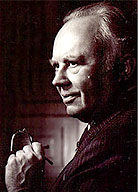
| Russell Kirk 1919-1994 Kirk is one of the main figures of the conservative movement and one of the best traditionalist intellectuals. Kirk's Six Canons of Conservative Thought: 1."Belief in a transcendent order, or body of natural law, which rules society as well as conscience." 2. "Affection for the proliferating variety and mystery of human existence, as opposed to the narrowing uniformity, egalitarianism, and utilitarian aims of most radical systems;" 3. "Conviction that civilized society requires orders and classes, as against the notion of a 'classless society'." 4. "Persuasion that freedom and property are closely linked: separate property from private possession, and the Leviathan becomes master of all." 5"Faith in prescription and distrust of 'sophisters, calculators, and economists' who would reconstruct society upon abstract designs." 6."Recognition that change may not be salutary reform: hasty innovation may be a devouring conflagration, rather than a torch of progress." |
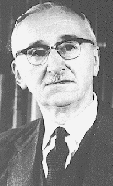
| F.A. Hayek 1899-1992 One of the most eminent of the modern Austrian Economists who contributed greatly to the Conservative Movement as a Classical Liberal. Key concepts in Hayek's thought: 1.Markets versus planning. Market exchange works because people value thing differently. The planned economy rests on the unlikely assumption that everyone can agree what to produce, and how. 2.Importance of prices. The price system reflects the imbalance of demand and supply, and automatically steers resources to where they are most needed - without the need for planners to discover, understand, and correct the imbalance. 3We're all planners. We all plan, and we do so on the basis of our own knowledge of local conditions. There is far more useful and current information in this dispersed knowledge bas than could ever be collected in a central planning agency. 4.Competition is dynamic. Competition is not a textbook 'given' but a dynamic process, in which people constantly search to discover the cheapest mix of resources to produce the most desired outputs. 5.Human action but not human design. The social order is like language. It is a product of human action, but not something that we have deliberately designed. It evolves and changes, but endures because it is useful to us. 6.Limits to our understanding. Just as language is built on complex rules of grammar that we follow with ease but cannot necessarily articulate, the social order is built on complex regularities in our behaviour - common law, ethics, customs, manners - whose importance we only faintly understand. 7.The fatal conceit. The totalitarian disasters that have occurred when utopians attempt to redesign society according to their rational plan shows just how little we know about the workings of the complex system of rules on which the social order is based. |
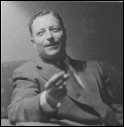
| Frank S. Meyer 1909-1972 Meyer was a former Communist who had seen the horrors of Communism first hand. Inspired by his experiences Meyer joined the Conservative movement to fight Communism. He is purhaps the best of the anti-communist component. During his lifetime he promoted his political philosophy of Fusionism (fusing Traditionalism with Classical Liberalism)--which is considered to be the mainstream form of conservativism today. |
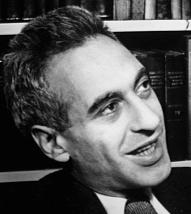
| Irving Kristol b. 1920 - Irving Kristol is credited with having founded the Neo-Conservative Movement in the late 1960s. The Neo-Conservatives agreed with the Traditionalists in many aspects but were much more comfortable with a Keynsian mixed economy than the fusionists or Classical Liberals. Neo-Conservatism was formed by disillusioned leftists such as Kristol and continued to attract liberals who were thrown off by the Radicalism of the 1960s and 1970s. |
| Gary Bauer Gary Bauer is just one of the many Christian Conservatives. He is joined by such people as Jerry Falwell and Pat Robertson. This group is more populist than many of the other conservative components and are more concerned with Social issues such as Drugs, Abortion, and Family. Though memebers of the Religious Right typically favor the Republican Party, they have never paused in opposing moderate Republicans for Conservative Democrats. This component is typically the more activist of all conservative sects and have contributed greatly to the conservative movement. |
 |