Rain Water Harvesting
Rotary
International District - 3020
History:
Water has been harvested in India since antiquity, with our ancestors perfecting
the art of water management. Many water harvesting structures and water
conveyance systems specific to the
eco-regions and culture has been developed.
TRADITIONAL
Methods:
n
They harvested the rain drop
directly. From rooftops, they collected water and stored it in tanks built in
their courtyards. From open community lands, they collected the rain and stored
it in artificial wells.
n
They harvested monsoon runoff by
capturing water from swollen streams during the monsoon season and stored it
various forms of water bodies.
n
They harvested water from flooded
rivers
Rain water Harvesting - Advantages :
* In areas where there is inadequate groundwater supply or
surface resources are either lacking or insufficient, rainwater harvesting
offers an ideal solution
.
* Helps in utilizing the primary source of water and prevent the runoff from
going into sewer or storm drains, thereby reducing the load on treatment
plants.
 * Reduces urban flooding.
* Recharging water into the aquifers help in improving the quality of
existing groundwater through dilution
Urban rainwater harvesting:
Urban centers in India are facing an ironical
situation today. On one hand there is the acute water
scarcity
and on the other, the streets are often flooded during the monsoons. This has
led to serious problems with quality and quantity of groundwater.
This is
despite the fact that all these cities receive good rainfall. However, this
rainfall occurs during short spells of high intensity. (Most of the rain falls
in just 100 hours out of 8,760 hours in a year). Because of such short duration
of heavy rain, most of the rain falling on the surface tends to flow away
rapidly leaving very little for recharge of groundwater. Most of the traditional
water harvesting systems in cities have been neglected and fallen into disuse,
worsening the urban water scenario. One of the solutions to the urban water
crisis is rainwater harvesting - capturing the runoff.
Roof Top Harvesting
:
n 
n
This is
practiced on a large scale in cities like Chennai, Bangalore and Delhi where
rainwater harvesting is a part of the state policy. Elsewhere, countries like
Germany, Japan, United States, and Singapore are also adopting rainwater
harvesting.
Recharge of Ground water Aquifers
:
n
Rain water may be collected and
recharged into the ground water aquifers through the following methods.
n
1. Roof Top Harvesting
n
2. Harvesting rain water from open
spaces.
1. Roof Top Harvesting
n
Roof top harvesting has been
practiced since ages, and even today it is practiced in many places throughout
the world. As we know the rain water collected from the terrace is free from any
bacteriological contamination (except small amount of dust and other silt
particles which can be filtered) it can be diverted to the existing wells/
bore-wells which are in use as detailed below
(A) Open well method
:
n
This is the simple method of RWH
(Fig.1) in which all the rain water falling on the terrace of the building is
collected through pipe lines and diverted into an existing open well through a
filter tank/chamber. The filter chamber helps to filter fine dust, silt and
other small floating particles such as leaves etc. which normally found on the
terrace. (A mesh filter / grill may also be provided at the mouth of the drain
pipe on the terrace to arrest larger particles).
n
The size of the filter chamber
depends on the amount of rain water flows from the terrace. Normally this may be
of 2' x 2' x 2' size. The bottom of the chamber is filled with broken bricks
followed by gravels and coarse river sand on the top. The location of the
chamber is preferred based on the site conditions either below or above
n
ground level.
Fig.1

(B) Bore well method
:
n
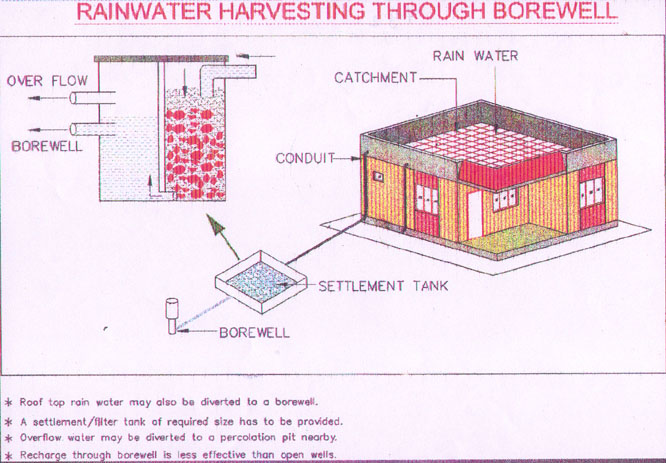
As in the case of open wells, the
rain water from the terrace may be diverted to a bore well also (Fig.2). In this
case it is to be kept in mind that during excess rain fall, the rate of recharge
may not match the rate of rainfall. In such situations, a percolation pit has to
be provided nearby to divert the excess flow of rain water.
n
Defunct bore wells which are not
in use may also be converted in to a recharge well (Rain Water Harvesting
Structure)
Fig. 2