WHITE SHARK
Order - Lamniformes
Family - Lamnidae
Genus - Carcharodon
Species - carcharias
Geographical Distribution
Habitat
Biology
Conservation
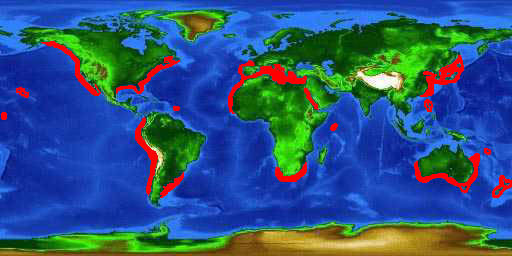
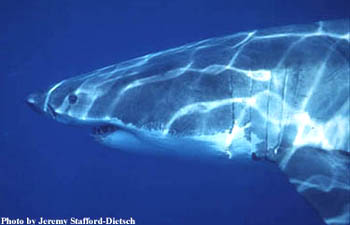
The white shark is principally an epipelagic (living in the upper part of the water column) dweller of neritic (nearshore) waters. However, it ranges from the surfline to well offshore and from the surface and to depths over 250 m (775 ft). This shark commonly patrols small coastal archipelagos inhabited by pinnipeds (seal, sea lions and walruses), offshore reefs, banks and shoals and rocky headlands where deepwater lies close to shore. The white shark usually cruises in a purposeful manner, either just off the bottom or near the surface, but spends very little time at midwater depths.
Biology
· Distinctive Features
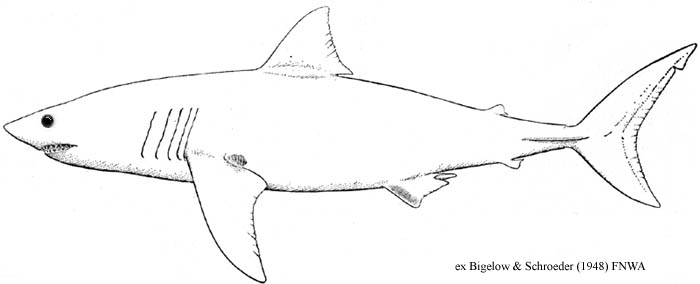
Body fusiform, snout conical and relatively short, long gill slits not encircling
the head. Large first dorsal fin with the origin over pectoral fin inner margins.
Second dorsal and anal fins minute. Caudal fin homocercal (crescent shaped),
without a secondary keel below extension of caudal keel.
· Coloration
Dorsal surface blue-grey to grey-brown, often bronzy. Ventral surface is white.
Boundary between these tones is generally abrupt. Small, irregular dark spots
may be present on the flanks posterior to the last gill slit. Most specimens
exhibit a black oval blotch in the axil of the pectoral fin.
· Dentition
Teeth large, erect, triangular and serrated. More slender in lower jaw. In
juveniles under 1.8 m (5.5 ft), the teeth have small lateral cusplets and
in neonates, the lower teeth may actually lack marginal serration.
· Dermal Denticles
Denticles minute, tightly packed with three ridges and very flat blades. Skin
of the white shark is relatively smooth in comparison with many other species.
· Size, Age & Growth
The maximum size attained by white sharks has been the target of many debates
and spurious information. Scientists now suggest that the maximum total length
of this species is about 680 cm (22.3 ft). Males mature at about 350 cm (10.5
ft) and females at about 450 cm (14 ft). White sharks are 120-150 cm (47-59
in) in length at birth. Studies have indicated that white sharks live at least
14 years. However, in reality, this number is likely much higher. Growth rates
of the white shark are also largely unclear, although one recent study included
a tagged specimen that had grown 69 cm (27 in) in a period of 2.6 yrs.
· Spatial Behavior
Although information about its movements is limited by the rarity of the white
shark, some data has been gathered through tag-and-release programs in the
United States, South Africa and Australia. These studies reveal that the white
shark is capable of making movements on localized, regional and intercontinental
scales. Generally, larger individuals undertake long journeys across the great
ocean basins. Observations of two white sharks cruising in open water, apparently
not feeding, revealed a strong tendency to ascend and descend slowly and steadily.
The white shark is also capable of short, high-speed pursuits and even launching
itself clear from the surface. Patterns in movement and abundance within some
areas appear to be linked with seasonal variations in surface temperature.
However, this may only have a minimal effect on the distribution of the white
shark.
· Feeding Behavior
In most areas where white sharks occur, pinnipeds such as these California
sea lions (Zalophus californianus), make up the bulk of the white shark's
diet.
The white shark is a macropredator, known to be active during the daytime.
Its most important prey items are marine mammals (including, seals, sea lions,
elephant seals, dolphins) and fishes (including other sharks and rays). Marine
reptiles are sporadically ingested, mostly sea turtles. Marine birds and sea
otters are almost exclusively rejected as prey. These animals are commonly
found having suffered injuries from encounters with white sharks, but are
rarely ingested.
Predatory behavior is usually divided into five stages; detection, identification,
approach, subjugation, and consumption. However, these stages, especially
the first and second, are poorly understood in white sharks. The patterns
of prey detection and identification in white sharks have been investigated
by the use of experimental targets, baits, and other objects in which they
are "offered" to the sharks. The results of these experiments reveal
that when white sharks have a choice between a square target and a fusiform,
seal-shaped target, they select the shape that is more common in their natural
environment. Indeed, the choice made in nature is usually whether to respond
to a single potential prey item rather than choosing between two of them.
When only a single object was presented, it was invariably investigated. Some
scientists believe diver and surfer silhouettes, when viewed from below, resemble
those of pinnipeds and that this misidentification on behalf of the shark
is the cause of most white shark attacks on humans. However, the fact that
white sharks attack inanimate objects of a variety of shapes, colors and sizes,
none of which resemble those of a marine mammal, refute the well-known hypothesis
of "mistaken identity". Researchers suggest that white sharks often
strike unfamiliar objects to determine their potential as food. In this case,
it would seem that grasping an unfamiliar object would be the shark's only
reliable method of determining palatability.
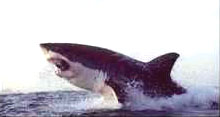
White shark demonstrating a "surface charge" style of predatory
behavior, photographer unknown
Based on underwater observations, scientists described some approach patterns.
Most sharks used an "underwater approach" in which the shark swam
just below the surface until it was approximately 1 m (3.3 ft) from its intended
prey and then attacked by deflecting the head upward and emerging out of the
water. The white shark also presented a "surface-charge" which consisted
of a rapid rush with the body partially above the surface. In rare cases,
whites performed an "inverted approach" in which they swam with
the ventral side up. "Vertical charges" often result in the shark's
entire body clearing the surface of the water, photographer unknown
Although the majority of approaches are horizontally oriented, vertical approaches
are nonetheless common. White sharks readily engage in vertical swimming during
feeding activities, sometimes swimming perpendicular to the surface in direct
and rapid pursuit of floating objects. There are benefits of using the vertical
approach to capture prey positioned near the surface. Firstly, a predator
attacking from below is more difficult for the prey to see, while at the same
time, the shark has a better view of its prey positioned overhead. In addition,
fleeing (rapid movement away from an approaching predator) is probably the
most common escape tactic used by animals under attack. Considering these
situations, extended escape in the direction opposite the vertically approaching
shark is virtually impossible. The propensity for vertical swimming was observed
in small white sharks approximately 220 cm (86 in) in length. Scientists believe
that the development of this behavior precedes physical changes, such as broadening
of the teeth, believed to be adaptations for feeding on large marine mammals.
Few hypotheses about the consumption patterns of white sharks have been made
based on observations under natural conditions.
One of these hypotheses, the "bite, spit and wait" theory, is composed
of three elements. Initially, the white shark seizes its prey and releases
it intact; secondly, the shark waits until the prey lapses into a state of
shock or bleeds to death; finally, the white shark returns to feed on the
dead or dying animal. However, recent studies do not support this hypothesis.
Scientists believe that these sharks may not release potential prey to permit
them to die but, rather, let them go in response to their defensive behavior
or unsuitability as food. Some evidence suggests that white sharks decide
a prey's palatability while it is lodged in the shark's mouth. Researchers
also believe that white sharks may prefer animals rich in energy, such as
marine mammals, in favor of less fatty, energy-poor prey. This is supported
by some observations of aggregations of white sharks selectively feeding on
the blubber but not the muscle layers of mysticete whales. This behavior seems
based upon a size-hierarchy, where large sharks dominate in the feeding.
A behavior pattern described as "repetitive aerial gaping" was observed in white sharks of southern Australia. The sharks were seen with their heads out of the water, mouths at or above the surface, rolling onto their side and opening and closing their mouth in a moderately slow, rhythmic, partial gape while swimming slowly along the surface. The most notable difference between this behavior and normal surface feeding is that the repetitive aerial gaping is not oriented toward food or possible targets. White sharks also scavenge from fishermen's nets and longlines and take all manners of hooked fish. This propensity often results in their own accidental entrapment.
· Predators
The white shark is an apex predator (atop the food chain) and as such, has
very few predators. Killer whales (Orcinus orca) and larger sharks pose the
only real threats for an adult white shark. Click here for a first hand account
of a killer whale/white shark encounter and here for an interpretation of
the encounter.
· Social Behavior
Some of the white's swimming modes, such as a cautiously timed turn away between
two animals on reciprocal approaching courses, are interpreted as ensuring
avoidance of conspecifics and maintenance of individual space. A parallel
swim mode, whereby two sharks heading in the same direction at an unfluctuating
distance from each other, also seems to be a result of the shark preserving
its space from others. When two white sharks attempt to feed on the same prey,
it is disadvantageous for one to discourage the other from further feeding
by biting it and inflicting a wound. Such an injury might reduce either shark's
future ability to catch prey. For this reason, scientists believe that white
sharks sometimes use displays in order to discourage other sharks. White sharks
have been observed with their caudal fin out of the water and slapping the
surface, propelling water usually in the direction of a second shark. The
recipient shark probably perceives the sign with its vision, lateral line
(related with mechanical stimulation), and sense of hearing. This behavior
is called a "tail slap" and is the most common avoidance display
shown by white sharks. These sharks also present other types of displays.
White sharks have been observed rolling on their sides and directing exaggerated
tail beats in one direction, a phenomenon know as "tilting behavior".
Sometimes a white shark will position itself between prey and another shark,
preventing the second shark from feeding. White sharks have also been known
to propel two-thirds of their body out of the water and land flat against
the surface, causing a large splash. This behavior is called a "pattern
breach" and may represent a similar, but more intense sign than the tail
slap. This specific behavior might also be used to help remove external parasites,
attract a mate during courtship or may be the result of a vertical charge
approach pattern toward a prey item.
· Reproduction
White sharks are viviparous (embryos hatching in uteri, with the female giving
birth to live young). Embryos are nourished through oophagy (ingestion of
unfertilized eggs). While in uteri, the embryonic white sharks swallow their
own sets of shedded teeth, perhaps to reutilize calcium and other minerals.
Size at birth ranges from 120-150 cm (47-59 in) in total length. It is possible
that any one female only reproduces biennually, mating soon after giving birth,
but this remains to be confirmed. Gestation time is also unknown, but is thought
to be quite long, possibly up to one year. Some bite-marks observed on the
dorsum, flanks and particularly the pectoral fins of mature female white sharks
have been interpreted as results of mating activity. As in other species of
sharks, the male white shark most likely grabs the female during copulation.
Some records suggest that parturition occurs in temperate shelf waters during
the spring to late summer. Click here for more information on the reproductive
strategy of white sharks.
Despite its relative sparseness, the white shark's rate of capture by humans
is alarmingly high. This is due in part to the increasing monetary value of
its jaws and teeth. Entire specimens, some attaining more than 5m in length
have been preserved by freezing or taxidermy for permanent public display
or as private trophies or curios. Also, the flesh is utilized for human consumption,
the skin for leather, the liver for oil, the carcass for fishmeal and the
fins for shark-fin soup. Worldwide, specimens are reported annually from gill
nets, trammels, herring weirs, purse seines, tuna enclosures as well as surface
hooks, bottom longlines and set-lines.
Conservation
Overall population estimates for this species are unknown and even regional
and localized estimates are questionable. It has been proposed that white
sharks should be afforded protection for the same reasons as other top carnivores.
In addition to being rare, they are important participants in a complicated
food web. As with most species of shark, white sharks are slow-growing animals
with low productivity and are therefore highly vulnerable to overfishing.
Fortunately, the threat of habitat loss appears minimal to white sharks. They
are adaptable predators capable of shifting diet as conditions dictate and
may simply cease to inhabit an area with little food. The most significant
problem in applying definitive measures in favor of the white shark remains
the lack of data, such as fecundity, age, growth, and population numbers.
Considering the lack of data, it has been proposed that protective measures
should be based on a precautionary principle, until more biological information
has been collected. Researchers do know that shark populations, including
the white shark, will inevitably dwindle unless careful measures are implemented.
Some governments, such as those in South Africa, Australia and the United
States, have already afforded protection to the white shark. At present, the
white shark is listed as "vulnerable" by the International Union
for Conservation of Nature and Natural Resources (IUCN).