TIGER SHARK
Order - Carcharhiniformes
Family - Carcharhinidae
Genus - Galeocerdo
Species - cuvier

Geographical Distribution
Habitat
Biology
Conservation
Geographical Distribution
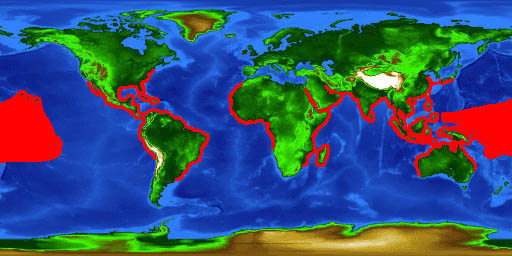
This shark has a notable tolerance for many different kinds of marine habitat but generally prefers murky waters in coastal areas. It is commonly found in river estuaries, harbors, and other inlets where runoff from the land may attract a high number of prey items. Shallow areas around large island chains and oceanic islands including lagoons, are also part of the tiger shark's natural environment. It is often seen at the surface and has been reported to depths of 350 m (1085 ft).
Tiger sharks undergo seasonal migrations. It is well known that they move into temperate waters from the tropics for the warmer months and return during the winter. These sharks also make long oceanic migrations between islands and are capable of traveling long distances in a short amount of time.
Biology
· Distinctive Features
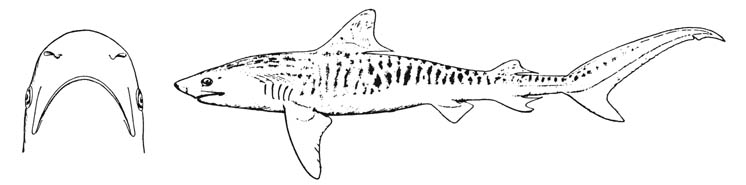
Probably the most easy to recognize of the requiem sharks, the tiger gets
its name from dark black spots and vertical bars which run the length of the
body. The anterior portion of the body is stout but becomes increasingly slender
posterior to the abdomen. The tiger shark has a robust head with large eyes
and a very blunt snout. The mouth itself is large with long labial furrows.
The broad first dorsal fin originates posterior to the pectoral axil. The
much smaller second dorsal fin initiates anterior to the origin of the strongly
recurved anal fin. A ridge is present along the back between the dorsal fins.
A low longitudinal keel is present on the caudal peduncle and the upper lobe
of the caudal fin is long and thin with a subterminal notch.
· Coloration
Bluish-green to dark gray or black dorsal surface with a yellowish-white to
stark white underbelly. The characteristic dark spots and stripes are most
prominent in young sharks and fade as the shark matures.
· Dentition
The tiger shark has very distinct dentition. The jaws house large teeth with
curved cusps and finely serrated edges. Each tooth has a deep notch on the
outer margin lined with numerous cusplets. Upper and lower teeth are similar
in shape and size and decrease in measurement as they move back toward the
mouth's corners.
· Size
One of the largest sharks, the tiger shark commonly reaches a length of 325-425
cm (10-14 ft) and weighs over 385-635 kg (850-1400 lbs). Length at birth varies
from 51-76 cm (1-1.5 ft). Males reach sexual maturity at 226-290 cm (7-9 ft),
while females become mature at 250-325 cm (8-10 ft). The largest specimens
are believed to attain a length of over 5.5 m (17 ft) and weigh over 900 kg
(2000 lbs).
· Feeding Behavior
Undoubtedly the least discriminative all species, the tiger shark has a reputation
as an animal that will eat almost anything. Preferred prey varies depending
upon geographical region but commonly includes sea turtles, rays, other sharks,
bony fishes, sea birds, dolphins, squid, various crustaceans and carrion.
The tiger shark's highly serrated teeth combined with the saw-like action
from shaking the head back and forth allows it to tear chunks from much larger
marine animals. Interestingly, it is not uncommon to find objects of human
origin in this animal's stomach. One large female caught off the north end
of the Gulf of Aqaba in the Red Sea contained two empty cans, a plastic bottle,
two burlap sacks, a squid, and a 20 cm (8 in) fish. Garbage and refuse is
often recovered from the stomachs of sharks caught in harbors and river inlets
where it is commonly dumped into the water. Although far from a natural food
item, human remains sometime end up in the guts of these scavenging sharks.
Tiger sharks are solitary hunters that feed primarily at night as the shark
moves further inshore and closer to the surface. Tiger sharks are sometimes
seen in groups of several but this is probably a result of congregations of
food items in the vicinity.
· Reproduction
The tiger shark is the only species of its family that is ovoviviparous. The
gestation period ranges from 14-16 months, at which time a female can give
birth to anywhere from 10 to 80 pups. In the Northern Hemisphere, mating takes
place between March and May and the young are born between April and June
of the following year. In the Southern Hemisphere, it is believed that pupping
occurs in November to January. It is believed by some scientists that because
of the large size of the young at birth, uterine nutrition is supplemented
by 'uterine milk' secreted by the lining of the uterus.
Although not targeted directly by the commercial fishery in the US, the tiger
shark is routinely harvested for its fins and flesh. In addition, its liver,
which tends to have a very high vitamin A content, is used to produce vitamin
oil while its thick, tough skin makes for quality leather. Beside its significance
to the commercial fishery, the tiger shark is a highly sought after big game
fish.
Both commercial and recreational fishing catch rates for this species in the mid-Atlantic region have declined since the mid-1980's, indicating that fishing pressure has adversely affected the size of the population. In contrast, relative abundance and catch rates for this species noted by commercial fisheries observers, especially for juveniles, are much higher than in previous fishery-independent and fishery-dependent surveys. The International Union for Conservation of Nature and Natural Resources (IUCN) presently lists the tiger shark as "lower risk".