SANDBAR SHARK
Order - Carcharhiniformes
Family - Carcharhinidae
Genus - Carcharhinus
Species - plumbeus
Geographical Distribution
Habitat
Biology
Conservation
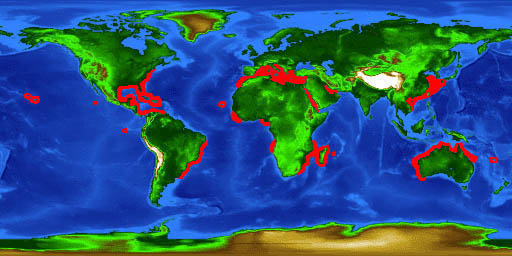
C. plumbeus is essentially a bottom-dwelling, shallow coastal water species that is seldom seen at the water's surface. It tends to prefer waters on continental shelves, oceanic banks, and island terraces but is also commonly found in harbors, estuaries, at the mouths of bays and rivers, and shallow turbid water. Despite this, plumbeus is exclusively a marine species and does not venture into freshwater. It is believed that the sandbar shark favors a smooth substrate and will avoid coral reefs and other rough-bottom areas. It spends most of the time in water from 20-65 m (60-200 ft) deep but undoubtedly moves into deeper water to undergo migration and has also been reported in water so shallow it leaves the first dorsal fin exposed.
Like many sharks of its genus, the sandbar shark undergoes seasonal migrations. These movements are influenced mainly by temperature although it is believed that ocean currents also play a significant role. In the western North Atlantic, adult sandbars move as far north as Cape Cod during the warmer summer months and return to the south at the onset of the cooler weather. The adults of this species do not migrate together. Instead, males migrate earlier and in deeper, cooler water than females. Male sandbar sharks also demonstrate congregated migrations and often travel in large schools whereas females experience solitary migrations. It is believed that populations of this species along the southeastern coast of Africa also take part in seasonal migrations. Off the Hawaiian Islands, however, sandbar sharks are thought to be annual residents. Due to the vast distances between known populations of sandbar sharks around the world, it is highly probable that these animals are capable of long, pelagic migrations as well. However, these long-range movements are most likely a result of accidental or irregular "rides" of prevailing oceanic currents rather than regular migrations associated with seasonal temperature.
Biology
· Distinctive Features
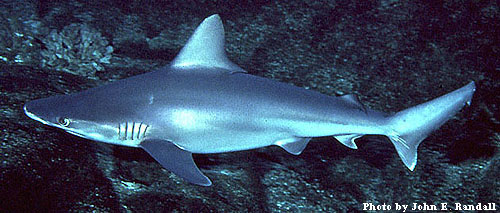
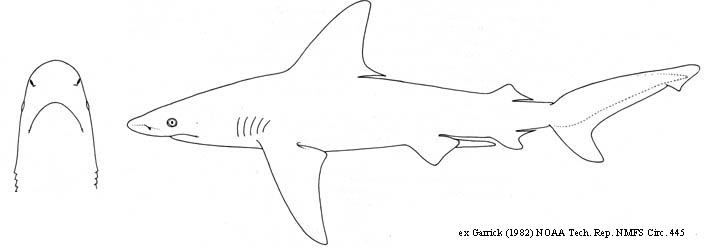
The sandbar shark's most distinguishing characteristic is it's taller than
average first dorsal fin, which originates above or slightly anterior to the
pectoral axil. It has a short, bluntly rounded snout that is shorter than
the width of the mouth. An interdorsal ridge is present between the dorsal
fins. Its widely spaced dermal denticles have no definite teeth and don't
overlap as is with most sharks of the family carcharhinidae.
· Coloration
Bluish to brownish gray dorsally, and a lighter shade of the same color to
white underneath. Although the tips and outer margins of the fins are sometimes
a darker tone, this species has no obvious markings.
· Dentition
The upper teeth are broadly triangular, serrated with high cusp. The lower
are narrower and more finely serrated. The front teeth are erect and symmetrical
but become smaller and increasingly oblique as they move toward the corners
of the jaws.
· Size
C. plumbeus is a moderately large shark that can reach up to 2.4 m (7.5 ft)
in length but more typically grows to 200 cm (6 ft). Males reach maturity
between 130-180 cm (4-5.5 ft) while females mature at 145-180 cm (4.5-5.5
ft). Size at birth ranges from 55-70 cm (1.5-2 ft). The sandbar shark can
weigh from 45-90 kg (100-200 lbs) at maturity but averages 50 kg (110 lbs)
for males and 68 kg (150 lbs) for females.
· Feeding Behavior
The sandbar shark is an opportunistic bottom-feeder that preys on relatively
small fishes, mollusks and crustaceans. Common food items include various
bony fishes, eels, skates, rays, dogfish, octopus, squid, bivalves, shrimp
and crabs. The sandbar shark feeds throughout the day but becomes more active
at night. Because of the high percentage of sharks found with partially full
stomachs and their relatively large liver, which contains high percentage
of oil and vitamins, it is believed that these sharks have a very successful
feeding strategy and receive a more regular supply of food than other carcharhinids.
· Reproduction
In the Northern Hemisphere, mating occurs in the spring or early summer (May-June).
In correlation with the warmer summer season, mating takes place in late October
to January in the Southern Hemisphere. During this time, a mature male persistently
follows a female, occasionally biting the area between her dorsal fins until
she turns over allowing him to insert his claspers into each oviduct via the
cloaca. This form of courtship behavior, which is present in most carcharhinids,
often leaves the female with permanent scaring.
Once fertilization occurs, the gestation period can range from 8-12 months
depending upon geographical location. For example, female sandbar sharks of
the western Atlantic generally carry their young for 9 months whereas in southeastern
Africa, the gestation period can last as long as 12 months. A female sandbar
shark can become gravid every other year, with a resting year occurring after
each birthing event. The embryos are nourished via a placental sac, a reproductive
strategy known as viviparity. In the western Atlantic, pups are born from
June through August while off southeastern Africa, pups are born from December
to February. When the time comes to drop her pups, a female moves into the
shoals, gives birth and leaves the area shortly afterward. This shallow water
habitat provides a 'nursery' area for young sharks where they are afforded
protection from larger sharks (it is well known that adult bull sharks, Carcharhinus
leucas, prey heavily on juvenile sandbar sharks). In the western North Atlantic,
the bays and estuaries from Delaware to North Carolina is the prime sand bar
shark nursery area. As with gestation period and mating times, litter size
also varies by region. In the South China Sea, litters typically number from
6-13, whereas off the Hawaiian Islands, litters average about 7 pups. Regardless
of location, litter size is dependent upon the size of the mother, with larger
sharks producing larger litters. Remarkably, both sexes are almost always
represented in a 1:1 ratio. Young sandbar sharks resemble their adult parents,
although the characteristically large first dorsal fin may not yet be as prominent
at this early stage. Juvenile sandbar sharks remain in the shallows until
late fall at which time they form schools and move southward and further offshore
only to return for the summer months. This movement between shallow coastal
waters and warmer, deeper waters may continue for a period of up to five years
but should not be confused with adult migrations that involve much greater
distances.
The sandbar shark plays an important role in the commercial shark fishery
along the eastern United States. In fact, because of its numbers, moderate
size, palatable meat, and high fin-to-carcass ratio, it is the primary targeted
species in this area. It is also harvested in the eastern North Atlantic as
well as the South China Sea for its fins, flesh, skin and liver. In addition
to the significant impact the sandbar shark has on the commercial fishery,
it is valuable to recreational fishermen as a game fish.
Conservation
As is with other species of shark that demonstrate a reproductive strategy
that includes a relatively long gestation period, a low number of offspring
per litter and a slow growth rate, the sandbar shark is vulnerable to over-exploitation
by fishing. Increased recreational fishing and a heightened demand for shark
fins as well as shark meat in the 1980's had a profound adverse effect on
the numbers of sandbar sharks in the southwestern Atlantic. It has been proposed
that the population of sandbar sharks in this area dropped by two-thirds between
the 1970's and early 1990's. However, there has been a slight rise in population
numbers in recent years directly as a result of the imposition of fishery
regulations. In addition, it is believed that there has been a decrease in
the predation of juvenile sandbar sharks in nursery grounds by larger sharks.
This is based on the observation that fishing pressure was also reducing the
number of larger predatory sharks, most notably tiger (Galeocerdo cuvier)
and bull sharks. Currently, the sandbar shark is listed as "lower risk"
by the International Union for Conservation of Nature and Natural Resources
(IUCN)