NURSE SHARK
Order - Orectolobiformes
Family - Ginglymostomatidae
Genus - Ginglymostoma
Species - cirratum
Geographical Distribution
Habitat
Biology
Conservation
Geographical Distribution
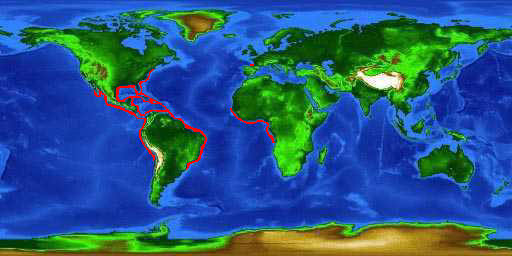
Common in the Atlantic and in the eastern Pacific, in coastal tropical and
sub-tropical waters. Reported from Senegal to Gabon, Rhode Island to Southern
Brazil, and Mexico to Peru. Also, some individuals have been reported in the
Gulf of Guascony in Northern France. This species is locally very common in
shallow waters throughout the West Indies, south Florida and the Florida Keys.
Apart of the eastern Pacific, the nurse shark is absent from the Indo-Pacific
area, where other related groups have successfully evolved.
The nurse shark is a nocturnal animal that rests on sandy bottoms or in caves or crevices in rock in shallow waters during the day. They occasionally occur in groups of up to 40 individual, as they lie very close together sometimes even piling upon one another.
Nurse sharks are very active during the night. In addition to swimming near the bottom or well off it, the nurse shark can clamber on the sea floor, using its flexible, muscular pectoral fins as limbs. Large juveniles and adults are usually found around deeper reefs and rocky areas at depths of 3-75 meters (10-250 ft) during the daytime and migrate into shallower waters of less than 20 meters (70 ft) deep after darkness.
Juveniles up to 170 cm (6 ft) are generally found around shallow coral reefs, grass flats or mangrove islands in 1-4 meters (3-13 ft) of water. They often lie in groups within limestone solution holes or under rock ledges.
Nurse sharks show a strong preference for certain resting sites, and repeatedly
return to the same caves and crevices after a nocturnal activity.
· Distinctive Features
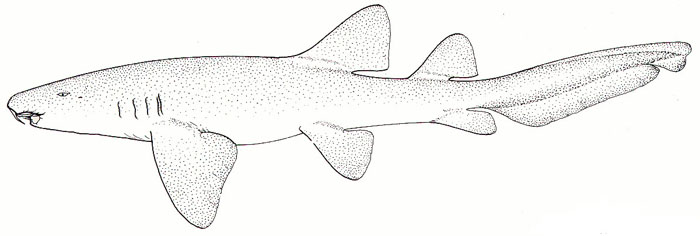
Nurse sharks have two spineless, rounded dorsal fins with the first dorsal
fin much larger than second, and one anal fin. The origin of the first dorsal
fin is about over the origin of the pelvic fin. The caudal fin is more than
¼ of the total animal length.
The sub-terminal mouth is placed well in front of the eyes, the spiracles
are minute, and moderately long barbels reach the mouth. Nasoral grooves are
present, but there is no perinasal groove.
· Size
One of the largest sharks, the tiger shark commonly reaches a length of 325-425
cm (10-14 ft) and weighs over 385-635 kg (850-1400 lbs). Length at birth varies
from 51-76 cm (1-1.5 ft). Males reach sexual maturity at 226-290 cm (7-9 ft),
while females become mature at 250-325 cm (8-10 ft). The largest specimens
are believed to attain a length of over 5.5 m (17 ft) and weigh over 900 kg
(2000 lbs).
· Dentition
Nurse sharks possess independent dentition, the simplest type of tooth arrangement
found in sharks. This means that there is no overlap between teeth, and that
forward movements of teeth leading to shedding does not depend on other teeth.
In sharks with various degree of overlapping dentition, replacement of teeth
cannot take place until outer blocking teeth are lost. Replacement rates among
juveniles are generally faster than for adults. Also teeth replacing occur
faster in summer, when water temperatures are higher.
· Coloration
Adult nurse sharks generally range from light yellowish tan to dark brown
in color. Juveniles up to 60 cm (23 in) have small black spots, with an area
of lighter pigmentation surrounding each spot, covering the entire body. These
are bands of lighter and darker pigmentation along the dorsal surface. Juveniles
(70-120 cm / 28-48 in) are capable of limited color changes. In a tank experiment
small nurse sharks, covered for just a few minutes became considerably lighter
than individuals exposed to full sunlight. Unusually pigmented individuals
(e.g. brilliant yellow or milky white) have been reported several times.
· Size and Growth
Averaging 220-270 cm (7.5-9 ft) in total length and weighing 75-105 kg (167-233
lbs), adult females reach a larger size than adult males (210-260 cm / 7-8.5
ft ; 90-120 kg / 200-267 lbs). Size at maturity is also larger for females,
about 225 cm (7.5 ft) in females vs 210 cm (7 ft) for males. Size at birth
is in the 28-30 cm (11-12 in) range, with growth rates for juveniles of about
13 cm (5 in) and 2.3 kg (5 lbs) per year. Once maturity is reached, growth
rates are usually much lower.
· Feeding Behavior
A nocturnal predator, the nurse shark feeds mainly on fish especially stingrays,
molluscs (octopi, squids and clams) and crustaceans. Algae and corals are
occasionally founded in the stomachs as well. The nurse shark has small mouth,
but its large, bellows-like pharynx allows it to suck in food items at high
speed. This system probably allows the species to prey on small fish that
are resting at night, species that are too active for the sluggish nurse shark
to catch during the day. Heavy-shelled conches are flipped over, and the snail
extracted by use of suction and teeth.
Young nurse sharks have been observed resting with their snouts pointed upwards and their bodies supported off the bottom on their pectoral fins. Some suggest this posture may possibly provide a false shelter for crabs and small fishes that the shark ambushes and eats.
· Reproduction
The nurse shark is an ovoviviparous species. This means that embryonic development
occurs in an egg case within the mother's ovary. The embryo has its own yolk
sac, which is absorbed during development, and there is no placental nourishment
from the mother. The nurse shark has a biennial reproductive cycle. After
mating, gestation takes about six months. It then takes other eighteen months
for the ovaries to produce mature eggs for the next breeding.
Mating generally occurs in the summer between the end of June and July, with female nursing sharks giving birth around November and December. Broods are typically of 30-40 individuals. In the waters of the Florida Keys and the Dry Tortugas archipelagos, the reproductive behavior of the nurse shark has been regularly observed and studied, making it's copulatory behavior among the best known in shark species.
Males approach females that resting on the sea floor or are swimming just above it. The male then bites one of the female's pectoral fins simultaneously pushing, trying to turn her onto one side. In this position it is easier for a male to insert his clasper, vigorously bending the lower portion of his body towards the female's cloaca.
A large number of males generally try to mate with a single female, often leading to females bearing numerous scars and bruises from male bites. Females frequently try to avoid contact with males by swimming in very shallow water, where they can bury their pectoral fins in the sand.
· Predators
There are no species that regularly prey on nurse sharks. However some larger
sharks are known to feed occasionally on them. Remains of nurse sharks have
been found in lemon and tiger shark stomachs, and attacks on nurse sharks
by bull sharks and great hammerhead sharks have been observed.
Importance to Humans
At present there is not a fishery for this species. The fins are not marketed
and the meat, although edible, is not often retained for human consumption.
However it is sometimes sold as crab bait.
Nevertheless, nurse shark are caught and killed by fishermen in some regions
because they are considered a nuisance animal that takes bait intended for
other species. In the Lesser Antilles, where it often raids fish traps, it
is considered a pest. Commercial fishers in the United States routinely release
nurse sharks alive.
In the past nurse sharks were sought for various reasons. The liver oil often
was used as fuel. The oil also was used by commercial sponge fishers to calm
the water surface, allowing them to more readily locate sponges on the seafloor.
The skin was considered the best of all elasmobranch species, being extremely
tough and thick, and was used to make high quality leather. The skin also
was occasionally salted for human consumption.
Although the nurse shark is not an endangered species, its abundance in the
littoral waters of Florida has decreased in the past decades. The presence
of this species in areas with constant anthropogenic activity makes it susceptible
to disturbance. Because of its relatively docile behavior, swimming with (and
handling and feeding) nurse sharks is a very popular form of ecotourism.
The effects of high levels of interactions with humans in coastal waters are
not completely known, but the fact that nursing areas are now limited only
to remote regions suggests a correlation.
Identification and protection of these areas, coupled with further research
on the biology of nurse shark, is essential to provide effective conservation.