MEGAMOUTH SHARK
Order - Lamniformes
Family - Megachasmidae
Genus - Megachasma
Species - pelagios

Geographical Distribution
Habitat
Biology
Geographical Distribution
Although only 15 sightings (see Table) of megamouth shark are reported, this species is now known from Indian, Pacific and Atlantic Oceans. As with the two other filter-feeding sharks, the basking and whale sharks, this species is wide-ranging. However, the megamouth is considered to be less active and a poorer swimmer than the basking or whale sharks. Poor mobility likely is a reflection of its flabby body, soft fins, asymmetrical tail, lack of keels and weak calcification.
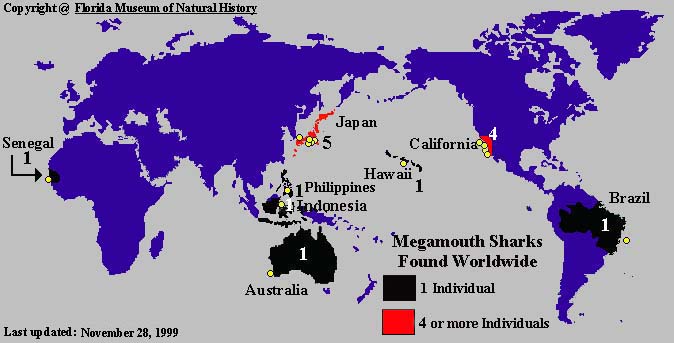
As its species name (pelagios, the Greek word for "of the sea') suggests,
the megamouth lives epipelagicly (in the upper part of the water column) in
open ocean. Although only few sightings of megamouth have been reported, the
capture of the 6th megamouth was very important in augmenting our understanding
of the ecology of this species. This specimen was tagged and followed for
two days, allowing insight into its habitat preference and behavior. It remained
at a depth of 15m during the night, then dove to 150m at dawn and returned
to shallow waters at dusk. So the megamouth is presumed to be a vertical migrator
on a diel cycle, spending the daytime in deep waters and ascending to midwater
depths at night.
Biology
· Distinctive Features
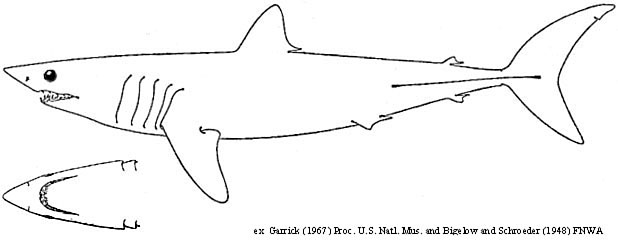
Body stout, tapering posteriorly. Head bulbous, wide and long; snout very
short and broadly rounded. Gill slits moderate long but not reaching dorsal
surface of head. Mouth broad, terminal, corner extending behind eyes. Caudal
peduncle without keels or ridges.
First dorsal fin origin closer to pectoral fin bases than to pelvic fin bases;
dorsal fins relatively low; second dorsal fin less than half size of first
dorsal fin. Pectoral fins shorter than head length in adults. Caudal fin asymmetrical,
with pronounced ventral lobe.
· Size
The sizes of all reported megamouth sharks are listed in a table (see Table).
Maximum size is at least 550cm (17ft). Males mature by 400cm (13ft) and female
by 500cm (16ft).
· Coloration
Dorsal surface of body, pectoral and pelvic fins, dorsal fins, center of anal
fin and caudal fin are blackish brown. Ventral surface of body, below level
of pectoral end pelvic fins, tips and posterior margins of pectoral and pelvic
fins, abruptly white, as the posterior margins of dorsal and anal fins and
postventral caudal margins.
Dorsal side of head is blackish brown, except areas between nostril and eye
and between eye and spiracle, which are paler than the rest of dorsal area
of head. Lateral side of head behind mouth corner is darker. Lower jaw dark
with silver tint and many small dark blotches. Ventral side of head behind
lower jaw dirty white.
Mouth roof on dorsal and lateral parts, and oral membranes, silvery. Tongue
purplish brown with slight silvery tint on both sides, dorsally and ventrally.
Both sexes seem to have a white band on the anterior surface of the snout.
This white band could be considered a feeding behavioral characteristic, because
it is so contrasted by the dark coloration of the snout and upper jaw, and
becomes very prominent when the upper jaw is protruded. Probably under low
light this white band may be more visible. This band might also be related
to recognition of other individuals of the same species.
· Dentition
The megamouth has approximately fifty rows of very small and relatively numerous
teeth on each jaw, but only three rows are functional. Females seem to present
fewer teeth rows than males. Upper and lower jaws have a symphyseal (where
the two halves of the jaw meet) toothless space, but it is larger in upper
jaw. A difference between the upper and lower teeth was recognized on a female
specimen. The first five upper teeth are smaller than the first five lower
teeth; the more distal upper teeth are smaller than the lower teeth; the cusps
of the lower teeth are more acute and longer than those of the upper teeth.
Megamouth tooth in A, lingual; B lingual; C lateral; and D, basal views, from
Compagno
· Mucous and Dermal Denticles
Megamouth sharks have very small mucous (on the tongue) and dermal (on the
skin) denticles that differ in shape and size at each region of the body.
There are many pigment cells on the dorsal side, but none on the ventral side.
· Behavior
Only two observations of megamouth provide information about this species
behavior. The 6th specimen from Dana Point, California (21 October 1990) offered
the most important insights into the behavior of this species. The male specimen,
with 494cm in total length, was tagged and tracked for two days. One of the
conclusions of these observations is that megamouth is probably a vertical
migrator on a diel cycle spending the daytime in deep waters and ascending
to midwater depths at night. This vertical migration may be a response to
the movements of the small animals on which it feeds. The krill that make
up part of megamouth's diet are known to migrate from deep waters to the surface.
Megamouth, in contrast to many other deep-water sharks, shows a decrease in specific gravity in the form of a soft, and poorly calcified cartilaginous skeleton; very soft, loose skin; and loose connective tissue and muscles. Others epibenthic (live in the water just above the bottom) and epipelagic sharks often have an enlargement of their abdominal cavity and increased liver volume. The huge liver allows for greater production of liver oil in order to reduce specific gravity and increase hydrostatic support.
The 13th sighted also offered important megamouth behavioral observations.
This sighting documented sperm whales attacking megamouth shark. Observers
reported that the megamouth was swimming slowly and apparently confused at
the surface. The shark showed signs of the whales' attack, on the base of
its dorsal fin and gills.
· Feeding Behavior
The megamouth shark, which reaches over than 500cm in length, is one of the
three giant filter-feeding sharks in the sea. The other two are the basking
shark (Cetorhinus maximus) and the whale shark (Rhincodon typus).
Precise details of feeding behavior are unknown due to the lack of observations
on a live, feeding specimen. However, some inferences can be made from morphological
observations on the captured specimens. The megamouth shark, as its vernacular
name indicates, has a huge mouth that is terminal and extends behind the eyes.
Scientists believe that this shark swims slowly through aggregations of euphasiid
shrimp ("krill") and other small prey with its mouth open (A). It
feeds by protruding its jaws and expanding its buccal cavity in order to sucks
the prey inside (B). Then the mouth is closed and the jaws retracted. This
action decreases the pharyngeal volume and makes possible the expelling of
water through the gill openings (C).
· Stomach Contents
All analyzed specimens presented euphausiid shrimp in the stomach, indicating
a filter-feeding habit. The stomach of the first megamouth captured contained
only one type of shrimp, Thysanopoda pectinata. The second megamouth's stomach
contents included fragments of euphasiids, copepods (animals that make up
plankton) and the jellyfish, Atolla vanhoeffeni. In general, euphasiids are
the main alimentary item of megamouth diet.
· Origin of Filter-Feeding
There are two conflicting hypotheses about the origin of filter feeding in
megamouth exist. The first theory suggests a single origin for this habit
between megamouth and basking sharks. In contrast, the other suggests that
adaptations for filter feeding evolved independently in the two lineages from
different ancestral origins. Results of recent studies argue strongly in favor
of the latter hypothesis. This makes sense when considering morphological
and behavioral differences between the two sharks. The second hypothesis also
suggests that megamouth may have evolved its distinctive feeding apparatus
from an ancestral sand tiger-like shark (family Odontaspidae) through jaw
size exaggeration, acquisition of papillose (bud-like) gill rakers, and modification
of jaw protrusion for suction feeding.
· Reproduction
The megamouths II and VI were both mature males, and both showed evidence
of recent mating. The claspers of megamouth II were oozing spermatophores
and those of the sixth specimen were abraded and bleeding, a common occurrence
in sharks that have just mated. The 6th megamouth also had a fresh wound on
the lower jaw, a feature found in other sharks that grasp one another's mouth
during mating. Megamouth II was taken in late November and megamouth VI in
late October, these factors make scientists believe that Southern California
might be a mating area for megamouth sharks in the fall.
The claspers of the first captured megamouth were fully described. Its claspers were relatively slender, with tip elongated, forming a very narrow, slender process.
The 7th megamouth observed, a female with 471cm in total length was heavily
studied and one of the conclusions is that this specimen is immature. This
judgement was based on uteri that were enlarged only posteriorly, a poorly
developed ovary and ostium and the small size of the oocytes. The ovary of
the megamouth is similar to other mackerel sharks and this suggests that megamouth
embryos are oophagous (the first well-developed embryo eats the other eggs
in the uterus). The 12th megamouth captured is the only known mature female.
The total length of this specimen was 5.44m and the expanded uteri measured
260mm. The right ovary possessed a large number of whitish yellow eggs.
· Parasites
Almost all megamouth reported presented scars in different parts of body.
These scars are considered bite marks of the cookiecutter shark (Isistius
brasiliensis). Cookiecutter sharks are small dogfish sharks that attach to
prey with the help of suctorial (aiding in suction) lips, and a modified pharynx.
The cookiecutter removes a conical plug of flesh from the sides of the prey,
leaving a crater-like wound. This parasitic shark is presumed to be a vertical
migrator on a diel cycle, spending the daytime in deep waters and ascending
to midwater depths and to the surface at night. The similar suggested pattern
of megamouth combined with its slow swimming speed would make it easy prey
for the active cookiecutter shark. Some specimens, males and females, of a
parasitic copepod (Dinemoleus indeprensus), also have been found on the megamouth
body surface.
A few species of parasites are found internally in megamouth sharks, including
specimens of a cestode worm species (Corrugatocephalum ouei) and specimens
of a poorly known trypanorhynch (Mixodigma leptaleum) recovered from the intestine
contents of the 7th megamouth. A microscopic parasite (Chloromyxum) was also
found in this megamouth from its gall bladder.
· Predators
The only confirmed register of a megamouth predator is an isolated event of
sperm whales (Physeter macrocephalus) attacking this shark. This occurred
in Manado, North Sulawesi, Indonesia (30th August 1998) near midday, while
some researchers were observing the whales. The base of the dorsal fin and
the gills of the shark showed signs of the whales' attack.
Sperm whales are usually considered squid feeders but there are a few notes
about small deep-sea sharks in their diet. This behavioral observation significantly
alters our views on the relationship between whales and sharks (see notes
on the webpage).
Fishery Importance
Megamouth had probably been encountered more times than we know, but often
such large sharks are returned to the sea by their captors because of the
difficulty in handling them. However, those encounters were never been confirmed.
Actually, the megamouth is too rare to be harvested.