SHORTFIN MAKO
Order - Lamniformes
Family - Lamnidae
Genus - Isurus
Species - oxyrinchus
Geographical Distribution
Habitat
Biology
Conservation
Geographical Distribution
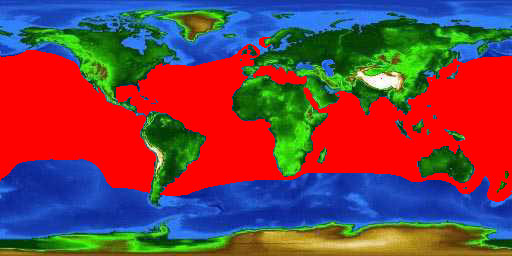
The shortfin mako is a true pelagic species with a primarily anti-tropical distribution. However, they will enhabit the cooler, deeper water of tropical regions. In some tropical areas where the surface temperature is 27°C (81°F), water temperature may be as low as 59°F (15°C) at depths of 30-60 m (94.2-188.4 ft). With the ability to elevate body temperature, makos are able to maintain themselves in temperatures of 5-11°C (41-52°F). In this sense the makos are somewhat "warm-blooded," meaning that heat in their blood is conserved within the body and not lost through the gills. They have been recorded at depths 740 m. However, shortfin makos prefer water temperatures between 17-20°C. It has been hypothesized this species migrates seasonally to warmer waters. This theory has been supported by tag and release studies.
These studies have also shown that while shortfin makos follow warm water, they do so within the confines of a specific geographical area. Consequently, there seems to be limited genetic flow between these geographically distinct populations.
Biology
· Distinctive Features
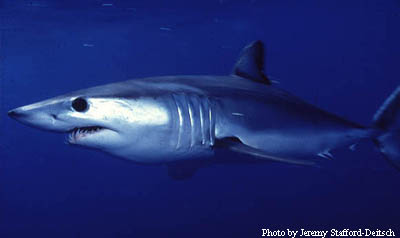
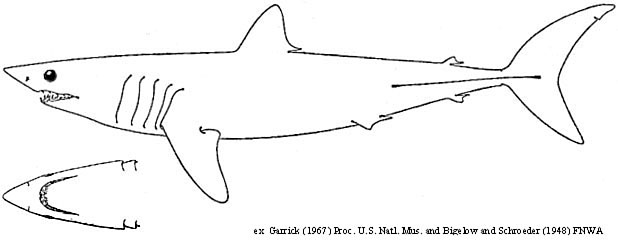
The shortfin mako body is conic-cylindrical and and extremely hydrodynamic. The snout is bluntly pointed with large black eyes. The caudal keel is prominent and the caudal fin is lunate. The tail has a high aspect ratio (ratio of height to length), which produces maximum thrust with minimum drag and provides almost all of the propulsion for the shark. The anteroventral zone of the snout is black.
There are two extant (living) mako sharks, the longfin mako (Isurus paucus)
and the shortfin mako (Isurus oxyrinchus). The longfin mako resembles the
shortfin mako, but has larger pectoral fins and larger eyes. The presence
of only one lateral keel on the tail and the lack of lateral cusps on the
teeth distinguish the makos from the closely related porbeagle sharks of the
genus Lamna.
· Coloration
Color is brilliant metallic blue dorsally and white ventrally. The line of
demarcation between blue and white on the body is distinct. The underside
of the snout and the area around the mouth are white.The latter is important
because is helps differentiate the shortfin from the longfin mako, which has
a darkly pigmented mouth region.Color is related to size. Larger specimens
tend to possess darker color that extends onto parts of the body that are
white in smaller individuals. The juvenile mako differs in that it has a clear
blackish stain on the tip of the snout.
· Dentition
The mouth is parabolic, or bowl-shaped, with the first teeth of the lower
jaw aligned in a continuous row. The large, triangle-shaped, narrow hooked
teeth have razor-sharp smooth edges. They are blade-like without basal cusps
or serrations. Teeth of both the upper and lower jaw are roughly uniform in
size and shape with the first two teeth on either side of the mandibular symphyses
being longer and more slender than the rest. Teeth of the lower jaw are visible
even when the jaw is shut while the upper teeth remain partially hidden except
when the jaw is projected outwards.
· Dermal Denticles
Denticles are small and overlapping, with 3 to 5 ridges, and 3 marginal teeth.
The middle marginal tooth is the longest and appears more worn down in comparison.
· Social Behavior
Very little is known about the social habits of the shortfin mako, except
that it is a solitary shark. Flank and abdominal scarring noted on females
indicates an aggressive mating ritual.
· Size, Age & Growth
Average adult size is 3.2 m (10 ft) and 60-135 kg (135-300 lbs). As with most
shark species, females are larger than males and may reach 380 cm (12.5 ft)
and weigh 570 kg (1,425 lbs). The largest "mako" taken on hook and
line worldwide was 505.76 kg (1115 lbs), however no positive species identification
was made (shortfin or longfin mako). The shortfin mako has a growth rate that
exceeds other lamnids. Length analyses, as well as counts of growth rings
on vertebral centra have been utilized in studies to estimate the age of this
species. Shortfin makos likely live about 20 years.
· Feeding Behavior
The shortfin mako feeds on other fast-moving pelagic fishes such as swordfish,
tunas, and other sharks as well as squid. The stomach contents of sharks caught
in gillnets off Natal, South Africa, showed a 60 to 40 ratio of shark to bony
fish, while a study from the northeastern United States found 77.5 percent
of the mako diet was bluefish. Marine mammals and sea turtles are rarely ingested
by this species.
Despite being a top predator, shortfin makos run the risk of physical harm
when hunting prey. There have been many reports of captured sharks bearing
scars apparently due to encounters with swordfishes. One mako recovered from
a net was impaled through the eye with the bill of the swordfish.
· Reproduction
Males mature at about 2 m (6.5 ft) and females at about 2.75 m (9 ft). Both
sexes reach sexual maturity between 4-6 years of age. Development is ovoviviparous.
Embryos in the uterus are nourished by yolk stored in a yolk sac. There is
no placental connection between mother and young. Once the young are hatched
into each uterus, uterine cannibalism (known as oophagy) occurs. Oophagy is
the ingestion of unfertilized or less developed eggs by a fetus that is more
developed. Young are born after 15-18 month gestation period. Litters range
from 8-10 pups measuring 68-70 cm (27-28 in). Upon capture, pregnant females
usually abort embryos, therefore few specifics about reproduction are known.
· Speed
The shortfin mako is the fastest shark, capable of attaining speeds of up
to 32 km/h (20 mph), and leaping skillfully out of the water. The mako holds
the speed record for long distance travel: approximately 2130 km (1320 miles)
in 37 days for an average of about 58 km (36 miles) per day.
· Predators
Larger sharks may feed upon juvenile shortfin makos. Adult makos likely fall
prey only to humans.
· Parasites
Shortfin makos host a variety of parasitic copepods. These are found on the
skin, in the mouth, and on the fins. Species recorded from the shortfin mako
include Dinemoura latifolia, Echthrogaleus denticulatus, Pandarus smithi,
Anthosoma crassum, and Nemesis lamna.
Due to its beauty, aggressiveness, and jumping ability, the shortfin mako is considered one of the great gamefishes of the world. Shortfin makos are caught with trolled baits and lures as well as with live or dead baits fished from anchored or drifting boats.
Highest recreational catches occur off southern California, the northeastern
United States, Australia and New Zealand. The shortfin mako was made famous
in Ernest Hemingway's The Old Man and the Sea. Hemingway also caught a 786
pound mako with a rod and reel off Bimini, the Bahamas, in 1963. It is a highly
sought after commercial species as well. Its flesh is flavorful and limited
quantities may be found in the United States markets, including California
where it sometimes is sold as swordfish. Commercial captures are made using
longlines, stationary gill nets, and drift nets. The fins and liver oil are
also marketed. Shortfin makos are a major by-catch component of the tuna and
swordfish fisheries.
The world's affinity for shark fin soup and the delectable flesh of the shortfin mako has lead to a decrease in population numbers. Worldwide, the shortfin mako is not only subject to overharvesting by direct hunting, and they are often by-catch victims of the tuna and swordfish fishing industries. As a result, the U.S. National Marine Fisheries Service has included the shortfin mako on their list of managed pelagic sharks. The NMFS has reduced the number of commercial and recreational shortfin mako catches allowed per year by 50% in an attempt to counter act its declining numbers. However, the NMFS regulations apply only to the United State's Atlantic and Gulf waters. Hastening their population decrease is their slow reproductive rate.