DUSKY SHARK
Order - Carcharhiniformes
Family - Carcharhinidae
Genus - Carcharhinus
Species - obscurus
Geographical Distribution
Habitat
Biology
Interest to Humans
Conservation
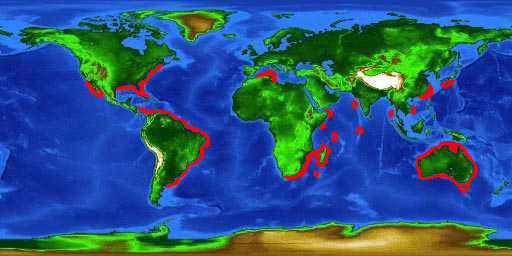
C. obscurus occurs along continental shorelines where it ranges from shallow inshore waters to the outer reaches of the continental shelf and adjacent oceanic waters. Although generally a bottom feeder, it can be found from the surface to a depth of 400 m (1240 ft). Adults of this species tend to avoid areas of low salinity and rarely enter estuaries. The young congregate in very shallow coastal water (nurseries) in estuaries and bays .
This species is known to be highly migratory in the western Atlantic and
eastern Pacific, moving north during the summer months and south in the winter.
Males and females undertake these seasonal migrations separately.
Along the coast of South Africa, immature dusky sharks are known to undergo
sex-segregated migrations with females moving north and males moving south.
However, this phenomenon is complicated by the occurrence of temperature-regulated
seasonal migration with sharks traveling southward during summer and northward
in winter. This, in turn, is further complicated by the tendency for some
sharks to move into deeper water during summer months.
Biology
· Distinctive Features
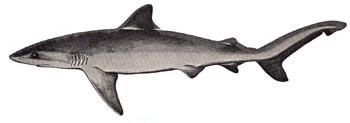
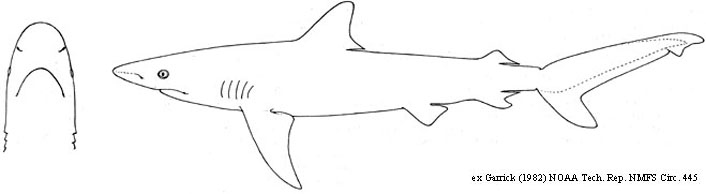
This species is characterized by a snout that is slightly shorter than or
as long as the width of the mouth, origin of the first dorsal fin over the
free rear tip of moderately large falcate pectoral fins, and a low interdorsal
ridge. The dusky shark is sometimes confused with the sandbar shark (Carcharhinus
plumbeus) but can easily be distinguished by its smaller and more posterior
first dorsal fin.
· Coloration
Typical of many of the carcharhinids, the dusky shark is bluish gray above
and white below. Tips of most fins dusky in younger sharks but inconspicuous
in adults.
· Dentition
Upper teeth are triangular and slightly oblique with serrated edges. Lower
teeth are erect, narrowly cusped and more finely serrated. Both sets of teeth
become increasingly concave as they move distally in the jaw.
· Dermal Denticles
The dermal denticles for C. obscurus are large, closely imbricated, and show
five keels with five distinct pointed lobes. The denticles rest on a large
rhomboidal base plate.
· Size, Age & Growth
A large shark, C. obscurus can attain a length of about 400 cm (12.5 ft).
Average size and weight are 320 cm (10 ft) and 160-180 kg (350-395 lbs), respectively.
Males mature at about 280 cm (8.5 ft) and females the same or slightly larger.
Size at birth ranges from 70-100 cm (33-39 in). Dusky sharks are very slow
growing, mature at about 20 years and may live as long as 45 years.
· Feeding Behavior
C. obscurus preys on a wide array of bony and cartilaginous fishes as well
as a variety of invertebrates. Food items include herring, eels, mullet, groupers,
grunts, croakers, bluefish, mackerel, tunas, various flatfish, a variety of
sharks, skates and rays, crabs, octopuses, squid, starfish and sometimes human
refuse.
· Reproduction
In the western Atlantic, mating occurs in the spring. Due to the presence
of two class sizes of young found in pregnant females off the coast of Florida,
it is believed that females of this species only mate every second year. These
different class sizes suggest alternating birth seasons every two years with
a gestation period of about 8 months or a single season with a longer gestation
period of about 16 months.
Dusky shark embryo showing placental connection, photo by José Castro©
As with other carcharhinids, developing embryos are nourished via a pseudo-placental
sac, a reproductive strategy known as viviparity. In the western Atlantic,
the number of young per liter ranges from 6-10 with an average of 8, whereas
in the southeastern Atlantic, numbers are slightly higher (range 6-14, average
10). In both cases, both sexes are represented in a 1:1 ratio.
Populations off the coast of Africa show no distinct breeding season although it appears that the young are born throughout the year with an increase in births from April to June. In the western North Atlantic, females give birth in the shallow bays and estuaries along the southeastern United States leave the area shortly after. This shallow water habitat provides a 'nursery' area for young sharks where they are afforded protection from larger sharks.
Interest to Humans
Dusky shark caught on a commerical longline set, photo by George Burgess©
The dusky shark is commonly harvested in the western Atlantic where its fins
are sold overseas for shark-fin soup base. It is also regularly taken on commercial
longlines as a bycatch in the swordfish/tuna fishery. Its flesh is marketed
for human consumption, its skin is used for leather and its rich liver oil
yields important vitamins. In this region, catch rates of all sizes of dusky
sharks are greatly reduced; large individuals are now a rarity in recreational
catches and their occurrence on commercial gear has declined. Because of its
large size and tenacity, the dusky shark is regularly sought after by anglers.
In southwestern Australia, juvenile and newborn dusky sharks are targeted
in the directed gill-net fishery.
On a global scale, dusky shark populations are considered at-risk, with the World Conservation Union (IUCN) assessing the species as LR/nt (Lower risk, near threatened). However, an ongoing decline in numbers indicated by low catch rates in the western North Atlantic has prompted a ban on the harvesting of dusky sharks by U.S. commercial fishermen and has led to this regional population being placed on the 2000 IUCN's Redlist of threatened species. Presently, the dusky shark in the western North Atlantic is listed as VU A1abd (Vulnerable, with a population reduction of 20% over the last ten years). In a recent assessment of fish stocks at risk of extinction by the AFS (American Fisheries Society), populations of dusky sharks in the western Atlantic and eastern Pacific are both considered vulnerable (not endangered or threatened severely but at possible risk of falling into one of these categories in the near future).