
Order - Lamniformes
Family - Cetorhinidae
Genus - Cetorhinus
Species - maximus
Geographical Distribution
Habitat
Biology
Interest to Humans
Conservation
Geographical Distribution
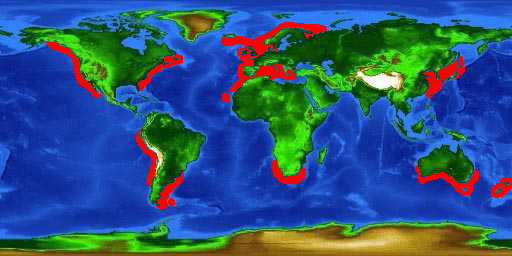
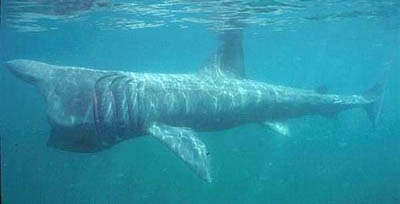
The basking shark is typically seen swimming slowly at the surface, mouth agape in open water near shore. This species also travels further offshore as well, and is known to enter bays and estuaries. Basking sharks are often seen traveling in pairs and in larger schools of up to a 100 or more. Its common name comes from its habit of 'sunning' itself at the surface, back awash with its first dorsal fin fully exposed.
Basking sharks are highly migratory. Off the Atlantic coast of North America
it appears in the southern part of its range in the spring (North Carolina
to New York), shifts northward in the summer (New England and Canada), and
disappears in autumn and winter. Off the southwest coast of the United Kingdom
in the northeast Atlantic, the basking shark feeds at the surface of coastal
waters during the summer. These sharks are absent from November to March,
suggesting a migration beyond the continental shelf during the winter months.
This is explained by the high zooplankton density (the primary food of the
basking shark) that exists in these waters during late spring and early summer.
Sightings of groups of individuals of the same size and sex suggest that there
is pronounced sexual and population segregation in migrating basking sharks.
· Distinctive Features
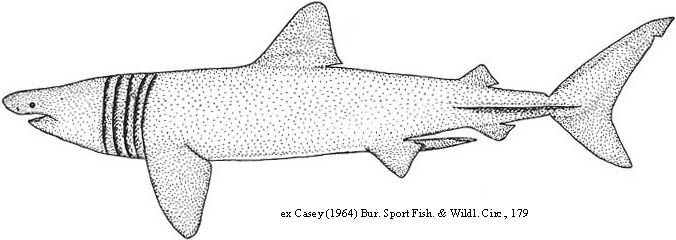
The basking shark is one of the most recognizable of all sharks. Its massiveness,
extended gill slits that nearly encircle the head and lunate caudal fin together
help distinguish it from all other species. It possesses a conical snout and
numerous large gill rakers modified for filter feeding. Its enormous mouth
extends past the small eyes and contains many small, hooked teeth. The basking
shark has a very large liver that accounts for up to 25% of its body weight.
The liver is high in squalene, a low-density hydrocarbon that helps give the
shark near-neutral buoyancy.
· Coloration
Dorsal surface is typically grayish-brown but can range from dark gray to
almost black. Ventral surface may be of the same color, slightly paler or
nearly white.
· Feeding Behavior
Along with the whale shark and the megamouth shark (Megachasma pelagios),
the basking shark is one of three species of large, filter-feeding sharks.
However, it is the only one that relies solely on the passive flow of water
through its pharynx by swimming. The other two assist the process by suction
or actively pumping water into their pharynxes. The basking shark is usually
seen swimming with its mouth wide open, taking in a continuous flow of water.
Food is strained from the water by gill rakers located in the gill slits.
The 1000-1300 gill rakers in the basking shark's mouth can strain up to 2000
tons of water per hour. Occasionally the basking shark closes its mouth to
swallow its prey. These sharks feed along areas that contain high densities
of large zooplankton (i.e., small crustaceans, invertebrate larvae, and fish
eggs and larvae). There is a theory that the basking shark feeds on the surface
when plankton is abundant, then sheds its gill rakers and hibernates in deeper
water during winter. Alternatively, it has been suggested that the basking
shark turns to benthic (near bottom) feeding when it loses its gill rakers.
It is not known how often it sheds these gill rakers or how rapidly they are
replaced.
Interest to Humans
In the past, basking sharks were hunted worldwide for their oil, meat, fins,
and vitamin rich livers. Today, most fishing has ceased except in China and
Japan. The fins are sold as the base ingredient for shark fin soup. A "wet"
or fresh pair of fins can fetch up to $1,000 in Asian fish markets while dried-processed
fins generally sell for $350 per pound. The liver is sold in Japan as an aphrodisiac,
a health food, and its oil as a lubricant for cosmetics. From a 4-ton (3629
kg), 27 feet (8.2 m) basking shark, a fisherman will get 1 ton of meat and
100 gallons (380 liters) of oil.
Conservation
As with other sharks, basking sharks are vulnerable to overfishing for several reasons. They have a lengthy maturation time, slow growth rate and a long gestation period. These factors combined with an already depleted population in many areas have prompted many countries to establish laws to protect the basking shark from further exploitation. The following is a list of significant conservation developments over the past ten years.
1993 - It was reported that the global population of basking sharks had dropped
by 80% since the 1950's.
1995 - A Barcelona Convention Protocol added the basking shark to its list
of Threatened Species.
1997 - The U.S. National Marine Fisheries Service banned the fishing for basking
sharks in US Federal Atlantic waters.
April 1998 - The British Government announced a movement to protect the basking
shark in UK waters, under Appendix II of CITES (The Convention on International
Trade in Endangered Species of flora and fauna). This request would not have
banned the hunting of basking sharks worldwide, but would have demanded that
countries that engaged in trading basking shark parts keep detailed records.
These records could then be used to determine whether the fishery was sustainable
or not.
October 2000 - U.S. Departments of Commerce and Interior announced their support
for UK movement to protect basking sharks.
November 2000 - AFS (American Fisheries Society) lists the population of basking
sharks in the western Atlantic as conservation dependent (reduced but stabilized
or recovering under a continuing conservation plan) and vulnerable in the
eastern Pacific.
Presently - The FAO (Food and Agricultural Organization of the United Nations)
is leading a plan to establish international shark fishery management strategies
for a number of species, including the basking shark.