What happened after that I can't remember for the life of me. Lionel was shaking me by the shoulder. "Charlie - Charlie! - hey, Charlie, we're here!"
Looking at the inside of the coach hurt my eyes - all those lights, glaring at me like the sun, hovering over the dark silhouettes of men, slumped over and lethargic. The flat smells of sweat, old tobacco smoke on clothing and dirty boot leather hung foggily over everything. My hand and shin both stung like the devil, while my neck moved like something that hadn't been oiled in years. I turned to the window and stared into my own reflection, punctured in places by the lights outside the car.
"Get up, c'mon, he's only going to sit here for a few minutes." Realizing I had no choice, I threw a hand out to the chair in front of me and hauled myself up, floating into the aisle. Lionel ushered me past him and followed me into the vestibule, where I gripped every grab iron available to help me and my giant, leaden boots down the steps.
Lionel trotted into the baggage room to get his bike, and I stood on the platform like a post, waiting. The conductor disappeared and an arm sprang out the coach window with a light attached to it, waving up and down in a signal. Two low, vibrant notes sang from the whistle, and the long line of lighted windows was drawn away, moving so heavily and smoothly it seemed that part of the earth was shifting into oblivion.
As I stood watching in what I guess was a sort of daze, I became aware of a bicycle sprocket whirring behind me. "Are you, ah, all right on your feet?"
I looked down at the paper cup still in my hand, empty. Good grief, I'd been an idiot . . . I could've killed myself in that cab, so close to the firebox, out in the middle of the desert from morning to dusk . . . I wondered why I hadn't been sent to the hospital, or why no one had noticed before Lionel. I could've keeled over in the cab, out on the line someplace. A fireman falling over . . . they couldn't have that, couldn't tolerate that, couldn't have tolerated me -
"Well, let's go."
Yes, let's go.
It was a summer night we were walking through, a warm desert night. It wasn't like winter nights, which tended to be full of pale blue moonlight when there was any at all, icy, wet and forbidding. This was a night you could only find in the desert, where the moon was a dim amber color and the shadows so deep you could disappear into them. The few lights left on in town retreated ever so slowly as we took the dirt road, the one light-colored path between the shifting, shadowy crops and furrows thick with a scent like dry grass, but sweeter. Once or twice, a train's whistle would wash over the fields, not breaking the silence so much as permeating it.
Lionel and I were side by side, me twiddling with that paper cup while he walked his bike alongside him like a faithful dog, its sprockets whirring. I spoke up. "Is that your dad's bike?"
Silence, for just a moment, then he answered "No, my mom's. See, it doesn't have a crossbar, so she could ride it wearing a dress."
"It's a girl's bike?"
"Yeah. It runs real well, though. It's got two separate gears on the back wheel so you can get different speeds."
"It sounds like you just oiled it."
"This morning. Got to, otherwise it gets gummed up with dust."
I was wondering why he didn't jump on his bike and take off for home, bouncing over the rocks and pebbles with ten times the speed I could manage with my shuffling pace and giant boots. That was what I wanted to do, fly along and see the road and crops becoming a blur and the horizon rushing closer. Even Lionel's boots were built for speed, a pair of worn but polished patent-leathers that were a few steps away from being slippers, perfect when you wanted to be light on your feet. I found my eyes drawn to his gold watch chain, its gleam brought out in the warm-toned moonlight. I swear I could hear the watch itself ticking in his vest pocket.
"How's Mr. Alexander?"
Lionel's question made me break stride a little. "Hm?"
"Mr. Alexander."
"He's a fair man."
"A fair man?" The sprocket on his bike stopped clicking. I saw his face twitch into an expression of disbelief, and I also stopped.
"What gives you the idea he isn't?"
The depot clerk answered very quietly, "I overheard."
We both instantly started forward again. If we'd gone on with that conversation, one of us would've wound up questioning his elders, something that went against the grain of seventeen years of training.
It wasn't such a long walk after that; already I could see a single pale brown light in a window, suspended over seas of wheat. "I'll take it from here," I tried to assure Lionel.
"Sure you will." He kept following.
"It's gotta be a long walk back to your place. Where do you live, anyway?"
"Near enough."
He saw me onto the porch, my boots clumping over floorboards even drier and crisper and with more of a hollow sound than they'd had almost a day before. Turning the doorknob against the pressure of the spring needed a huge effort on my part, one that made me wince as I brushed against the palm with the splinters in it. Farm work was tough, to be sure, hauling sixty-pound bales of hay into the barn, lifting heavy sacks and tractor parts, all manner of things to be fixed, from pipes to grain bins to steam lines, animals to be fed, watered, put out to pasture, but nothing had ever been as exhausting as that first day on the railroad. That door became a solid slab of hickory pivoting on hinges that resisted me with all the force that rust and friction could muster. As I hauled it shut, I saw Lionel on the front path, a black silhouette, standing like a sentry next to his mechanical steed.
The door slammed, its iron parts clanking and jolting into place. I turned and had to shield my eyes from the light, a small, bare bulb at the center of the table. My eyes were adjusting, and at first I saw a shadow, then two shadows, and finally my father.
I guess you wouldn't think of him as a farmer at first sight; he was a small man, six inches shorter than me but just as skinny. His hair glimmered grey in the lamplight, thin and short and wavy, while his skin hung in loose, wrinkled folds. The way it caught the light reminded me of the old suits I'd found in trunks in the attic, made of velvet that hadn't been pressed or ironed in years. Altogether he looked like one of those elves in picture books, small and spry and eager.
Hastily, he took off his glasses and set them aside. "You're back! Sit down, go on, sit down, you're probably worn through, first day and all that. Take your cap off when you come inside. Are you hungry? Your, ah, your mother left something on the warming shelf for you." Getting up, he trod quietly across the semi-dark room toward the stove, a monolith of black cast iron that stood dully against the wall, broken up by the deep shadows around its hinges and doors and wire handles. My father opened a metal door a foot or two above the burners and when he reached in with a hand draped in a rag, I suddenly remembered that the benign-looking stove was probably hot as a live steam line.
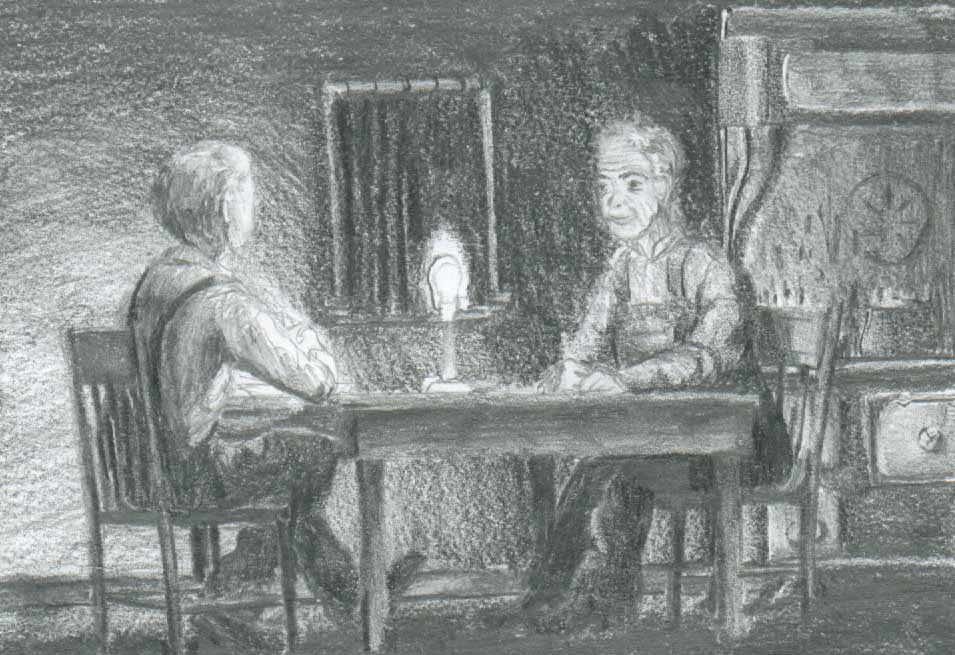 The plate he took from the warming shelf clinked as he set it down in front of me, steam rising from the vegetables spread
over it. I took up a fork, deciding that yes, by golly, I was hungry, not having touched anything since that sandwich in the
early afternoon. After plowing through several bites I realized my father was watching me from across the table and I
instinctively slowed down, but now his mouth had formed a slight but very genuine smile; I don't think he could've cared
less how fast I was eating. I heard him speak again, his voice quiet, controlled, just a little raspy: "Which engine did you
have?"
The plate he took from the warming shelf clinked as he set it down in front of me, steam rising from the vegetables spread
over it. I took up a fork, deciding that yes, by golly, I was hungry, not having touched anything since that sandwich in the
early afternoon. After plowing through several bites I realized my father was watching me from across the table and I
instinctively slowed down, but now his mouth had formed a slight but very genuine smile; I don't think he could've cared
less how fast I was eating. I heard him speak again, his voice quiet, controlled, just a little raspy: "Which engine did you
have?"
I swallowed before answering. "Number nine."
"How far was the run?"
"Owenyo to Keeler and back."
"How'd she fire?"
I sank my fork into a chunk of potato like I was spearing it. "Made the tractor look like a cakewalk."
Something like a chuckle came through on his breath. "Oh, that can't be right. Bigger boilers are always more stable."
There was silence after that, a long silence. I kept eating, my father stayed still, his smile fading but not his eyes. When I finished and got up to put my plate next to the sink he spoke again: "Think you'll be called again tomorrow?"
My tired brain fumbled to grab a response. "I, ah, I don't know, why, is it the farm?"
"Probably will be. I think you got called for an extra train, so they'll probably want the same man to fire it again."
I stared. "How do you know that?"
"Read it in there." He was pointing toward my rulebook, lying on the table in the lamplight. Turning away, I walked heavily toward my bedroom and heard my father call out behind me "Good night," his shadow so large it spread over the door and most of the wall.
Managing a feeble return "good night," I shut the door, undressed and flopped into bed, shifting my weight to avoid the broken springs and lumps of cotton in the mattress. The bedspread felt rough and smelled like the Owenyo depot did - like the desert locked in a room and neglected for years. I pulled it up over my ear and lay expecting sleep, but my mind was still coasting, full of questions. I wondered why my father had left the light when electricity was expensive and rationed besides, and why he'd left the black curtains over that window open, which would supposedly leave us vulnerable to air attack by the Japanese. I smiled inwardly at what they'd destroy if they targeted us - a few holes dug in acres of half-grown crops, maybe if they were lucky they'd miss us by half a mile to the west and put a hole in the S.P. main line. I imagined running out there in the morning and heroically flagging the Daylight down before it struck the damaged track. I wondered why my father had been reading the rulebook. Some people were great readers - Lionel was, I was sure - but I'd never thought of my father as one. Lionel had probably read all those reams of paper at that desk by the end of the first day, and overheard everything like a fly on the wall besides. I saw the Daylight rushing down the tracks in the pale, warm moonlight, saw the crater left by the Japanese bomb, saw myself bounding over the fields, lantern in hand, to flag the train down . . . I was in the center of the tracks, running between the rails straight for the headlight rushing at me . . . a perfect 'stop' signal, lantern swung side-to-side at waist level . . . sparks erupting from the wheels, brakes smoking, whistle howling in the dark, me diving down the side of the grade as the fusillade of steel, steam and sparks roared overhead . . .
What happened next was painful, like slamming into that water tower again. I think maybe I woke up when dawn broke, I was well used to that by then, but I was tired and didn't become aware of being awake until I was shaken by the shoulder and heard my father's voice. "Get up, come one, get up boy! The caller's here!"
Being awake is a brutal place to be, and I kept blinking and rubbing my eyes, trying to break into the real world. My father towered over me, now in his working overalls, smelling of hay and soil, and I was in a sweat, cocooned in the bedspread while the room had been heated by the morning sun. I looked up into my father's face. Gone were the glasses, the glittering eyes, the velvet tone of the skin - the father of last night was gone, this was the father who I called "sir" and who ordered me to have the tractor lit off by seven. As I crashed head-on into consciousness, bucking and rolling like a plow hitting a drift, he stood off to the side, tossing my overalls to me. "They want you to light off number nine and fire her back to Keeler. See if they have anything else for you to do, you could use the hours."
I finished tying my boots and snatched my cap from a wire hook on the wall, where it had been warmed by a spot of sun from my open window. Twisting the bill so it would curve around my head, I brushed that spot on my hand and clenched my arm against my side. Even my shin was aching. Would there be time for a shave, or breakfast? Who could tell. Pulling the door open, I stumbled into the main room, so shadowy last I'd seen it, now ablaze with yellow light.