By the time school got out for the last time, things had changed for me as they had for Lionel. Randy didn't seem to hold it against me much, but the rest of them took to me the same way they did to Lionel. I didn't care; I had bigger fish to fry than some childish schoolyard bullies.
That last day no one was talking much, but the air was thick with youthful restraint, everyone damming up their energy for the final few hours. Most of those hours were taken up by the teacher delivering her obligatory speech to cap off the year. This speech was always directed mostly at the twelfth-graders, but this was the first year I'd been a twelfth-grader, and we were all now seventeen, eighteen, nineteen years old, some of us barely folding ourselves into the desks and almost squirming more than the first-graders. For the past few years the teacher's preferred subject was exhorting us all to go into the Army and what a grand and noble enterprise it would be to go fight for freedom and whatnot. I had a feeling her speech had fallen a little flat a year before, when Will's brother came back dead. At least half of him, anyway; rumors around the schoolyard were that they couldn't find his legs on the battlefield, so they stuffed some pants with straw like a scarecrow and buried him that way. I never knew if it was true. No one ever asked Will about it.
That final day I heard her ring that little brass bell on her desk for what I knew was the last time, and she declared "Class dismissed." Just as the first-graders were filing down the aisle (the upper grades had to let the lower ones out first) she added "Lionel and Charles, I want to talk to you."
We glanced at each other, wondering if maybe this was about the fight a month ago. I still didn't know how Lionel had explained it to his parents. The other twelfth-graders looked at us, and as soon as the aisle was clear, they didn't wait to use it.
Lionel and I marched forward like soldiers, advancing through the bright prisms of sunlight that fell from the gaunt, Gothic windows. The teacher was a middle-aged woman who allowed the wrinkles to run riot over her face, but her brown hair showed nary a hint of grey and fell to her shoulders in a modern style. She'd been the only teacher here for twelve years, as long as I knew, with only occasional substitutes. We stopped just ahead of her desk, full of white papers that glowed a very pale blue from the blue sky outside. Lionel and I were right in front of a window, and I could feel the sunlight beat against the left side of my face.
"I hear you're both going to work for the railroad," she began. We both knew the pause after this sentence meant one of us had to give an answer, and Lionel got there first: "Yes, ma'am."
"You're two of the brightest boys in my class. Why not go in for the Army? They could use you."
Lionel answered for himself: "I don't think they'd take me, ma'am."
Her eyes rebuked him for his honesty and I became uneasy as she turned them on me, again expecting an answer. "When they call me, I'll go," I promised. I knew they wouldn't call. Not with me being so far below the required weight. Her eyes flickered disapprovingly up and down my skinny frame, one that made even the slight, lithe Lionel look robust. Cutting as she was, what she said wasn't going to make me change my plans, not now. I remembered broaching the subject a month earlier at the dinner table, starting off with how much extra money a job like that would bring in. My father chuckled at the idea, don't be ridiculous, I need a helper on the farm. I could still help out, I pleaded, they'd let me off for that, surely. Even school was let out for planting in the spring and harvest in the fall. "I've worked on the tractor long enough," I insisted. "They could use me for a fireman. Lionel says they've been shorthanded. Maybe they'd even put me on the Daylight."
"The Daylight. Now wouldn't that be something." My father said that deadpan, and I couldn't tell if was being admiring or scornful. I did fear the worst, however, and left the subject alone for the rest of dinner.
I wonder if my mother entered a plea on my behalf that night after I'd gone to bed. She was the last person who'd be the deciding voice in what were essentially men's affairs, but my father had somehow warmed to the idea by the following day and at breakfast, he told me I could walk down to the depot in town to see if they had anything available. "Thank you, sir," I replied, and not another word was said until the meal was over. I wanted to blurt "Thank you! Thank you! Thank you!" and shake his hand, but he'd never have stood for that, so after drying the dishes I went and put on my Sunday suit. It was a brown woollen outfit, the last thing I'd normally wear on a California summer day, but I was taking no chances. If I didn't get hired, it wouldn't be because I didn't look respectable.
If the teacher (Mrs. Middleton was her name) had known just the start of that, she wouldn't have expended the effort to get us both into the armed forces. But she didn't, and so she went on: "Well, the railroads are important to the war effort, I guess. Usually they're jobs better left to older men, men with experience, and it's the younger fellows who have to put themselves forth for real. I still can't help finding it a waste, what you're doing."
Neither of us could think of a reply to that one, even though we could both see her waiting for one. She kept sitting there, waiting out the silence until both of us knew we'd have to say something. Lionel did: "Yes, ma'am."
Her eyes flashed at him again. "Working on a railroad means you'll be traveling farther from home than you think, going to places you've never been before."
That time Lionel had a ready reply. "We'd be doing the same in the Army, ma'am."
Now her eyes flashed like an express train rounding a curve. "Don't disrespect. In the Army you have your friends, your fellows, boys your own age and men to look after you. Going into the railroad means going at it alone. A thousand-mile-long track that goes to nowhere."
She stopped again. Lionel didn't dare provide a "yes, ma'am" that time.
"You can go now."
We were glad to hear those words. Turning, we marched towards the dark back of the schoolroom, the sliver of a half-open door unconscionably bright. Lionel picked up his books and went straight on, but I stopped and pretended I had to turn around to pick them up. I cast one final eye over the dusty sunbeams, the antiquated desks, the peeling paint, and Mrs. Middleton, and then I turned and headed out into the sun. It was going out we heard the teacher's firm voice behind us, clear but so plaintive I'm still not sure if we were meant to hear it: "And the best of luck."
Those fields looked like they went on for miles, which they genuinely did, but now we could see the tiny figures of the other students so far off in the distance that we had a real sense of scale for it. On the steps just above the worn dirt path, he turned to me. "So, I'll be seeing you on the railroad?"
"I expect so." We each went our separate ways, and I walked down the road like I was no longer subject to the same laws of gravity as the rest of these mortals. There was no keeping my feet on the ground now; I'd felt the same way a month before at the train station, a building very much like Mrs. Middleton: a quaint but imposing creation of the turn of the century. I was walking hurriedly down the street, pulling on my sport coat, oblivious to the few cars and trucks puttering down the newly paved main street.
The whole train station huddled under its huge roof eaves, trying to keep itself in its own shade, and the boards along the walls were just starting to look dried out. The putty hung in the window panes, parched and cracked. Only the window glass and the colorful 'Railway Express Agency' sign gleamed. The iron doorknob felt cool to the touch, and I shoved the narrow door open.
Inside everything was covered with dark wood, and my eyes took a moment to adjust; at first, it seemed like I'd stepped into a black hole. Walking up to the iron-barred ticket window, I asked if Mr. Donnellon, the stationmaster, was in.
The ticket agent behind those bars had a look in his bloodshot eyes that suggested it would cost something to be cheerful. I beat a hasty mental retreat. What do you want to know for, he muttered. It's about a job, I answered.
That made him give me a second look. Then he got up and I could hear a door open someplace. I just caught some male voices speaking - "one of those rookie boys" - and the door to the right of ticket window clicked open. "All right, he'll see you."
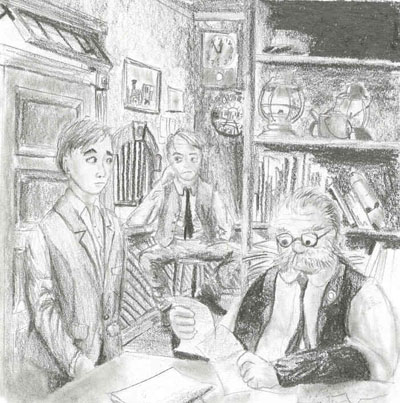
It would have been hard to prepare me for the sight of Mr. Donnellon after seeing the choleric ticket agent. He wasn't plump, but he had a nice pear-like shape to both his face and the rest of him, as well as long, slightly unkempt whiskers sprouting from his face, connecting his mustache to sideburns with a fuzzy grey rug. Looking at me owlishly from behind immense glasses, he started. "Rusk, isn't it?"
My last name. "Yes, sir, that's me."
"Yes, you're their lad . . . you must be seventeen by now, am I right? . . . hm . . . well, do you know Morse code?"
 I didn't, and answered as such. "Oh, that's a pity . . . I'm afraid we haven't much use for an office boy in this town, at least
not one who can't operate the telegraph. Well, I'd like to do your folks a good turn, if I can . . . what else can you do?"
I didn't, and answered as such. "Oh, that's a pity . . . I'm afraid we haven't much use for an office boy in this town, at least
not one who can't operate the telegraph. Well, I'd like to do your folks a good turn, if I can . . . what else can you do?"
I know steam, I know it like the back of my hand! "Really? Where did you learn steam?" On the steam tractor. I can fire just about any engine. "And you're how old . . . seventeen . . . my, that's good . . . tall for your age, too, and I hear you're a bright fellow to boot."
At this point, he was digging through the pile of flimsy papers on his desk that threatened to bury him to the elbows. "It's a pity we don't have a roundhouse nearby, or even a crew change point, you'd make an excellent hostler, at least if you didn't mind night work . . . ah, here's something . . . your folks wouldn't object to something, ah, far afield, would they?"
Anywhere, Mr. Donnellon, anywhere!
"Ah, yes, you are a real Rusk, aren't you . . . I wonder if you'll get farther than the others. Well, there's a place for you on the branch interchange at Owenyo, they're looking for firemen . . . my, yes, those engines would be perfect for you. It's a bit of a ways off, but there's always the interurbans, or one of our own local trains. When does the school year end here? . . . hm, I wonder if you could learn the rules of the road before then . . . yes, of course you could, Mrs. Middleton said you're a bright fellow. Well, there's the rulebook, see that you learn everything in it within the month. What's the name . . . yes, Rusk, that's it, Charles Rusk."
Far off in the distance, I heard a train whistle. I knew instantly it wasn't the Daylight (it was the wrong pitch) but Mr. Donnellon's owlish eyes saw something in my face. "Hm, I should have known you'd be genuinely fascinated by the trains, Rusk. The one that's coming is no streamliner, but you're welcome to watch it go by on my platform."
I finally got out some words of my own: "Thank you, Mr. Donnellon, thank you very much . . . you, ah, you don't need any papers or anything like that?"
"The written word isn't for me, Rusk. I'll take a handshake over that any day." He extended a long, freckled, weathered hand, and I took it. "Good day, Rusk. Be ready for the call boy in a month or so, he'll tell you where to go." I nodded and rushed out of the office as fast as was polite, out the door I'd come by, the looped around the depot and onto the platform next to the double-track main line.
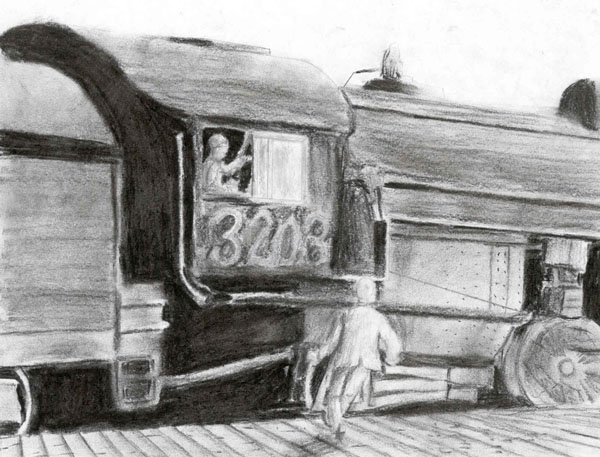
Mr. Donnellon was right, it wasn't the Daylight coming, but this would do: two smaller, coal-black engines with tall smokestacks, pulling together to haul a line of varicolored boxcars that stretched to the vanishing point. Those engines! . . . long cords of white steam streamed out each time the whistles howled, black smoke billowed skyward as I heard the exhaust pick up. And the size of those things! I could not have been more amazed had a building gotten up and rolled down the tracks, and when those engines went by me just six feet away at somewhere around thirty miles per hour, I could only think that a force of nature had descended on the depot.
The immense black behemoths thundered by with speed incongruous with their ponderous size, and I felt the infernos raging in each steel belly. I just caught a glimpse of the man inside the cab, flying along eight feet above the track, and in a month that man would be me . . .
With the endless boxcars still rumbling past, I struck out for home, clutching the precious, pasteboard-bound rulebook beneath one arm, unmindful of how hot that wool sports coat would get on a day like this. The schoolhouse and the contentious interview with Mrs. Middleton were all in the distant future and a world away, and the Daylight was even closer than before.