
I wish I could relate to you what it's like walking home from school in the afternoon with an incredible feeling of despair over the fact that Pearl Harbor was just bombed, but I can't, for the simple reason that I had no feeling of despair.
To be sure, I could understand it, like in Will's case, an eleven-year-old whose brother was just old enough to be drafted and whose father was just young enough to receive the same fate. And yes, it is awful that they'd sneak attack like that and slaughter six thousand of our boys (or some number; no one seemed sure). But I had no brothers, only a sister who'd already been an Army stenographer somewhere in Tennessee for fifteen months and a father who was well beyond the oldest reaches of the Selective Service since the Depression began. I didn't find it a shock, either, not after both parents had been intoning a year's worth of dire predictions over the supper table for the past six months.
No, I was thirteen and my first priority was scampering home fast enough to see the southbound Daylight Limited rush past the western edge of the field. Sure enough, it came charging out of the distance just as I was hurrying through a knee-deep sea of winter wheat, and it rushed past as a blur of orange streamlining atop a whirlwind of black and silver wheels.
The thunderous roar of the stack threatened to level the landscape around me, and it was then I finally made the connection between that towering presence and the timid 'chuff-chuffs' generated by the old Case tractor that crawled out of the barn each year. For two years now my father had been certain I was big enough to help him build a fire within the iron beast in the barn, but it was not until that Monday I formed an idea that it might be the not-so-distant cousin of the revered Daylight. There were similarities: the smoke-belching stacks, the long, tubular boilers, the rhythmic exhausts . . . could both machines be animated by the same force of nature? I promptly went home and amazed my father by asking if we were going to fire up the tractor tomorrow, and he had to explain in detail the principles of planting in spring and harvest in the fall, two subjects I took an interest in only now that they had a direct effect on resurrecting the beast in the barn.
I fairly haunted the barn from then till spring, poking around the hole in the back I would later identify as the 'firedoor' and generally getting into everything I wasn't supposed to. Spring did eventually come, and I'm not sure if my father had discovered the source of my obsession by then, but if he had, he didn't care; it meant he had a new and devoted hand with the troublesome tractor. He'd wanted to replace it with a gasoline-powered model as long as I could remember, but first there was the Depression and then there was the war, with its attendant steel shortages. Once or twice a university kid would come by and ask us to donate it for the scrap drives; my father would turn him out of the house amidst arguments of "what do you want me to do, go back to the horse and plow? I sold them before you were born!"
It used to be my father would expect me to be out there when he lit off the tractor (usually around dawn, which would've been five in the morning or so); now he expected it lit by the time he came. Digging through our limited family wardrobe, I cobbled together what I thought was a reasonable fireman's outfit: gauntlet gloves, a denim shirt, overalls with a rag hanging artfully from the hip pocket. I even managed to dig up an old shop cap from the attic. Out in the cold, dark barn, I'd stack kindling wood into a graceful sculpture in the colder, darker firebox, then set a match to it. My face glowing with firelight, I'd lay coal in as a bed on the grate, and then black, cindery smoke would start billowing from the stack. I'd keep stoking, tamping, refining my skills with the panache of the artist, until finally the needle on the lustrous brass gauge lifted off the peg and began climbing. My father failed to notice or even hear the creaking and groaning of the boiler expanding, but it was loud and clear to me and I knew the beast was just fluttering its eyelids, coming to life beneath my hands in that firelit, smoke-filled, cavernous barn.
The big moment, of course, came when the gauge stood at about the 120 mark and my father eased the throttle open. There's no cliché I can use that would do this event justice; I could say it stirred the blood, send it pounding to my head, sent chills up my spine, and I'd still be understating. But in those moments I pitied all the boys whose fathers had stuck them with lifeless gasoline tractors, as I clung to a post on the operator's platform, paralyzed with awe. The steam whirled around us, and with a bark from the stack, the engine would rouse itself from its den and lumber toward the light, bouncing, shaking, shuddering with each turn of the huge back wheels (taller than I was!) and each fierce, guttural breath.
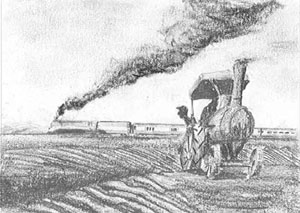 Once out on the fields the old tractor really came to glorious life, bucking around so hard that I had a hard time getting the
coal through the firedoor. Then in the mid-afternoon light, the Daylight would come speeding into view and show up our
engine for the puny rattletrap it was. Sometimes it would even issue a whistle that reverberated all around the valley to drive
the point home. It only inspired me to turn to my own machinery with a youthful, scrambling enthusiasm, determined to
keep the steam pressure on the balance between turning the wheels and opening the safety valves. I kept my fire roaring, the
needle at the right spot on the gauge, and the wheels turning as the echo from the whistle faded away to parts unknown.
Once out on the fields the old tractor really came to glorious life, bucking around so hard that I had a hard time getting the
coal through the firedoor. Then in the mid-afternoon light, the Daylight would come speeding into view and show up our
engine for the puny rattletrap it was. Sometimes it would even issue a whistle that reverberated all around the valley to drive
the point home. It only inspired me to turn to my own machinery with a youthful, scrambling enthusiasm, determined to
keep the steam pressure on the balance between turning the wheels and opening the safety valves. I kept my fire roaring, the
needle at the right spot on the gauge, and the wheels turning as the echo from the whistle faded away to parts unknown.