Concrete Training
Manual
Abdalla F. Sadi
Concrete Engineer
-
Index:
Chapter (1) :
Concrete components
[1] Cement
1.
Cement production
2.
Types of cement
3.
Testing The Cement
[2] Aggregates
1.
Sources
2.
Geological
Classification
3.
Size Of Aggregate
4.
Shape And Texture Of
Aggregate
5.
Grading of Aggregate
6.
Hardness Of Aggregate
7.
Fineness Of Aggregates
8.
Moisture condition of
aggregates
9.
Specific Gravity and
unit weight
10.
Bulking of Sand
11.
Impurities In Aggregates
[3] Water
1.
Impurities in water
2.
Effects of the quality
of water on concrete
Chapter (2) :
Hardening of the cement paste
1.
Hydration of cement
2.
Components of the cement
3.
Chemical reactions
4.
Rate of hydration
5.
Heat of hydration
6.
Hydration stages
7.
Setting of cement paste
8.
Paste microstructure
9.
Porosity
10.
Development of strength
11.
Curing
Chapter (3) :
Concrete properties
1.
Workability
2.
Bleeding and segregation
3.
Strength
4.
Durability
Chapter (4) :
Durability problems in concrete
1.
Freezing and thawing:
2.
Sulphate attack:
3.
Alkali-aggregate
reaction
4.
Sea Water Attack
5.
Carbonation
Chapter (5) :
Concrete basic relation
1.
Water
2.
Aggregates
3.
Air content
4.
Temperature
5.
Age
6.
Cement
7.
Other factors
Chapter (6) :
Admixtures
1.
Water reducers
2.
Superplasticizers
3.
Accelerators
4.
Set-retarders
5.
Air-entraining
admixtures
6.
Pozzolans
7.
Silica Fume
Chapter (7) :
Concrete mix design
1.
Introduction
2.
ACI Absolute method
3.
The British method
Chapter (8) :
Jordanian specifications
Chapter 1 : concrete components
At a basic level, concrete consists of cement, aggregate, water and
entrapped air.
Cement
Cement production:
Hydraulic cement is the
cement that undergoes a chemical reaction with water and will set and harden in
air or under water and does not undergo any changes due to exposure to water.
The major raw materials in manufacturing cement are:
- Calcium: found in limestone, shale and marl.
- Silica: found in sand, clay, shale and marl.
- Alumina: found in clay, shale and slag
- Iron oxides: found in iron ore, clay, and mill scale.
The production process:
- Collecting the raw materials: while calcium source controls the location of the plant, silica is usually shipped to the plant.
- Preparing the raw materials: grinded to a mixture of specified proportions.
- The materials are fed to an inclined rotating klin from the higher edge while heat is blown from the lower edge.
- The materials burn in the klin (1400-1600 C°), Forming new compounds (C3S, C2S, C3A, C4AF and others) that fuse as 3 - 3.5 mm balls called “Clinker”.
- The clinker is cooled down and grinded to a fine powder.
- Gypsum is added.
Portland cement is basically a mixture of:
|
C3S |
3CaO.SiO2 |
Tricalcium silicate |
|
|
|
C2S |
2CaO.SiO2 |
Dicalcium silicate |
|
|
|
C3A |
3CaO.Al2O3 |
Tricalcium aluminate |
|
|
|
C4AF |
4CaO.Al2O3..Fe2O3 |
Tetracalcium aluminoferrite |
|
|
|
CSH2 |
CaO.SiO2.H2O |
Gypsum
|
||
Where: CaO = C SiO2 = S Al2O3 = A Fe2O 3= F H2O = H
The proportion of each component makes the difference from one type of Portland cement to another as each component has a different effect on the final property of the cement. The properties of these four major components can be controlled by:
- Changing the proportion of the raw materials in the klin.
- Changing the temperature in the klin
- Changing the duration in the kiln
- Adjusting the amount of the added gypsum.
In
addition to the main components, other materials are also present in low
quantities like MgO, TiO2, Mn2O3, K2O and Na2O. Two of them (K2O
and Na2O) are known as "The
Alkalis" they react with some aggregate types causing disintegration of
the concrete in addition to affecting the rate of the gain of strength of
cement.
Types of cement:
Type I : General purpose Portland cement
No exposure to sulphates in the soil or ground water.
Type II :
Modified Sulphate resistant Portland cement
Moderate Sulphate attack, this cement got a higher rate of hydration than type I.
Type III : Early strength Portland cement
Used when there is a need for removing formwork earlier or early strength is required for further construction (higher CS content and higher fineness of cement).
Type IV :
Low heat of hydration Portland cement
This cement got a low heat of hydration (low content of C3S and C3A) but ultimate strength is not affected.
Type V :
High Sulphate resistant Portland cement
Used in Sever Sulphate attacks conditions , this cement got a low content of C3A
In addition to the five
major types of Portland cement, a number of special purpose hydraulic cements
are manufactured. Among these is white Portland cement. White Portland cement
is identical to gray Portland cement except in color. During the manufacturing
process, manufacturers select raw materials that contain only negligible
amounts of iron and magnesium oxides, the substances that give gray cement its
color. White cement is used whenever architectural considerations specify white
or colored concrete or mortar.
For local Jordanian cement,
by experience the cement content should be increased by 20 kg/m³ to maintain
the same compressive strength.
Testing The Cement:
The compressive strength of cement is tested using a standard concrete mix or testing the cement paste in two methods:
BS
Cement: sand 1:3 standard one-size sand
Water content=10% mass of the dry materials
Cubes of 71 mm
Demolded after 24 hours and cured in water
Tested in a wet surface condition
ASTM
w/c = 0.485
Cement: sand 1:2.75 Ottawa sand
Demolded after 24 hours and cured in saturated lime water at 23C°
Aggregates
The large, solid coarse
aggregate particles form the basic structural member of concrete. The voids
between the large aggregate particles are filled by smaller fine aggregate
particles, the voids between the smaller fine aggregate particles are filled by
still smaller particles, and Finally, the voids between the finest grains are
filled with cement while all the particles are bonded by the cement paste.
Aggregate occupy almost
three quarters of the concrete volume. It increases the strength of concrete,
reduces the shrinking tendencies of the cement, and is used as economical
filler. Because aggregates fill up 60-80% of the concrete volume, their
properties greatly influence the strength, durability, and the structural
performance of concrete.
Sources:
1. Natural and crushed : River gravel and sand, crushed quarry rock.
2. Manufactured : Expanded shale, blast furnace slag.
3. Recycled : Old concrete or asphalt pavement.
Geological Classification:
Natural aggregates result from the breakdown of large rock masses. Rocks can be of three basic types:
- Igneous: produced from hardening of volcanic lava. This includes granite and basalt.
- Sedimentary: form from he deposits of disintegrated existing rocks or inorganic remains of marine lives. This includes limestone, shale, chalk, chert, and sandstone.
- Metamorphic rocks: form from the igneous or sedimentary rocks coming under heat and
pressure. Like quartzite.
Size Of Aggregate:
Aggregate size is usually defined by the following two terms:
1. Nominal maximum size: the smallest sieve size that the percent passing for that sieve isn't less than 95%. (The smallest of all the sieves having a percent passing >=95%).
2. Maximum size: the smallest sieve size for which 100% of the sample passes through, usually one sieve size bigger than the nominal maximum size.
Aggregates can be categorized into two types with respect to size:
1. Coarse aggregates : aggregate
that have a minimum of 20 % retained on sieve #4.
2. Fine aggregates : aggregate that is 100 % passing the 3/8” sieve with a minimum of 80% passing the #4 sieve.
Local aggregates and sizes
|
||
Aggregate local name
|
Size |
First sieve to be retained on
|
|
Jozeah |
40 mm |
1 ½ “ |
|
Fuliah |
25 mm |
1 “ |
|
Humsiah |
20 mm |
¾” |
|
Adasiah |
12 mm |
½” |
|
Sumsumiah |
9.5 mm |
3/8” |
|
Sand (2) |
4.75 mm |
#4 |
|
Sand (3) |
1.18 mm |
#16 |
|
Slandered ASTM sieves |
||
|
Sieve |
Sieve |
Aggregate Type |
|
No. |
Size |
|
|
3" |
75 |
Coarse |
|
2.5" |
63 |
|
|
2" |
50 |
|
|
1.5" |
37.5 |
|
|
1" |
25 |
|
|
3/4" |
19 |
|
|
1/2" |
12.7 |
|
|
3/8" |
9.5 |
|
|
#4 |
4.75 |
|
|
#8 |
2.36 |
Fine |
|
#16 |
1.18 |
|
|
#30 |
0.6 |
|
|
#50 |
0.3 |
|
|
#100 |
0.15 |
|
|
#200 |
0.075 |
Silt |
|
|
< 0.02mm |
Clay |
Shape And Texture Of Aggregates:
|
Particle shape classification BS 812 |
|
|
Rounded |
Fully water worn or completely shaped by abrasion. |
|
Irregular |
Naturally irregular or partly shaped by abrasion with rounded edges. |
|
Angular |
Well-defined edges formed at the intersection of rough planner faces. |
|
Flaky |
Thickness smaller than the length and width. |
|
Elongated |
Length larger than the width and thickness. |
|
Flaky and Elongated |
Length larger than the width and the width larger than the thickness. |
|
Local
Available Aggregate Shapes |
|
|
Rounded |
From the desert, river and sea shores |
|
Angular |
Crushed rocks and crushed rounded gravel |
The degree of packing of one sized aggregate depends on the shape and texture.
Flakiness/Elongation Index: percent of mass of flaky/elongated particles in a sample of aggregates.
Grading of Aggregate:
Concrete is made with aggregate particles covering a range of sizes up to a maximum size. The particle size distribution is called grading.
To achieve a well graded
aggregate content. The total aggregate weight is divided over many aggregate
piles each with a different grading and maximum size. This will ensure better
packing and a minimum void.
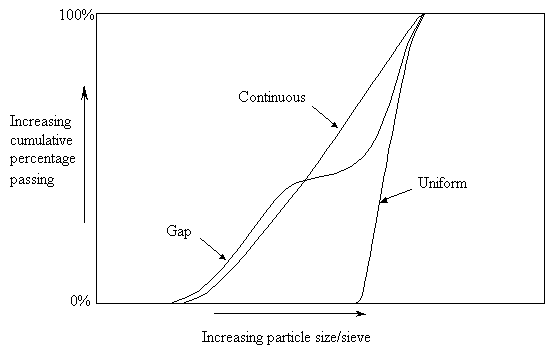
Three different kinds of size distributions: continuously graded (well graded), gap-graded, and uniformly graded, are illustrated in the figure below.
- Well-graded aggregates are desirable for making concrete, as the space between larger particles is effectively filled by smaller particles to produce a well-packed structure.
- Gap grading is a kind of
grading which lacks one or more intermediate size.
- Uniform grading; only a few sizes dominate the bulk material. With this grading, the aggregate particles are not effectively packed, and the resulting concrete will be more porous.
Hardness Of Aggregate:
Hardness, or resistant to wear is an important property of concrete and can be measured using the Los Angeles abrasion test. Which will judge the hardness of the aggregates by measuring the resulting amount of material less than 0.075 mm after the aggregate and steel balls are rotated 500 times in a cylinder.
Fineness Of Aggregates:
A factor relating to the fineness of the aggregates, useful in detecting slight variations in the aggregates supplies from the source, which will affect the workability of the concrete. The fineness modulus is usually calculated for the fine aggregates only since sand gradation has the largest effect on workability. The fineness modulus can be used to check the constancy of grading when relatively small change is expected; but it should not be used to compare the grading of aggregates from two different sources.
Fineness modulus = Sum of the cumulative percent retained on the sieves (excluding #200)
divided over 100.
The sieves used for determining the Fineness Modulus are the sieves that have a ratio of 1/2 in size. Those sieves are:
( #100 , #50 , #16 , #8 , #4 , 3/8" , 3/4" , 1 ½" ) and larger, increasing in a ratio of (2 : 1).
Note that when the percent retained for any lower sieve is zero, the cumulative percent retained should be entered as (100)
|
Fineness modulus |
Description |
|
2.3 – 2.59 |
Fine sand |
|
2.6 – 2.89 |
Medium sand |
|
2.9 – 3.10 |
Coarse sand |
For blended types of aggregates:
FM
blend = FM(A) * PA/100 + FM(B) * PB/100
FM: fineness modulus
A,B : aggregate A, aggregate B
PA,PB : percentage of A,B
Moisture condition of
aggregates:
The moisture condition of aggregates refers to the presence of water in the pores and on the surface of the aggregates. There are four different moisture conditions:
1. Oven Dry (OD): This condition is achieved by keeping aggregates at a temperature of 1100C for a period of time long enough to reach a constant weight. Pores in the aggregates are dry.
2. Air Dry (AD): This condition is achieved by keeping the aggregates under room temperature and humidity. Pores inside the aggregates are partly filled with water.
3. Saturated Surface Dry (SSD): This condition is achieved by immersion the aggregates in water for 24 hours followed by drying of the surface with wet cloth. Pores in the aggregates are filled with water while the surface is dry.
4. Wet (W): The pores of the aggregate are filled with water and the surface of the aggregate is covered with a film of water. Achieved as in the SSD condition but without drying the surface.

Specific Gravity and unit weight:
Pores in an aggregate unit volume consist of voids between aggregate particles and voids in the aggregate particle itself (impermeable and capillary)
Specific Gravity also known as the “Relative density” is the ratio of mass (weight in air) of a unit volume of a material to the weight of the same volume filled with water.
The absolute specific gravity (ASG) (particle density): refers to the weight and volume of the solid part of the aggregate excluding all pores in and out the aggregates.
The bulk specific gravity (BSG): refers to the weight and volume of the solid materials and the voids in the aggregates with out the voids between the aggregate particles measured in OD and SSD conditions.
The apparent specific gravity (apparent particle density) : refers to the volume of the solid materials including the impermeable pores but not the capillary ones in the aggregates.
ASG > BSG (SSD) > BSG (OD)
Because the porosity of
most rocks are low (1-2%) the values of all the specific gravities are in the
range of 2.5 – 2.8
Unit weight (UW): the ratio of the aggregate weight to their
volume considering the volume of the voids in and out the aggregates.
Bulking of Sand:
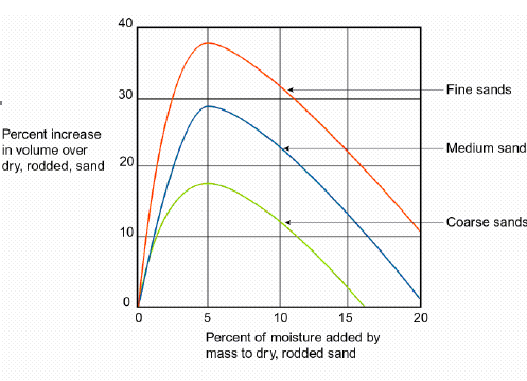
When the dried sand gets wetted, its volume will stay constant till it reaches 100% absorption. If the moisture content increase after the 100% saturation, the volume of the sand will increase as the forces of surface tension push the particles away from each other. This will also decrease the unit weight of sand because the water is taking the place of sand grains in the unit weight and because water is lighter than sand the unit weight will decrease.
As the water content increase more and more, the thin film of water surrounding the particles thickens, the volume of the sand will decrease because of the lubrication effect that will help pack the sand particles closer.
Impurities In
Aggregates:
There
are four types of impurities in the aggregates that can lead to lowering the
quality of the concrete:
1. Organic impurities: these are the decaying products of vegetable matter found usually in sand and easily removed by washing. The presence of these organic materials will affect the hydration of the cement paste.
2. Clay and fine materials: clay, silt and crushing dust found in aggregates as surface coating will affect the bond between the aggregate surface and the cement paste. Silt and crushing dust could also be present as loose materials increasing the water requirements of the concrete because of their large surface area.
3. Salt: found in sand collected from sea or river shores can be removed by washing. may cause corrosion of steel reinforcement in concrete. In addition to absorbing moisture from the air which will form white deposits on the surface.
4. Soft particles: such as clay lumps, wood and coal will cause scaling of the surface and lack of durability.
|
Impure Substances |
Effects on concrete |
|
Organic impurities |
Affects setting and hardening |
|
Materials finer than |
Affects bonding and increases |
|
Coal, lignite, or other |
Affect durability and may cause |
|
Soft particles |
Affects durability |
|
Friable particles |
Affects workability and durability and |
Water
The quality of water used
in concrete is judged by the impurities in it and the effect it could have on
the concrete.
In general, the water
suitable for concrete should be fit for drinking provided that it doesn't
contain a high concentration of sodium and potassium because of the danger of
alkali-aggregate reactivity.
Impurities in water:
- Suspended solids: high amounts of solid can increase the water demand, increase dry shrinkage, cause Efflorescence and affect air entraining.
- Dissolved solids: dissolves salts can cause slower setting and hardening times and reduced strength.
- Organic materials retard hydration and entrain excessive amount of air.
Effects of the quality of
water on concrete:
Hardening of the concrete: water containing Humic or other organic acids also water with high alkaline content.
- Strength: water containing Algae tend to entrap air thus lowering the strength.
- Staining of the concrete surface: water with high chloride (salt) content like seawater.
- Corrosion of the steel reinforcement: water with high quantities of salts like seawater.
- Higher early strength
with a lower long-term strength: water high in NaCl, MgCl2 and MgSO4 like
seawater.
- Alkali-aggregate reactivity: water with a high concentration of sodium and potassium like some
tab water.