by Tricia Luedeman
&
Jessica MacLellan
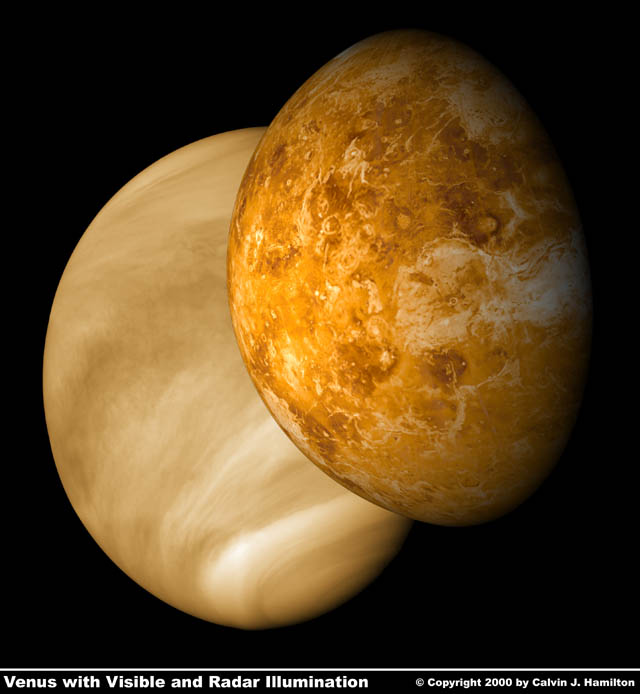
A double image of
Venus:
its clouds and its
surface
by Tricia Luedeman
&
Jessica MacLellan
A double image of
Venus:
its clouds and its
surface
Venus is the second planet from the sun and the sixth largest planet. Venus is named after the Greek and Roman Goddess of Love and Beauty.Since Venus is an inferior planet, it shows phases when viewed with a telescope from the perspective of Earth. Galileo's observation of this phenomenon was important evidence in favor of Copernicus's heliocentric theory of the solar system.
Venus is sometimes regarded as Earth's sister planet. In some ways they are very similar. Venus is only slightly smaller than Earth (95% of Earth's diameter, 80% of Earth's mass). Both have few craters indicating relatively young surfaces. Their densities and chemical compositions are similar.
The pressure of Venus' atmosphere at the surface is 90 atmospheres. It is composed mostly of carbon dioxide. There are several layers of clouds many kilometers thick composed of sulfuric acid. This dense atmosphere produces a greenhouse effect that raises Venus' surface temperature to over 740 K (hot enough to melt lead). Venus' surface is actually hotter than Mercury's despite being nearly twice as far from the Sun.
Venus Data
orbit: 108,200,000 km (0.72 AU) from Sun
diameter: 12,103.6 km
mass: 4.869e24 kg
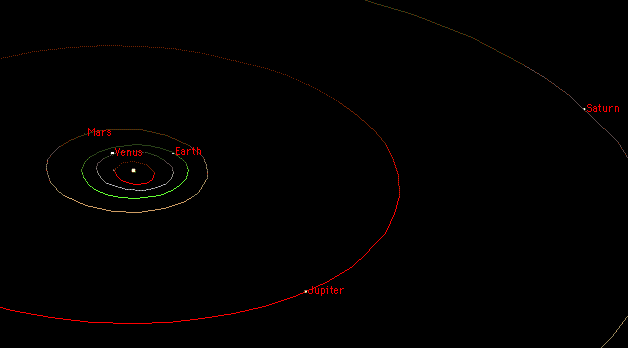
a map of the inner solar system showing the location of the planet Venus:
MORE INFORMATION:
For a Video of Venus Rotating Click Here (part of solarviews.com)
Information on the Space Probes That Have Visited Venus
Other Interesting
Features of the Planet Venus
OTHER HELPFUL WEBSITES: