Uranus
The Sideways Planet
By:
Holly Meyer
&
Melissa Turner
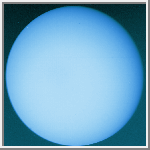
Uranus as a planet!
Uranus's atmosphere is made up or hydrogen and helium. About 15 percent is helium. Methane, acetylene, and other hydrocarbons exist in smaller quantities. Methane in the upper atmosphere absorbs red light, giving Uranus its blue green color. Winds at mid-latitudes on Uranus blow in the same direction as the planet rotates. These winds blow at velocities of 40 to 160 meters per second. Radio science experiments found winds of about 100 meters per second blowing in the opposite direction at the equator. A high layer of haze was detected around the sunlit pole. The sunlit hemisphere was found to radiate enormous amounts of ultraviolet light. Voyager scientist have dubbed “dayglow”. The temperature on Uranus is about 60 Kelvin or –350 degrees Fahrenheit. The minimum near the tropopause is 52 K. The tropopause is the boundary between the stratosphere and the troposphere, the lowest level of atmosphere, comparable to the region on Earth where life abounds. Voyager instruments detected a colder band between 15 and 40 degrees latitude where temperatures are about 2 to 3 K lower. The temperatures rise up to 150 K. Below the level, temperatures increase steadily to thousands of degrees in the interior.
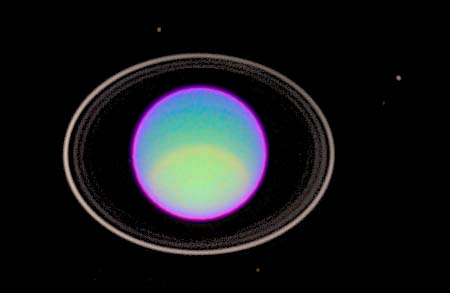
Uranus from the Hubble!
Hubble
Space Telescope has peered deep into Uranus’s atmosphere to see clear and hazy layers
created by a mixture of gases. Hubble captured the three layers of Uranus’s
atmosphere using infrared filters. The images from Voyager 2 are different
because it was not taken from an infrared light so it showed a greenish blue
color with very little detail. The red around the planet represents a very thin
haze at high altitude. The haze is very thin. The yellow near the bottom is
another hazy layer. The blue near the top shows a clearer atmosphere. Image
processing has been used to brighten the rings around Uranus so that
astronomers can study their atmosphere. The rings are actually dark as lava
black or charcoal. This false color picture was assembled from several
exposures taken July 3, 1995 by the Wide Field Planetary Camera-2.
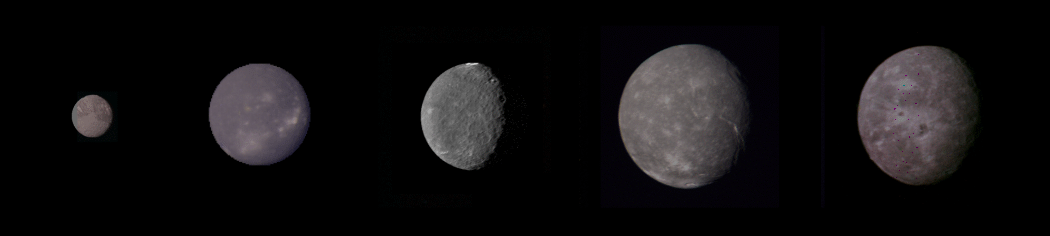
Uranus's moons
Voyager 2
found clear, high-resolution images of each of the five moons of Uranus. They
are Miranda, Ariel, Umbriel, Titania, and Oberon. The two largest moons are
Titania and Oberon. They are about 1,600 kilometers in diameter, about half the
size of Earth's Moon. The smallest moon is Miranda. It is only about 500
kilometers across. The largest of the moons is Puck. It is about 150
kilometers in diameter. The large Uranus moons appear to be about 50 percent
water ice, 20 percent carbon and nitrogen-based materials, and 30 percent rock.
Their surfaces are dark gray in color. Very ancient craters our found on the
surfaces of the moon. Huge fault canyons and systems that indicate some history
mark on Titania. Ariel is the brightest and possibly has the youngest surface
in the Uranian moon system. It has craters greater than about 50 kilometers in
diameter. Umbriel is ancient and dark. Large craters mark on its surface. The
darkness of this moon may be due to a coating of dust and small debris somehow
created near the moon’s orbit. Oberon has an old heavily cratered surface with
little evidence of internal activities. Miranda is the innermost of the five
planets. It is one of the strangest bodies yet observed in the solar system. It
has huge fault canyons as deep as 20 kilometers. Miranda has a small size and
low temperatures (-335 degrees Fahrenheit or –187 Celsius).
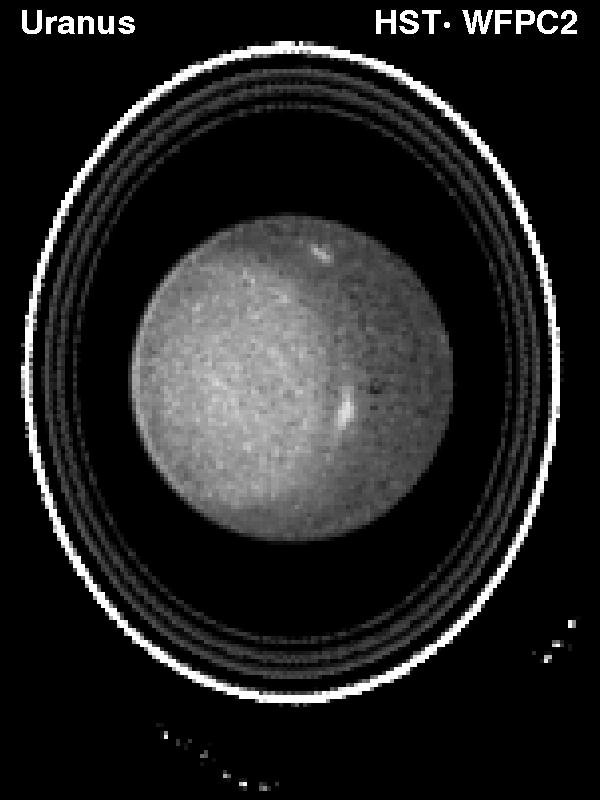
Uranus's Rings
Uranus's true and false images.
Voyager 2 discovered these faint, visible with only radical
enhancement, pictures of Uranus.

Uranus's 9 rings
There are nine know rings on Uranus that were
photographed and measured. They are different than Jupiter and Saturn. The
outermost ring is epsilon. Fine dust seems to spread throughout the ring
system. Scientists believe that the ring system did not form at the same time
as the solar system. Two new rings have been identified. The first was the 1986
U1R. It was detected between the outermost rings (epsilon and delta). It is a
narrow ring like the others. The second one was the 1986 U2R. The epsilon was
known to be gray in color. Scientists think that two small moons (Cordelia and
Ophelia) straddle the epsilon ring. The sharp edge of the epsilon ring states
that the ring is less than 150 meters thick and the particles near the outer
edge are less than 30 meters in diameter. The epsilon ring is about the size of
a beach ball.
Voyager probe
NASA's Voyager 2 flew passed Uranus in 1986. The closest
the spacecraft came was 81,500 kilometers of Uranus's cloud tops on Jan. 24,
1986. It got a lot of data about Uranus's moons, rings, atmosphere, interior
and the magnetic environment surrounding Uranus. Voyager 2 's images of the
five largest moons around Uranus indicate the varying geologic past. The
cameras also detected 10 unseen moons. Several instruments studied the ring
system. It found the fine detail of the known rings and two newly detected
rings. Voyager’s data found out that Uranus's rate of rotation is 17 hours and
14 minutes. It also found a Uranian magnetic field that is both large and
unusual. It also discovered that the temperature is the same temperature as at
the poles.
For more information about Uranus go to:
http://www.nineplanets.org/uranus.html
http://ftp.seds.org/pub/images/planets/uranus/.html/00Index-l.html
http://www.solarsystem.com/planets/uranus.htm